The operational continuity of the manufacturing industry in Indonesia today heavily relies on strict compliance with environmental regulations. Choosing competent and experienced WWTP SLO processing services is a strategic step to ensure your factory operates without the shadow of administrative or criminal sanctions.
For many industry players, the regulatory transition from the Liquid Waste Discharge Permit (IPLC) to Technical Approval (Pertek) and Operational Feasibility Certificate (SLO) often causes confusion and anxiety. Is the built Wastewater Treatment Plant (WWTP) in accordance with the new standards? Do the discharge parameters meet the increasingly stringent Environmental Quality Standards (BML)?
PT Mizui Osmosa Teknovisa is here not just as an administrative intermediary. We position ourselves as a strategic technical and legal partner. Our focus is to ensure your WWTP’s performance is truly “feasible” technically before it is submitted legally, so the risk of rejection by the Ministry of Environment and Forestry (KLHK) or the Environmental Agency (DLH) can be minimized to zero percent.
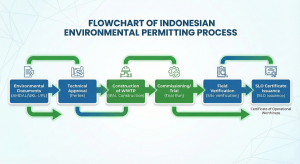
Since the enactment of the Job Creation Law and its derivative regulations, the environmental licensing paradigm in Indonesia has shifted fundamentally. An Operational Feasibility Certificate (SLO) is written proof issued by authorized officials (Minister, Governor, or Regent/Mayor) stating that the waste management facilities and infrastructure (in this case, the WWTP) have been completely built and meet the standards set in the Technical Approval.
Without an SLO, an industry is considered to have not fulfilled its environmental obligations, even if the physical WWTP has been magnificently built.
Many business owners underestimate the urgency of this legality until a warning letter arrives on their desk. Based on Government Regulation (PP) No. 22 of 2021 concerning the Implementation of Environmental Protection and Management, the absence of an SLO can trigger serious tiered sanctions.
The consequences to be faced include:
Written Warnings & Government Coercion: Orders to temporarily halt production activities until the permit is issued.
Administrative Fines: Nominal fines calculated based on delays and potential environmental damage.
Suspension/Revocation of Business Licensing: This is a nightmare for any entrepreneur, where the factory is completely banned from operating.
Criminal Sanctions: If proven to be polluting the environment without a permit (illegal dumping), the threat of imprisonment and billions of rupiah in fines awaits according to the PPLH Law.
As experienced liquid waste discharge permit consultants, we often encounter clients who come in a panic because their operations have been sealed off. This can actually be avoided if the SLO processing is done from the beginning of the WWTP commissioning period.
Many industry players still hold the old IPLC (Liquid Waste Discharge Permit) documents and feel safe. It needs to be understood that under the new regulatory regime, the IPLC has now transformed into a Wastewater Technical Approval (Pertek).
Pertek is a “planning document” approved by the government. However, having a Pertek alone is not enough. You must prove that the planning runs successfully in the field through the SLO mechanism. Conventional IPLC processing services might only focus on paper, but SLO processing requires technical proof of waste treatment performance. If your old liquid waste discharge permit (IPLC) is about to expire, immediately make adjustments to the Pertek and SLO format to avoid a legal vacuum.
The process of obtaining an SLO is not just “submitting files.” There are strict requirements that combine administrative aspects and technical engineering reliability. As a trusted industrial WWTP certification provider, PT Mizui Osmosa Teknovisa ensures all the following checklists are met before government auditors arrive at the location.
The main foundation of an SLO application is conformity with the master environmental document. The AMDAL or UKL-UPL document must state the production capacity and waste discharge relevant to actual conditions.
Often, there is a discrepancy between old documents and the condition of a factory that has undergone expansion. Our environmental approval technical consultants will conduct an in-depth review of:
Wastewater Technical Approval (Pertek) that has been issued.
Certificate of Functional Feasibility (SLF) for the WWTP building.
WWTP and Emergency Response Standard Operating Procedures (SOP).
WWTP Commissioning implementation report.
Verifiers from the DLH or KLHK will inspect the physical installation in detail. The technical requirements for wastewater SLO application include:
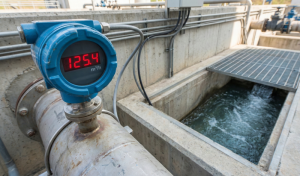
Compliance Point (Sampling Point): There must be a permanent, easily accessible, and safe sampling point at the outlet channel before mixing with the receiving water body.
Flow Measuring Device (Flowmeter): Inlet and outlet flowmeters must be installed to record daily discharge. For certain industries, it must be integrated with SPARING (Continuous and Online Wastewater Quality Monitoring System).
Sludge Treatment Unit: Availability of sludge management facilities or cooperation with licensed B3 third parties.
Daily Logbook: Consistent daily records of pH, flow rate, and chemical usage.
Why do you need professional services? Because the verification process is a crucial moment. Answering a technical question from the verifier incorrectly can result in SLO rejection. Here is our workflow:
Before we invite the agency, the engineering team of PT Mizui Osmosa Teknovisa will conduct an internal audit (verification simulation). We will take wastewater samples and test them in our laboratory or external partners.
If the results show parameters exceeding quality standards, we will not let you go “commit suicide” by submitting for verification. We will conduct technical troubleshooting first—whether it’s adjusting chemical doses, aeration, or process modifications—until the wastewater is stable and meets quality standards. This is an added value rarely possessed by ordinary service bureaus.
When verification day arrives, our senior consultants will be on-site to accompany you. We act as facilitators bridging the verifier’s technical language with the factory’s operational team. We help explain the process flow, answer technical questions regarding WWTP design, and ensure the verification minutes (BAP) are written according to facts that benefit the client.
Official sampling (legal sampling) is carried out during verification. These samples must be tested in a laboratory accredited by KAN (National Accreditation Committee). We partner with a network of trusted laboratories to ensure the test results are valid, accurate, and legally accountable.
Not a few companies that apply for an SLO independently end up failing and have to repeat the process from scratch. This failure wastes considerable time and money. Here are common causes of failure that we often handle:
Every industry has key parameters that are difficult to handle. For example:
High COD & BOD: Often occurs in the food/beverage industry due to fluctuating organic loads.
Ammonia & Total Nitrogen: A classic problem in the fertilizer or rubber processing industries.
Oil & Grease: Often escapes the grease trap in the palm oil or oleochemical industries.
As environmental approval technical consultants, PT Mizui Osmosa Teknovisa analyzes the root biological or chemical problems in your WWTP. We provide a repair prescription, not just sweet promises.
The verifier will calculate the Mass Balance. If the discharged wastewater flow is much larger than the design capacity stated in the Pertek, the SLO is automatically rejected.
This case often occurs due to clean water leaks into the sewer line or unreported production capacity increases. Our solutions include a water balance audit to identify sources of water waste and optimizing water recycle so the discharge flow falls within the permitted capacity range.
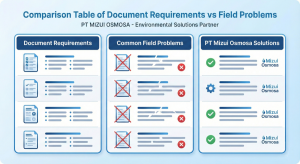
Why is entrusting environmental consultant fees to us an investment, not a burden?
Integrated Solution (Technical + Legal): We are different from service bureaus that merely deliver documents. We are an engineering company that understands wastewater biology as well as environmental law. We fix the water first, then process the permit.
Verification Pass Guarantee: With strict Pre-Assessment methods, we minimize the risk of rejection. We only submit for verification when we are sure your WWTP is performing.
Time & Cost Efficiency: Avoiding costly repeat lab tests and re-verifications. We do it right the first time (Right First Time).
Extensive Network: 15 years of experience means we understand the characteristics and expectations of auditors from various Environmental Agencies and KLHK.
Don’t let legal uncertainty hinder your business growth. Environmental regulations in Indonesia, including Law Number 6 of 2023, are becoming increasingly strict and transparent.
PT Mizui Osmosa Teknovisa is ready to be your protective shield as well as a technical partner ensuring your WWTP is not only compliant but also operationally efficient.
Are you ready to face an environmental audit? Or are you still unsure about your wastewater quality? Don’t wait for a warning letter to arrive.
Consult your WWTP SLO processing service needs with our experts. We will conduct a preliminary survey of your factory to map out strategic steps toward total compliance (100% compliance).
Contact Us for a Free Consultation
Disclaimer: This article is compiled based on regulations applicable in Indonesia up to the year 2026. Regulations may change at any time; always consult with current legal and environmental experts.
Butuh bantuan? Tim kami siap membantu.