In the heart of Indonesia’s manufacturing activity, particularly in the eastern corridor of Jakarta, water is not just a supplementary resource but a vital component of production. For those of you managing factories in Cikarang Baru or looking for Jababeka industrial area WTP services, the stability of water quality and quantity is an absolute, non-negotiable requirement. Even slight fluctuations in raw water parameters can lead to production downtime, boiler damage, and costly product rejects.
PT Mizui Osmosa Teknovisa is here with a deep understanding that the water management challenges in Jababeka I, II, and subsequent development phases have unique characteristics. As a strategic partner, we don’t just sell equipment; we provide engineering solutions that guarantee the operational sustainability of your factory. In this technical article, we will dissect in-depth how the right water treatment infrastructure can improve your factory’s efficiency.
The Jababeka Industrial Area is one of the largest industrial estates in Southeast Asia, housing thousands of tenants from various sectors, ranging from automotive and electronics to food and beverage. Although the Jababeka estate management has provided standard clean water infrastructure, specific industrial needs often demand parameters that are far stricter than regular drinking water standards.
As an experienced Cikarang Baru WTP contractor, we frequently encounter cases where the Total Dissolved Solids (TDS) or hardness of the supply water is still at threshold levels that pose risks to high-precision machinery. The molding industry requires scale-free cooling, the textile industry needs heavy-metal-free water for dyeing, and the electronics industry requires water with near-zero conductivity.
Therefore, relying on raw water supply without post-treatment is a risky strategy. This is where the crucial role of Jababeka water treatment installation services comes in, capable of tailoring system designs to the latest raw water analysis at your factory site.
One aspect often overlooked in utility planning but which has a fatal impact is the distribution system. Before discussing advanced filtration technology, the main foundation of a reliable WTP system lies in the industrial clean water piping installation.
In the industrial context of Jababeka, using standard residential PVC pipes is often inadequate to withstand working pressure and long-term chemical exposure. PT Mizui Osmosa Teknovisa recommends and applies higher material standards:
uPVC Schedule 80: For general clean water and non-hot process water distribution lines. Its resistance to pressure up to 16 bar makes this material the minimum standard for main lines in factories.
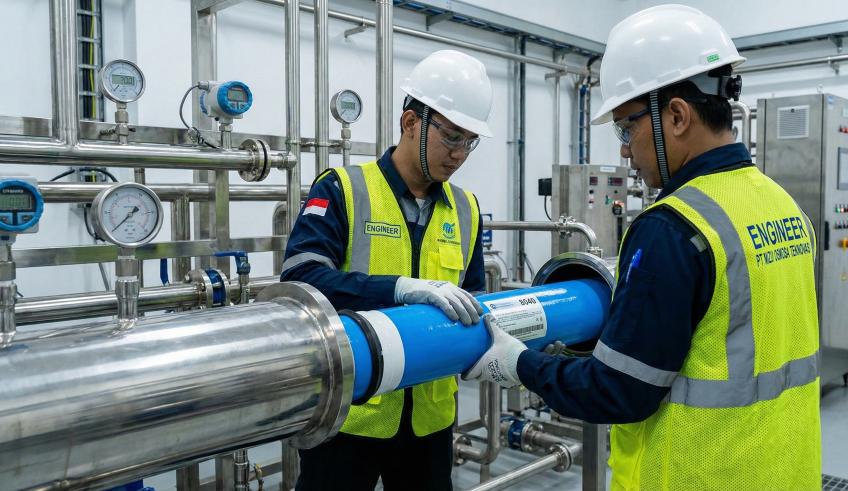
Stainless Steel 304/316L: Mandatory for the pharmaceutical, food, and demin/RO permeate water lines. Its anti-corrosion properties and smooth surface (sanitary grade) prevent the formation of bacterial biofilms that can contaminate the final product.
HDPE (High-Density Polyethylene): The ideal solution for long-distance raw water intake lines or recycled wastewater lines that require flexibility and resistance to ground movement, considering the clay soil conditions in some parts of Cikarang.
As a Jababeka I & II clean water treatment vendor, we see many system failures caused by dead-legs (blind pipe ends) that become breeding grounds for bacteria. Our installation design applies a looping system principle to keep the water circulating, minimizing stagnation.
Furthermore, calculating friction loss (pressure loss due to friction) is highly critical. Pipe diameters that are too small to save initial costs will cause pumps to work harder (wasting energy) and lead to cavitation. Our engineering team uses hydraulic simulations to ensure optimal pipe diameters, balancing material costs (CAPEX) with pump energy efficiency (OPEX).
For Factory Managers or factory owners, the question of cost is naturally a primary consideration. However, when talking about large capacity WTP package prices, we cannot simply look at the nominal figure in the initial quotation. The price of industrial WTP systems varies greatly depending on:
Raw Water Quality (Inlet): Is the source from the Estate WTP, deep well, or surface river water? The higher the pollutant load (TDS, Turbidity, Iron, Manganese), the more complex the required pre-treatment.
Target Product Water Quality (Outlet): Water for Cooling Towers is certainly cheaper to install than Water for Injection (WFI).
Level of Automation: Using PLC (Programmable Logic Controller) and SCADA for remote monitoring will increase the initial investment but significantly lower operator labor costs.
As a Cikarang industrial water filter specialist, PT Mizui Osmosa Teknovisa advises clients to look at the TCO. Cheap WTP packages often use low-efficiency pumps or low-grade membranes that clog quickly. Consequently, electricity bills swell, and the frequency of replacing consumables becomes very high within the first 1-2 years.
Our large-capacity packages (ranging from 10 m³/hour to 200 m³/hour) are designed with “Tier 1” components (such as Grundfos/Ebara pumps, DOW/Hydranautics/Toray membranes) that guarantee a longer lifecycle. We provide transparent Bill of Quantities (BoQ) that include estimated operational costs per cubic meter of water, allowing you to calculate ROI (Return on Investment) accurately.
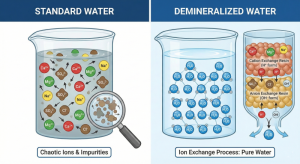
Entering a more technical realm, many industries in Cikarang Baru, particularly the electronic component and painting (electro-deposition painting) manufacturing sectors, rely heavily on mineral-free water. This is where the demineralized water supply for production becomes critical.
Natural water contains dissolved ions such as Calcium (Ca+), Magnesium (Mg+), Sodium (Na+), Chloride (Cl–), and Sulfate (SO4–). If this water is used to rinse printed circuit boards (PCBs) or mix precision chemicals, these ions can cause:
Microscopic short circuits on electronic components.
Spotting on car/motorcycle body paint finishes.
Interference with chemical reactions in pharmaceutical production processes.
PT Mizui Osmosa Teknovisa applies multi-stage technology to achieve water conductivity below 1 µS/cm (microSiemens per centimeter) or resistivity reaching 18.2 MΩ.cm (Megohm):
Double Pass Reverse Osmosis (RO): The initial stage of separating the majority of ions (up to 98-99%). A two-stage RO system ensures the water entering the polishing stage is already highly pure, extending the life of the resin or EDI.
Mixed Bed Ion Exchange: Uses ion exchange resin vessels (cation and anion) to capture residual ions. This is a reliable traditional method, but it requires periodic regeneration using acids and bases.
Electrodeionization (EDI): Modern technology that combines semi-permeable membranes and ion exchange resins, but is regenerated electrically (without chemicals). EDI is the preferred solution for modern factories in Jababeka that want to reduce B3 waste from the resin regeneration process.
We ensure our demin system designs have redundancy. This means that if one train is undergoing maintenance or regeneration, the other train can continue to supply production needs without interruption.
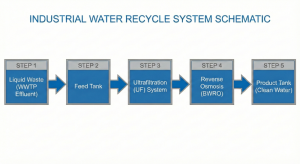
Amidst environmental issues and strict government regulations regarding groundwater use and wastewater quality standards, the concept of sustainability has become a necessity. The Ministry of Industry (Kemenperin) continues to promote green industry. One of the most effective solutions is the implementation of a water recycle system design.
Many factories in industrial estates discharge WWTP (Wastewater Treatment Plant) effluent, which is actually quite clear, into city drains. PT Mizui Osmosa Teknovisa views this as a waste of resources. We design Water Recycle systems that take WWTP effluent, re-treat it, and return it to the production process (as utility water, garden watering, or even boiler feed water).
The challenge of recycling wastewater is much tougher than treating river water. Residual organic content (COD/BOD) and bacteria are the main enemies. Our designs include:
Ultrafiltration (UF): Serves as the primary line of defense to filter out suspended solids, colloids, and bacteria. Our UF modules use hollow fibers that are strong and resistant to backwashing.
Brackish Water Reverse Osmosis (BWRO): Special membranes designed to handle water with a higher organic fouling potential than regular clean water.
Investing in this recycle system not only drastically reduces clean water purchasing bills (up to 50-70%) but also builds your company’s positive image as an eco-friendly factory.
Even the most advanced WTP system will not last long without proper maintenance. The heart of modern desalination systems is the Reverse Osmosis membrane. Over time, these membranes will experience fouling (clogging) by minerals (scaling), organic materials, or bio-fouling (bacteria). Therefore, the procedures and selection of industrial RO membrane chemical cleaning are a distinct science that we have mastered.
As part of Jababeka factory water system maintenance, we do not simply perform Chemical Cleaning (CIP) haphazardly. The first step is diagnosis:
If the pressure rises in the first stage, it is usually caused by colloids or TSS (Total Suspended Solids).
If the pressure rises in the second stage, it is usually caused by mineral scaling such as Calcium Carbonate or Silica.
If the pressure drop increases drastically accompanied by a decline in water quality, bio-fouling might be the cause.
Using the wrong generic chemicals can actually permanently damage the membrane’s polymer structure. PT Mizui Osmosa Teknovisa uses specialized chemicals with precise formulations:
Low pH Cleaner (Acid): Functions to dissolve inorganic mineral scale (carbonates, phosphates). We strictly control the pH to effectively dissolve the scale without thinning the membrane layer.
High pH Cleaner (Alkali): Functions to destroy organic dirt, oil, and bacterial biofilms. It is often combined with surfactants and chelating agents like EDTA to increase cleaning effectiveness.
Non-Oxidizing Biocide: To sterilize the membrane from bacteria without the risk of oxidation (because RO membranes are very sensitive to chlorine/bleach).
The Clean-In-Place (CIP) process we conduct is always accompanied by monitoring the solution temperature and cross-flow velocity to ensure dirt is truly lifted out of the membrane module, not just relocated.
Managing water utilities in a dynamic industrial area like Jababeka and Cikarang Baru requires more than just an equipment supplier; you need a technical partner who understands the intricacies of fluid engineering. From material selection in industrial clean water piping installation to precise calculations for large capacity WTP package prices, every decision impacts your factory’s profit margins.
PT Mizui Osmosa Teknovisa stands ready to assist you, whether in providing a consistent demineralized water supply for production, engineering an efficient water recycle system design, or conducting regular maintenance with high-quality industrial RO membrane chemical cleaning.
We invite you to discuss further the water challenges in your factory. With technical audits and in-depth consultations, we guarantee that a stable clean water supply will no longer be a concern, allowing you to focus entirely on your production targets.
Butuh bantuan? Tim kami siap membantu.