For operational managers in the palm oil industry (Palm Oil Mills/PKS) and the oil & gas sector in Riau, water management is a top priority. Water utility is not merely a support task. On the contrary, clean water is the heart of your production continuity. However, the geographical challenges in this province are unique. The dominance of peatlands creates raw water characteristics that are difficult to treat. Therefore, you need the right partner. As an experienced Pekanbaru water treatment contractor, PT Mizui Osmosa Teknovisa is ready to assist you.
We understand the fatal risks of water treatment system failure. Consequently, boiler damage and production downtime frequently occur. Furthermore, environmental sanctions could threaten your business. This article will discuss the technical aspects of peat water treatment in depth. Additionally, we will explain why a precision engineering approach is the best solution.
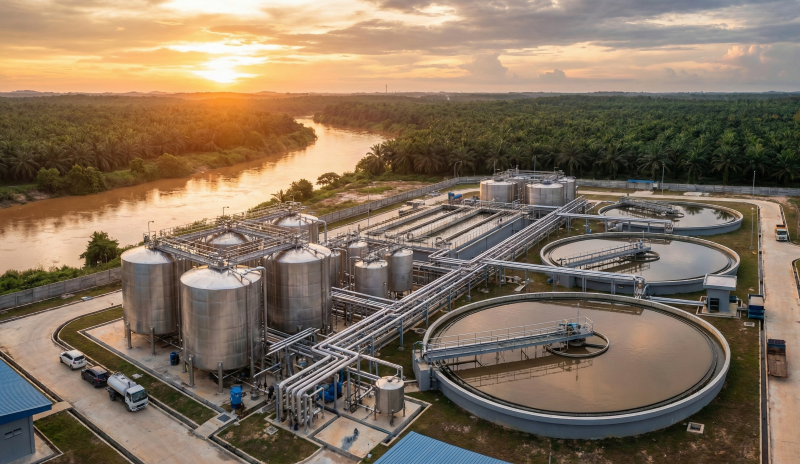
Riau Province is traversed by major rivers. Examples include the Siak River, Kampar River, and Rokan River. These rivers serve as the primary water sources for industrial areas in Pekanbaru, Duri, and Dumai.
However, this water brings major problems for engineers. The main challenge is the dominant characteristic of peat water. Peat water is not just ordinary dirty water. Visually, this water is reddish-brown, resembling tea.
Unlike ordinary turbid water, the color in peat water is colloidal. This means the color particles are very stable. Without a deep understanding of water chemistry, purification efforts often fail. As a result, operational costs swell without satisfactory results.
To design an effective Water Treatment Plant (WTP) system, we must dissect the two main enemies in peat water.
1. Extreme Acidity (pH) Peat water in the Riau region generally has a very low pH. The range is between 3.0 to 5.0. This acidic condition is caused by the high content of organic acids. These substances come from the decomposition of plants in peat swamps.
For industry, low pH is a serious threat. It triggers corrosion in carbon steel pipes and transfer pumps. Additionally, holding tank walls can undergo material thinning (material degradation). This damage can occur in a short time. Therefore, the water must be neutralized immediately at the pre-treatment stage.
2. Dissolved Organic Compounds (Humic & Fulvic Acid) The “tea” color in peat water is caused by Humic Acid and Fulvic Acid. These are organic compounds with a strong negative charge. Because they share the same charge, the color particles repel each other.
As a result, these particles remain suspended in the water and will not settle naturally. Even more dangerous, these organic compounds trigger other problems. For example, the formation of hazardous Disinfection By-Products (DBPs). In boiler applications, these compounds cause foaming. This certainly damages steam quality and triggers corrosion.
Many general contractors fail to handle projects in Riau. The reason is simple. They often try copy-paste methods from water treatment systems in Java. In reality, the water characteristics are vastly different.
How to purify Riau peat water requires a specific protocol. At PT Mizui Osmosa Teknovisa, we do not guess. Instead, we validate every design through rigorous laboratory Jar Tests.
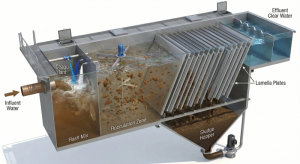
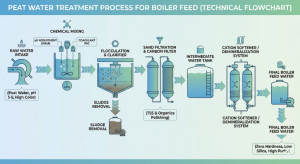
The heart of peat water treatment is the process of destabilizing the colloidal charge. Here are the technical stages:
pH Adjustment: First, the raw water pH must be raised to the optimum point. Usually at pH 6.0 – 7.0. We use precision Dosing Pumps with online pH meter sensors. If the pH is too low, the coagulant reaction fails. However, if it is too high, chemical wastage occurs.
Coagulation (Rapid Mixing): Next is the chemical injection stage. This process requires high-energy rapid mixing. The goal is to disperse the coagulant evenly. This is where many mistakes happen. Slow mixing causes the coagulant to clump before reacting.
Flocculation (Slow Mixing): After the charge is neutralized, micro-particles join to form flocs. At this stage, mixing must be slowed down. The goal is so that the clumps do not break apart again. For peat water, we often add Polymer (Flocculant). This material helps flocs become larger and easier to settle.
As a Dumai water treatment chemical supplier, we often see errors in chemical selection. This factor is crucial for cost efficiency.
Traditionally, Alum (Tawas) is often used. However, Alum is less effective for Riau peat water. Alum tends to lower the pH drastically. Furthermore, Alum produces large amounts of sludge.
As a solution, PT Mizui Osmosa Teknovisa recommends Polyaluminium Chloride (PAC). We supply premium quality PAC. The technical advantages of PAC include:
Wide pH Range: Remains effective even if water pH fluctuates.
Denser Flocs: Accelerates the settling process.
Low Residue: Prevents aluminum from escaping into the filtration stage.
Minimal Sludge: Reduces hazardous waste (B3) disposal costs.
The Palm Oil Mill (PKS) industry is the largest water consumer in Riau. Water needs are divided into two: process water and boiler feed water. Fatal mistakes often happen here. Many assume that clear water is enough for boilers. In fact, that assumption is dead wrong.
WTP for Palm Oil Mill Boilers High-pressure boilers are very sensitive. WTP for palm oil mill boilers must be able to remove dissolved minerals. Here are the main enemies of your boiler:
1. Total Hardness Calcium and Magnesium are the main scale formers. If they enter the boiler, these minerals will crystallize. This scale inhibits heat transfer. The effect is very detrimental. Fuel consumption skyrockets. Additionally, the risk of tube rupture increases sharply. As a solution, we use Softener units with quality cationic resin.
2. Silica (SiO2) River water in Riau often contains high silica. Silica scale is glass-like and very hard. This scale is almost impossible to clean with ordinary chemicals. Therefore, a Softener alone is not enough. A Demineralization or Reverse Osmosis (RO) system is required. The goal is to cut silica down to safe limits.
3. Dissolved Oxygen Oxygen causes pitting corrosion (pinholes). This corrosion is lethal to boiler pipes. As a prevention, we integrate Oxygen Scavenger chemical injection.
We are not just tool sellers. More than that, we are system integrators. Clean water treatment must align with waste management.
Ministry of Environment and Forestry (KLHK) regulations are getting stricter. For Palm Oil Mills, Liquid Waste (LCPKS/POME) has a high pollutant load. As a Riau WWTP (IPAL) contractor, we offer cutting-edge technology.
We design integrated WWTP systems. This system combines anaerobic and aerobic ponds. The goal is clear. We ensure the effluent discharged into the Siak River always meets quality standards. Thus, your company is free from the risk of environmental sanctions.
Many clients ask about the price of PAC in Pekanbaru. However, we suggest a different perspective. The metric that truly matters is the Cost per Cubic Meter (Rp/m³).
Buying cheap PAC is often a trap. Cheap products usually have low active ingredients. As a result, operators have to triple the dosage. This triggers new problems:
Chemical stock runs out quickly.
Logistics costs swell.
Filter backwash frequency increases.
Conversely, PT Mizui Osmosa Teknovisa provides industrial-specification PAC. With small but effective doses, your operational costs actually go down. So, don’t be tempted by momentarily cheap prices.
PT Mizui Osmosa Teknovisa holds an Engineering Excellence philosophy. We combine global expertise with local understanding.
The Duri and Dumai regions are strategic industrial hubs. Safety (HSE) standards here are very strict. Especially in the oil & gas contractor environment. Our team is highly trained in work safety compliance.
Moreover, we are accustomed to working in high-risk zones. We adhere to Permit to Work procedures with discipline. Our track record proves our ability to deliver projects on time.
The weakness of many contractors is after-sales service. Remember, a WTP is a dynamic system. River water quality changes during the rainy season. Therefore, the system needs recalibration.
Our commitment continues after the project is finished. Our services include:
Routine Visits: Our technicians will check pumps and instruments.
Media Replacement: We provide Silica Sand, Activated Carbon, and Resin.
Membrane Cleaning (CIP): RO membrane cleaning services.
24/7 Consultation: Our support team is ready to help with your operational constraints.
Peat water in Riau is a natural challenge. However, it can be managed with the right technology. Your decision in choosing a partner is crucial. It directly impacts machine lifespan and cost efficiency.
Don’t let poor water quality hinder your business. PT Mizui Osmosa Teknovisa, as a trusted Pekanbaru water treatment contractor, is ready to help. We provide measurable and guaranteed engineering solutions.
Are you ready to turn peat water into a valuable asset?
Contact Our Expert Team Now! We are ready to conduct a site survey and water sampling. Let’s optimize your factory water system with us.
Butuh bantuan? Tim kami siap membantu.