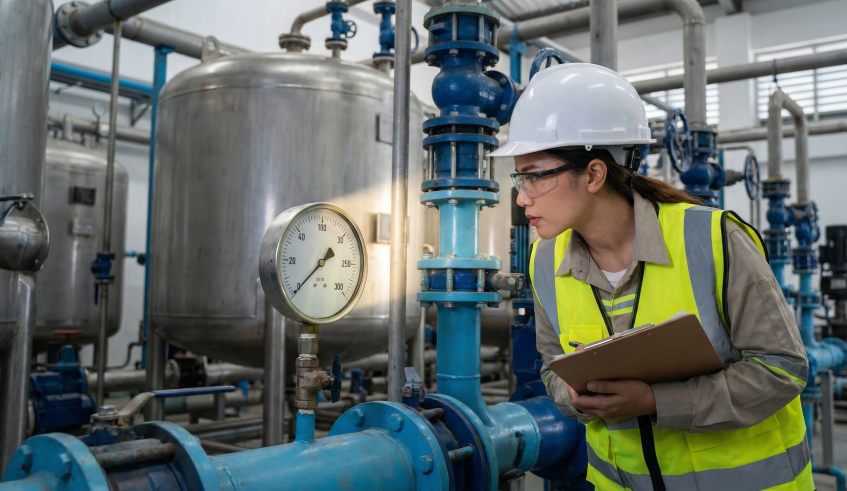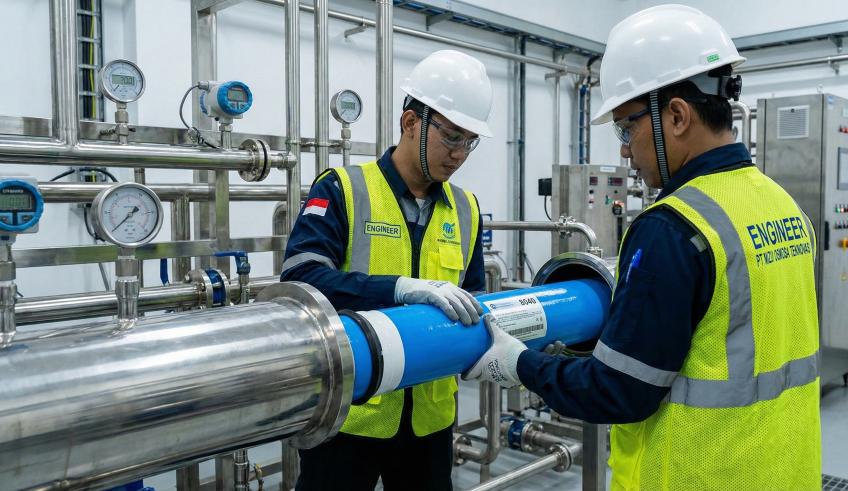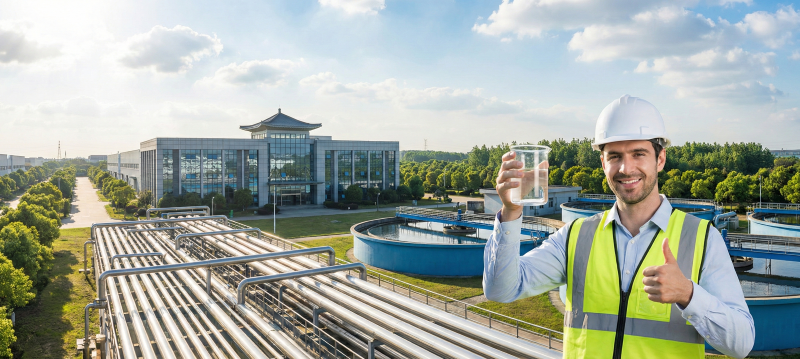
As the heart of the manufacturing and automotive industry in West Java, Karawang International Industrial City (KIIC) is known for its world-class operational standards and infrastructure. For Plant Managers and EHS Managers operating in this zone, maintaining compliance with environmental regulations is not merely a legal obligation, but an integral part of corporate reputation and business sustainability. This is where wastewater solutions for the KIIC Karawang area become a crucial element in a factory’s operational strategy.
PT Mizui Osmosa Teknovisa understands that the KIIC area is dominated by multinational companies, particularly from Japan, which firmly hold to the principles of Monozukuri (manufacturing excellence) and Kaizen (continuous improvement). These principles apply not only to the production line but must also be reflected in utility and waste management. Failure to manage a Wastewater Treatment Plant (WWTP) not only risks Red or Black PROPER sanctions from the Ministry of Environment and Forestry (KLHK), but can also tarnish the corporate image globally and jeopardize hard-earned ISO 14001 certifications.
This article will technically outline how the right engineering approach can address the complex characteristics of automotive industrial waste, from oil emulsion separation to hazardous (B3) sludge management, to ensure the resulting effluent always remains below quality standard thresholds.
The KIIC area has very strict environmental governance. As the area manager, KIIC requires every tenant to conduct independent waste treatment to reach specific standards before discharging it into the area’s drainage channels or centralized WWTP (if a joint treatment scheme exists). However, the biggest challenge for the automotive industry—ranging from casting, machining, and painting, to assembly—is the highly dynamic fluctuation of pollutant loads.
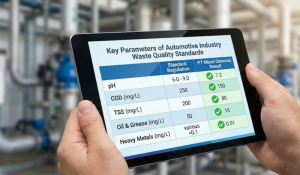
In the regulatory context, companies in West Karawang are subject not only to area rules but also to increasingly strict national regulations. Referring to the Regulation of the Minister of Environment and Forestry of the Republic of Indonesia Number 68 of 2016 concerning Domestic Wastewater Quality Standards and specific regulations for the metal coating or automotive industries, parameters such as COD (Chemical Oxygen Demand), BOD (Biochemical Oxygen Demand), Oil & Grease, and Heavy Metals are the main focus.
As an experienced environmental consultant for the KIIC area, we often encounter cases where factories experience shock loading. This occurs when pollutant concentrations spike suddenly due to machine washing processes or production line overhauls. If the WWTP system is not designed with an adequate safety factor, the outgoing effluent will exceed quality standards.
This compliance is closely related to ISO 14001 audits. Auditors look not only at the final wastewater results but also at process consistency, daily data recording (log sheets), and WWTP operator competency. Therefore, waste management strategies must be holistic: combining reliable technology, disciplined Japanese-style Standard Operating Procedures (SOP), and real-time monitoring.
Engineering Note: Often, compliance failures are not caused by the absence of technology, but by a mismatch between the initial design (Design Basis) and the actual waste characteristics that change along with factory expansion.
The automotive component industry generates wastewater with unique characteristics: high contents of oil, lubricants, coolants, and paint residue. This type of waste cannot be treated biologically right away because the properties of oil can kill decomposing bacteria and clog membranes or filter media.
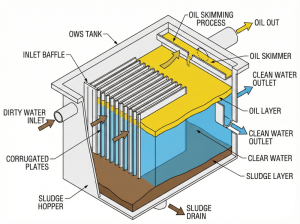
The first and most crucial step in Karawang automotive wastewater treatment is separating the oil and water phases. Oil in industrial waste generally comes in two forms: free oil and emulsified oil.
Free Oil Separation: For floating oil, utilizing a Corrugated Plate Interceptor (CPI) type Oil Water Separator (OWS) is highly effective. The corrugated plates within the CPI increase the contact surface area, allowing oil droplets to coalesce and rise to the surface faster due to the difference in specific gravity, to be subsequently swept away by an oil skimmer.
Emulsion Breaking: The toughest challenge is used coolant or degreasing wash water containing surfactants. Oil in this condition mixes with water (emulsion) and will not separate even if left for days. This is where the demulsification process is required. The addition of demulsifier chemicals or pH conditioning to an acidic environment (pH Cracking) is often needed to break these emulsion bonds before the water enters the next treatment stage.
Without an adequate pretreatment unit to remove oil and grease, downstream treatment units will experience fatal failures. Oil that escapes into the aeration tank will coat the bacterial flocs, block oxygen transfer, and cause anaerobic conditions that trigger foul odors and biomass death.
Once oil and grease are removed, automotive industrial wastewater still contains total suspended solids (TSS), heavy metals (such as Zinc, Nickel, Chromium), and dyes from the painting process (electrodeposition). For these inorganic and colloidal pollutants, a biological approach alone is insufficient. Precise chemical intervention is required.
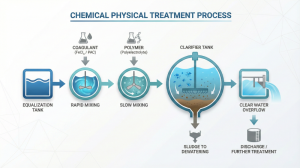
PT Mizui Osmosa Teknovisa recommends and implements a fully integrated Chemical-Physical WWTP System. This process works by altering the physical and chemical properties of the wastewater to separate pollutants from pure water. Here are the technical stages we apply:
Coagulation: In this stage, coagulant chemicals (usually PAC – Poly Aluminium Chloride or Ferric Chloride) are injected into the wastewater in a rapid mixing tank. The goal is to destabilize the electrical charges of the suspended colloidal particles so they can clump together. In the KIIC metal component industry, this stage also functions to precipitate heavy metals through pH adjustment (usually raised to pH 8-9 using Caustic Soda/NaOH).
Flocculation: Once the particles are unstable, the water is flowed into a slow mixing tank with the addition of polymers (polyelectrolytes). Polymers act as a “bridge” binding small particles into large clumps called flocs. The mixing speed here is highly critical; too fast will break the flocs, while too slow will cause premature settling.
Clarification (Sedimentation): The formed flocs have a higher specific gravity than water and will settle at the bottom of the sedimentation tank (clarifier). The clear water that overflows at the top will have significantly lower turbidity and a vastly reduced heavy metal load.
As a West Karawang WWTP contractor that prioritizes precision, we consistently conduct regular Jar Tests in our clients’ laboratories. This is crucial because factory waste characteristics often change. The exact chemical dosage today may not be effective next week. This data-driven approach prevents chemical waste and ensures optimal pollutant removal efficiency.
Although chemical-physical treatment is highly effective in reducing TSS and heavy metals, it is less effective in lowering dissolved organic matter represented by BOD (Biochemical Oxygen Demand) values. To achieve quality standards safe for environmental discharge, biological processes are the most economical and eco-friendly solution.
The Activated Sludge system is the most commonly used method yet often the most difficult to control. The success of this system depends entirely on the health of the microorganisms. In our KIIC WWTP management services, we emphasize:
F/M Ratio (Food to Microorganism): Maintaining the balance between the amount of “food” (BOD in the waste) and the number of bacteria (MLSS – Mixed Liquor Suspended Solids). If this ratio is unbalanced, phenomena like bulking sludge (hard-to-settle sludge) or pin-floc (broken flocs) will occur.
Macro Nutrients (C:N:P): Bacteria require balanced “nutrition.” Industrial waste often lacks Nitrogen or Phosphorus compared to its Carbon content. We perform precise nutrient dosing (Urea and DAP) to ensure the C:N:P ratio is close to 100:5:1, allowing bacteria to metabolize optimally.
Dissolved Oxygen (DO) Control: The oxygen supply via blowers and diffusers must be maintained at a level of 2.0 – 4.0 mg/L. A lack of oxygen will kill aerobic bacteria, while excess oxygen is a significant waste of electrical energy for factory utilities.
One of the innovations we offer is bio-augmentation, which is the addition of specialized bacterial cultures resistant to shock loading or mild toxicity from oil residues. These selectively mutated bacteria can degrade hydrocarbon chains that escape the pretreatment stage, providing an extra layer of security for effluent quality.
An efficient WWTP system inevitably produces a byproduct in the form of sludge. In the automotive and chemical industries, sludge resulting from both chemical-physical and biological treatments is often categorized as Hazardous and Toxic Waste (B3 Waste) because it contains heavy metals or oil residues. Managing this sludge is a critical point of legal compliance.
Many factories in KIIC experience WWTP issues not because of faulty design, but due to negligence in sludge management. The accumulation of sludge at the bottom of sedimentation or equalization tanks will reduce the effective treatment volume and, at the saturation point, the sludge will be carried out with the effluent (carry over), causing drastic spikes in TSS and COD parameters.
PT Mizui Osmosa Teknovisa provides comprehensive solutions as a Karawang factory STP vendor for handling this residue:
Dewatering System: We implement Filter Press or Screw Press technology to squeeze the water content in the sludge until the solid content reaches 20-40%. This drastic reduction in water volume significantly lowers transportation and disposal costs for B3 waste to third parties (such as PPLI or cement kilns).
Scheduled Sludge Removal: We offer service contracts for regular tank desludging and cleaning. Our technician team is equipped with complete PPE and Confined Space OHS certifications to perform the removal of heavy sludge settled at the bottom of hard-to-reach tanks.
Manifesting & Tracking: According to KLHK rules, every movement of B3 waste must be recorded in Festronik. We help clients ensure their sludge waste administration is orderly, keeping them secure during audits.
Mishandled sludge is a ticking time bomb. Besides environmental risks, sludge buildup can damage pumps, clog diffusers, and cause corrosion to the WWTP’s concrete structure.
Managing wastewater in a premium industrial area like KIIC requires more than just holding tanks and adding chlorine. It requires the integration of regulatory understanding, chemical-physical engineering expertise, microbiological knowledge, and high operational discipline.
For factory management, the main focus should be on core productivity—producing high-quality cars, motorcycles, or components. Let the complexities of wastewater be handled by the experts. PT Mizui Osmosa Teknovisa is here not just as a contractor, but as a strategic partner guaranteeing your peace of mind. With the wastewater solutions for the KIIC Karawang area we offer, we ensure your installation is not only compliant with today’s regulations but also ready to face stricter environmental standards in the future.
Referring to Japanese philosophy, we help you achieve Muda (waste/wastefulness reduction) in your environmental operations. Do not let wastewater issues hinder your company’s operations or reputation.
Next Steps: Would you like us to conduct a free site visit and initial audit of your current WWTP performance to identify potential operational cost savings and compliance risks? Contact our engineering team today.
Butuh bantuan? Tim kami siap membantu.