As an engineer involved in Wastewater Treatment Plant (WWTP) operations, you recognize an axiomatic fact: Aeration is the heart of the biological process, but it is also the largest burden in the Operational Expenditure (OPEX) structure. Wastewater aeration system optimization is not just about buying new equipment; it is about re-engineering the thermodynamics of oxygen mass transfer to achieve the highest efficiency point per kilowatt-hour (kWh).
At PT Mizui Osmosa Teknovasi, we frequently encounter industrial facilities still operating with obsolete conventional surface aerator technology. The logical consequence of this neglect is massive energy waste and unstable Dissolved Oxygen (DO) values, which threaten environmental regulatory compliance. This technical article will thoroughly dissect why transitioning to a Fine Bubble Diffuser system is the most rational engineering step to slash energy costs and boost aerobic bacterial performance.
In the energy balance of a wastewater treatment plant, the aeration unit consistently dominates power consumption. Data from various energy audits, in line with reports from EPA Energy Efficiency in Water and Wastewater Facilities, indicate that aeration can consume between 50% to 70% of a WWTP’s total electricity bill. For a Plant Manager, this figure represents the most significant cost-saving opportunity. If we fail to optimize WWTP aerator efficiency, we allow the company’s profits to be eroded by machine inefficiency.
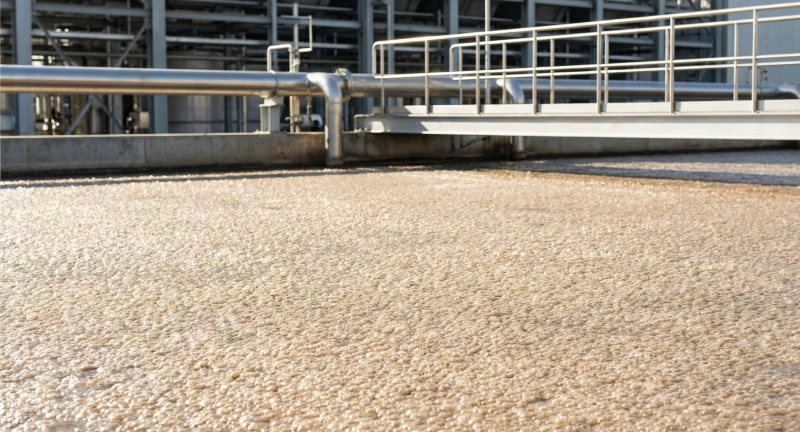
Historically, surface aerators (paddlewheel or turbine models) were the standard choice due to ease of installation. However, from the perspective of fluid mechanics and mass transfer, this technology has fundamental limitations. Surface aerators work by breaking the water surface to trap atmospheric air.
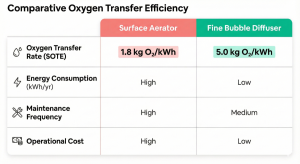
The main problem lies in their extremely low Standard Oxygen Transfer Efficiency (SOTE). A typical surface aerator can only achieve oxygen transfer in the range of 1.2 to 1.8 kgO2/kWh. The massive kinetic energy from the electric motor is mostly wasted fighting water friction (mechanical torque) and creating surface turbulence, rather than dissolving oxygen into the mixed liquor. This is why we often refer to them as “energy vampires”—they suck up huge amounts of power but deliver minimal dissolved oxygen output.
Oxygen transfer inefficiency often results in chronically low DO values (< 1.0 mg/L) inside the aeration tank. Microbiologically, this condition triggers a series of operational problems:
Filamentous Bacteria Growth (Bulking Sludge): Filamentous bacteria thrive in low DO conditions. This causes the Sludge Volume Index (SVI) to spike, making it difficult for sludge to settle in the Clarifier, leading to potential solids carry-over into the final effluent.
Nitrification Failure: Nitrosomonas and Nitrobacter bacteria, responsible for breaking down Ammonia (NH3-N), are highly sensitive to oxygen levels. If DO is not stable above 2.0 mg/L, the nitrification process is inhibited, causing outlet Ammonia parameters to exceed quality standards.
Foul Odors: Anoxic or partial anaerobic conditions trigger the formation of H2S gas and mercaptans, creating odor problems that disrupt the work environment.
Therefore, wastewater oxygen system repair is not just about electricity; it’s about guaranteeing compliance with Ministry of Environment and Forestry (KLHK) regulations.
The engineering solution to overcome this inefficiency is transitioning from surface aeration to sub-surface aeration using Fine Bubble Diffuser technology. The basic principle is to maximize the gas-liquid interfacial contact surface area.
In mass transfer physics, the oxygen transfer rate is directly proportional to the contact surface area. Imagine 1 liter of air. If released as one large bubble (like in coarse bubbles or surface aerator turbulence), its surface area is relatively small. However, if that 1 liter of air is broken down into thousands of micro-bubbles with a diameter of 1-2 mm, the total contact surface area increases exponentially.
Besides surface area, the bubble’s rise velocity is also crucial. Fine bubbles have lower buoyancy compared to drag, so they rise slowly to the surface. This increases the residence time between the air and water, giving oxygen more time to diffuse into the water.
Data from the Water Environment Federation (WEF) confirms that a well-designed Fine Bubble Diffuser system can achieve a SOTE of up to 6.0 – 8.0% per meter of depth, equivalent to an energy efficiency of 3.5 – 5.0 kgO2/kWh. This is an efficiency leap of over 200% compared to surface aerators.
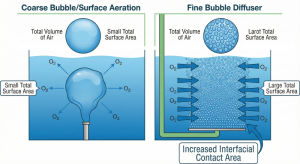
In the membrane diffuser installation projects we handle, we use high-quality EPDM (Ethylene Propylene Diene Monomer) material. These membranes have thousands of precise micro-pores. When air is pressurized in, the membrane expands, and the pores open to release fine bubbles. When airflow stops, the membrane shrinks back and closes the pores, preventing sludge water from flowing back into the piping system (backflow prevention).
Technical advantages of membrane diffusers include:
Operational Flexibility: Can operate efficiently across a wide range of air flow rates.
Minimal Dead Zones: Placing diffusers at the pond’s bottom (floor coverage) ensures much better mixing than surface aerators, which often leave dead zones in the bottom corners of the pond.
Heat Retention: Because they do not spray water into cold air (like paddlewheels), the water temperature in the reactor remains more stable, keeping bacterial metabolism optimal, especially during cold/rainy weather.
Performing WWTP blower upgrades and diffusion system improvements cannot be done haphazardly. Thorough Process Engineering calculations are required to ensure a balance between air supply and biological needs (Oxygen Uptake Rate).
The heart of a sub-surface aeration system is the blower. The use of Roots Blowers (Positive Displacement) is a reliable industry standard. However, for maximum efficiency, we highly recommend integrating with Turbo Blower technology featuring air foil or magnetic bearings, which can provide significantly higher isentropic efficiency.
Even more crucial is the use of a Variable Speed Drive (VSD) or Inverter. The incoming organic waste load to the WWTP fluctuates (day vs. night, production vs. cleaning). Without a VSD, the blower will run at 100% continuously, wasting energy during low-load periods. With a VSD connected to an Online DO sensor, the blower’s RPM can be automatically adjusted (modulating) to maintain the DO set-point (e.g., 2.0 mg/L). This is the key to smart electricity savings.
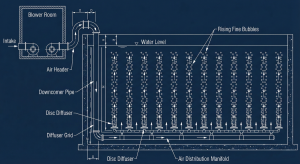
The diffuser layout at the bottom of the pond largely determines the success of the mixing. Calculating aeration air requirements must account for the Alpha factor (α)—the ratio of oxygen transfer in wastewater compared to clean water, and the Beta factor (β)—the salinity/TDS factor.
PT Mizui Osmosa Teknovasi applies grid or retrievable system designs focusing on:
Air Distribution: Header and manifold pipes must be accurately sized to minimize pressure drop.
Floor Coverage: We target a diffuser density sufficient to guarantee no sludge settles at the bottom, yet not so dense that it triggers coalescence (small bubbles merging back into large ones).
As data-driven consultants, let’s look at a real calculation simulation. Clients often ask about the price of fine bubble diffusers compared to surface aerators. Indeed, the initial CAPEX might seem more complex because it requires blowers and piping, but the OPEX tells a different story.
| Parameter | Surface Aerator (High Speed) | Fine Bubble Diffuser System |
| SOTE (Std. Transfer Efficiency) | 1.5 – 2.0 kgO2/kWh | 3.5 – 5.0 kgO2/kWh |
| Bubble Size | > 10 mm (Coarse/Turbulent) | 1 – 3 mm (Fine) |
| Alpha Factor (α) | 0.8 – 0.9 | 0.5 – 0.7 |
| Maintenance | High (Gearbox, Motor, Bearing) | |
| Energy Saving Potential | Baseline | 30% – 50% |
Let’s assume a plant has an Actual Oxygen Requirement (AOR) of 100 kgO2/hour.
Old Scenario (Surface Aerator):
Field Efficiency: ~1.2 kgO2/kWh
Required Power: 100 / 1.2 = 83.3 kW
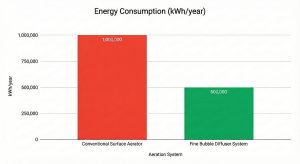
Annual Consumption (24 hrs x 365 days): 729,708 kWh
New Scenario (Fine Bubble Diffuser + Roots Blower):
Field Efficiency: ~2.5 kgO2/kWh (conservative estimate)
Required Power: 100 / 2.5 = 40 kW
Annual Consumption: 350,400 kWh
Savings: 379,308 kWh per year. If the industrial electricity rate is Rp 1,444/kWh, the cost savings amount to Rp 547 Million per year. With a new diffuser and blower system investment ranging from Rp 600-800 million, the Payback Period (ROI) is achieved in just 1.2 to 1.5 years. After that, the savings become pure profit for the company.
At PT Mizui Osmosa Teknovasi, we don’t just sell products. We provide end-to-end solutions. Our services include:
Oxygen Audit: Measuring existing DO profiles and energy consumption.
Engineering Design: Calculating air requirements, blower sizing, and diffuser layout.
Installation & Commissioning: High-precision installation of piping and diffuser systems.
After-Sales: Chemical cleaning (acid cleaning) services for diffusers and provision of membrane spare parts.
If your current aeration system still relies on old technology, you are burning operational money every second. The comparison of surface aerators vs. diffusers has a clear winner in terms of energy efficiency.
Are you ready to drastically lower your WWTP electricity bill?
Want to Discuss Technical Details Further? Contact the PT Mizui Osmosa Teknovasi engineering team for a free consultation regarding your aeration system retrofit. We will help you calculate the specific savings potential at your plant.
Butuh bantuan? Tim kami siap membantu.