As middle-tier healthcare facility management, finding a
Type C hospital WWTP contractor partner who truly understands the balance between regulatory compliance and budget efficiency is a challenge in itself. Often, Class C Regional Public Hospitals (RSUD) and growing private hospitals are faced with two difficult choices: building a WWTP (Wastewater Treatment Plant) system that is too sophisticated but burdens operational costs (OPEX), or choosing a cheap solution that fails during environmental quality standards testing.
At PT Mizui Osmosa Teknovasi, we position ourselves not just as a vendor, but as an Infrastructure & Sanitation Accreditation Consultant. We understand that for Type C Hospitals, with an average capacity of 50 to 100 beds, every rupiah spent on utilities must be accountable for its effectiveness, especially in supporting the achievement of Plenary Accreditation.
This article will thoroughly explore liquid waste construction and management strategies specifically for the characteristics of class C hospitals, starting from flow rate calculation, selection of “Low Maintenance” technology, to strategies for facing accreditation surveys.
The Type C Hospital Dilemma: Between Budget Efficiency and Accreditation Demands
In the healthcare service hierarchy in Indonesia, Type C Hospitals play a vital role as the first-level referral facility from Public Health Centers (Puskesmas). However, this position often brings a unique operational dilemma. Unlike Type A or B Hospitals which have large budgets and complete IPSRS (Hospital Facility Maintenance Installation) teams, Type C Hospitals often have to operate with leaner resources.
This condition becomes crucial when talking about the construction of Type C public or private hospital WWTPs. Hospital Directors and Commitment Making Officers (PPK) are often trapped in the procurement of inappropriate technology. Many vendors offer conventional Activated Sludge systems that require large land areas and high electricity consumption (large blowers running 24 hours), whereas the waste characteristics and finances of Type C Hospitals require a different approach.
FMS (Facility Management & Safety) Assessment Points That Are Often Missed
In the accreditation standards set by the
Hospital Accreditation Commission (KARS), the Facility Management and Safety (FMS / MFK) element is one of the most technical chapters and often becomes a stumbling block.
Accreditation surveyors do not just look at whether you have a WWTP or not. They will check:
-
Performance Consistency: Have the WWTP outlet laboratory test results consistently met quality standards over the last 3 months?
-
Operator Competence: Do the IPSRS staff understand how the system works, or is the system too complicated and thus left unmaintained?
-
OHS Documentation: Is the WWTP area safe for workers and the surrounding environment?
As a Type C hospital waste consultant, we often find cases where hospitals fail in this assessment element not because they do not have the equipment, but because the equipment is broken and there is no budget for expensive spare part repairs. Therefore, the choice of technology at the beginning greatly determines your accreditation score in the future.
Environmental Sanction Risks for Public Hospitals and Growing Private Hospitals
Aside from accreditation, the threat of sanctions from the Environmental Agency (DLH) is real. Referring to the Regulation of the Minister of Environment and Forestry No. P.68 of 2016 concerning Wastewater Quality Standards for Health Care Facilities, the class C hospital waste quality standards are no different from class A hospitals. Parameters for Ammonia, BOD (Biological Oxygen Demand), COD, TSS, and Coliform must be strictly below the threshold.
For Class C hospital WWTPs located in the middle of densely populated residential areas (which is common for growing private hospitals), odor leaks or unclear wastewater can trigger citizen complaints. This can lead to administrative sanctions, suspension of operational permits, and even environmental criminal charges. Choosing a contractor who can only “build” without understanding the “legal consequences” is a massive gamble for the Hospital’s reputation.
Designing the "Right Fit" WWTP for 50-100 Bed Capacity
The key to cost efficiency is sizing (determining the size) precisely. Oversizing means a waste of CAPEX (capital expenditure/construction costs) and land. Undersizing means treatment process failure (overflow) during peak hours.
Calculating Waste Flow Rate: Don't Build an Energy-Wasting "Giant"
In performing the Type C hospital WWTP capacity calculation, we cannot just look at the raw number of beds. We must calculate the Bed Occupancy Rate (BOR) and non-medical water usage.
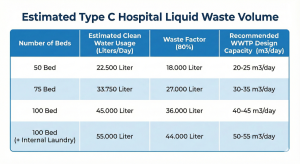
Generally, the standard for clean water usage for Type C Hospitals ranges from 350 – 450 liters/bed/day. However, this number can fluctuate. For example, if your hospital has active Hemodialysis services or massive internal Laundry, the wastewater flow rate will spike significantly.
Here is the calculation estimate we usually use as an initial reference:
Based on the data above, the cost of building a 50-bed hospital WWTP will certainly differ significantly from a 100-bed hospital with internal laundry. PT Mizui Osmosa always conducts field assessments to determine the real flow rate, so you do not pay for unnecessary concrete capacity.
Overcoming Type C Hospital Medical Waste Characteristics (Infectious & Laundry Dominance)
The main technical challenge in Type C Hospitals often lies in the fluctuation of organic loads. During morning to afternoon operational hours, the waste load is very high (polyclinic activities, kitchen, laundry), but drops drastically at night.
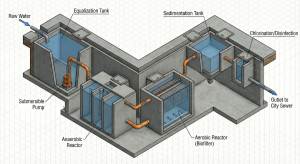
Conventional WWTP systems are often “shocked” (shock loading) by this fluctuation, causing decomposing bacteria to die. In addition, Type C Hospital waste often contains high detergent residues (phosphates) from laundry activities and disinfectant residues. If your contractor does not design the Pre-Treatment (initial holding and grease tanks) correctly, the biological system behind it will definitely fail. We design an equalization system capable of “damping” this surge so that the decomposition process runs stably 24 hours a day.
Bioreactor & Biofilter Technology Solutions: Space-Saving & Low Operational Cost
Answering the need for narrow land and the lack of expert human resources in Type C Hospitals, PT Mizui Osmosa Teknovasi recommends a hospital bioreactor technology approach based on Anaerobic-Aerobic Biofilters.
Why is this technology the most appropriate to
upgrade private hospital WWTPs and Class C public hospital WWTPs?
-
Minimal Sludge: The anaerobic process naturally reduces residual sludge production, so the frequency of sludge pumping is much rarer compared to activated sludge systems.
-
Shock Load Resistant: The biofilter media (honeycomb/bioball) becomes a home for bacteria, so the bacteria do not easily wash away when the water flow rate suddenly increases.
-
Energy Efficient: The oxygen (aeration) requirement is much smaller because most pollutants have been decomposed in the anaerobic (without air) stage.
Compact Design for Limited Hospital Land
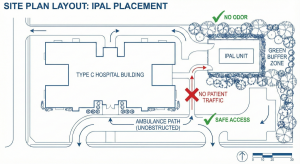
We understand that Type C Hospitals are often the result of the expansion of clinics or old buildings, so the available land is very limited. Often, the WWTP location must be “tucked” into the back area, near the mortuary, or under the parking area.
With an embedded (buried) or semi-basement design, the area above the WWTP can still be utilized as a garden or ambulance parking area, without disrupting the hospital’s aesthetics.
Simple Automation System to Lighten the Burden on IPSRS Operators
A classic problem in Type C Regional Public Hospitals is that WWTP operators often double as electrical or AC technicians. They cannot wait on the WWTP 24 hours a day. Therefore, our systems are designed with User-Friendly automatic control panels.
Pumps work based on Water Level Control (WLC), blowers work with Timers, and chlorine/bacteria dosing systems run automatically. If a malfunction occurs, the system will provide an alarm signal. This significantly reduces the IPSRS workload while maintaining treatment performance.
Partnering with PT Mizui Osmosa: Assistance Until Permit Issuance
Price Transparency and Reasonable Bill of Quantities (BoQ/RAB)
We are often asked, what is the cost of building a 50-bed hospital WWTP? The answer varies depending on land conditions and materials (Fiberglass vs. Concrete). However, PT Mizui Osmosa guarantees transparency in the Bill of Quantities (BoQ / RAB).
We detail Civil, Mechanical & Electrical costs, down to Testing & Commissioning costs. There are no hidden fees. We also provide efficiency options, for example, utilizing old holding tanks that are still feasible for revitalization (Retrofitting), so that investment costs can be reduced by up to 30-40% compared to building completely new.
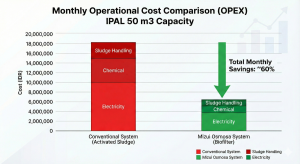
Here is the operational cost efficiency comparison you can expect:
Technical Support During Plenary Accreditation Surveys
This is our main Value Added. Our task is not finished when the water flows clear. Our Environmental Engineer team will accompany the hospital management when facing KARS/JCI surveyor questions related to sanitation.
We help compile supporting documents such as:
-
WWTP Operation SOPs (Standard Operating Procedures).
-
Operator Daily Logbooks.
-
Wastewater Quality Trend Analysis.
-
Hazardous Waste (Sludge) Manifest Documents.
This support provides a sense of security for the Director and the Accreditation Team that the sanitation sector is in the right hands.
Ready to Elevate Your Hospital's Sanitation Standards?
Don’t let waste problems hinder your Hospital’s accreditation and reputation. Entrust the construction of your Type C public and private hospital WWTPs to PT Mizui Osmosa Teknovasi. We provide precise engineering solutions, reasonable prices, and guaranteed regulatory compliance.
Contact our team of experts today for a free consultation and site survey. Let’s realize a Hospital that is environmentally friendly, efficient, and Plenary accredited.