Industrial areas in Banten Province, specifically Tangerang, have grown into the heart of national manufacturing. From industrial centers in Cikupa and warehousing in Balaraja to modern complexes in the Millenium Industrial Estate, production activities are constantly racing against time. However, behind the high productivity of the chemical, textile, and manufacturing industries lies a crucial challenge that cannot be ignored: wastewater management.
As an experienced Tangerang WWTP Contractor, PT Mizui Osmosa Teknovisa understands that a Wastewater Treatment Plant (WWTP) is not merely complementary infrastructure, but a vital asset for the continuity of operational permits and environmental sustainability.
For Plant Managers and factory owners, choosing the right partner to handle wastewater, especially those containing Hazardous and Toxic Materials (B3), is a strategic decision. This article will technically dissect the engineering approach required to build a wastewater treatment system that is reliable, space-efficient, and compliant with strict regulations in the Tangerang area.
The Greater Tangerang area has unique characteristics in environmental governance. The growth of residential areas that now border industrial zones in Cikupa and Balaraja demands much stricter effluent (treated water) standards compared to a decade ago. The Environmental Agency (DLH) of Tangerang Regency and Banten Province routinely conducts sudden inspections and wastewater sampling to ensure quality standards are met.
As a Tangerang WWTP construction service provider, we often encounter cases where factories have a WWTP, but it does not function optimally due to a design that does not match the current waste characteristics. Fluctuations in production capacity often cause shock loading to the biological system, leading to BOD (Biological Oxygen Demand) and COD (Chemical Oxygen Demand) parameters soaring above the threshold. Therefore, a customized engineering approach is the only viable solution.
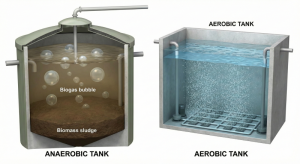
In environmental engineering, the heart of organic waste treatment lies in selecting the appropriate biological process. Often, our clients are confused about determining the most efficient method. The answer lies in the incoming pollutant load (influent).
Anaerobic System: High Load Handling The anaerobic system works without the aid of oxygen, utilizing bacteria living in a closed environment to break down complex organic compounds. This method is highly ideal as an initial stage (pretreatment) for wastewater with very high COD concentrations (> 2000 mg/L), as often found in the food processing industry or paper mills around Balaraja. The technical advantage of this system is the relatively low sludge production and the potential utilization of biogas (methane) as renewable energy. We often recommend the Upflow Anaerobic Sludge Blanket (UASB) type reactor due to its efficiency in reducing the organic load by up to 70-80% before the water enters the next stage. However, this system requires a fairly long Hydraulic Retention Time (HRT) and strict pH control so that methanogenic bacteria remain alive.
Aerobic System: Final Quality Polishing Unlike anaerobic, the aerobic system requires an intensive oxygen supply through aerators or blowers. Aerobic bacteria work very quickly in breaking down organic residue and eliminating odors. This is the gold standard for achieving wastewater quality standards that are safe to be discharged into receiving water bodies (rivers or city drainage).
PT Mizui Osmosa Teknovisa frequently implements Activated Sludge or Extended Aeration technologies to ensure ammonia and dissolved organic parameters drop drastically. The combination of these two systems (Anaerobic followed by Aerobic) is often the best configuration for industries that desire energy efficiency while still pursuing strict quality standards. As a Banten WWTP installation vendor, we precisely calculate the Oxygen Uptake Rate to ensure bacterial performance remains at its peak without wasting electrical energy.
Not all wastewater can be treated solely by relying on bacteria. Metal manufacturing, paint, textile, and basic chemical industries produce wastewater that is toxic to microorganisms. This is where a deep understanding of chemical reactions plays a crucial role.
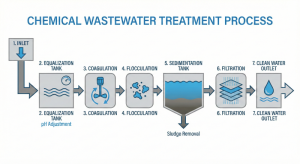
Wastewater from the chemical industry has a highly fluctuating and hazardous profile. The content of heavy metals, organic solvents, dye residues, and high surfactants requires careful physico-chemical pretreatment before the water is safe to enter the biological unit or be discharged.
Equalization and Neutralization: Because chemical factories often discharge waste in batches with extreme pH (highly acidic or highly alkaline), the equalization tank serves to homogenize the waste characteristics. The addition of Caustic Soda (NaOH) or Sulfuric Acid (H2SO4) is done automatically using a dosing pump integrated with a pH meter sensor.
Coagulation and Flocculation: This is the art of trapping colloidal particles that cannot settle naturally.
Coagulation: We use coagulants such as Poly Aluminium Chloride (PAC) or Ferric Chloride to break the charge stability of dirt particles.
Flocculation: The addition of polymers (polyelectrolytes) acts as a “bridge” that combines these small particles into large flocs that have a heavier specific gravity than water.
As a Tangerang hazardous waste treatment specialist, we also often apply Advanced Oxidation Processes (AOP) technology using Fenton’s Reagent or Ozonation to break down complex carbon chains that are difficult to degrade (refractory). Without this process, chemical waste will “kill” the bacteria in the biological unit, causing total system failure.
Technical Note: The separation of hazardous sludge resulting from this chemical sedimentation must be managed in accordance with Government Regulation No. 22 of 2021 concerning the Implementation of Environmental Protection and Management. This sludge must be dried using a Filter Press before being handed over to a licensed third party. Regulatory references can be viewed on the Ministry of Environment and Forestry (KLHK) website.
One of the biggest constraints for industries in Tangerang is land availability. Land prices in premium industrial estates like Millenium or Cikupa Mas continue to creep up, forcing factory owners to prioritize land for production areas rather than utility areas.
Responding to this challenge, PT Mizui Osmosa Teknovisa developed a compact and vertical WWTP design. For factories located in the Millenium Industrial Estate or dense Cikupa zones, conventional designs with large open ponds (lagoons) are no longer relevant.
As an innovative Cikupa WWTP Contractor, we apply MBBR (Moving Bed Biofilm Reactor) or MBR (Membrane Bioreactor) technologies.
MBBR: This technology uses special plastic media (bio-carriers) suspended in the aeration tank. This media provides a very large surface area for bacteria to attach, so the reactor tank volume can be reduced by up to 40-50% compared to conventional activated sludge systems.
Vertical & Underground Design: To save footprint, we often design reactor tanks that extend upwards (towers) or utilize underground space in parking areas or driveways. Reinforced concrete structures with high-standard waterproofing are used to prevent waste leakage into groundwater, which is a severe violation.
This design is not only space-saving, but also aesthetic and low-odor, so it does not disturb the surrounding work environment.
Many factories in Tangerang actually already have a WWTP, but it was built 10 or 15 years ago. Over time, the factory’s production capacity has increased two to three times, while the WWTP capacity remains the same. As a result, the WWTP experiences an overload and the resulting effluent is cloudy and odorous.
Building a new WWTP from scratch is not the only solution, and often not the desired option due to high investment costs (CAPEX) and operational disruptions during construction. Our Tangerang factory WWTP construction services include Retrofitting or revitalizing old systems.
The first step in optimization is a Process Audit. Our engineering team will take samples at each process stage (inlet, primary outlet, aeration tank, secondary outlet) to analyze at which point the failure occurred. Is it due to a lack of oxygen? Is it because the bacteria died from poisoning? Or is it because the retention time is too short?
Technical solutions we often apply include:
Aeration System Upgrade: Replacing outdated surface aerators with fine bubble diffusers which have a much higher oxygen transfer efficiency.
Bio-Augmentation: Adding specific bacterial cultures that are more resistant to shock loading and capable of degrading specific pollutants.
Media Modification: Adding MBBR media into the existing aeration tank to increase the biomass population without the need to enlarge the civil tank volume.
With this approach, factories can increase processing capacity up to 2-3 times at a much more efficient cost compared to building a new unit.
Advanced technology will not be complete without compliance with administrative aspects. The Regional Government of Tangerang and Banten Province are increasingly strict in supervising environmental documents as an absolute requirement for industrial operations.
Often, discrepancies between the actual field conditions and the environmental documents held become findings during environmental audits. The Environmental Management Efforts and Environmental Monitoring Efforts (UKL-UPL) or AMDAL documents must be “living” documents that are relevant to the factory’s current conditions.
PT Mizui Osmosa Teknovisa is not only engaged in physical construction but also provides UKL-UPL environmental document consulting services. We help clients prepare or revise environmental documents so they are synchronized with the built WWTP design. This includes:
Calculation of water balance and waste mass balance.
Preparation of WWTP SOPs (Standard Operating Procedures).
Routine reporting of UKL-UPL implementation to relevant agencies (DLH Tangerang/Banten).
This compliance is important to avoid administrative sanctions, permit suspensions, and even environmental criminal lawsuits. You can learn more about wastewater quality standards for industrial estates through regulations published by the Environment and Forestry Agency of Banten Province.
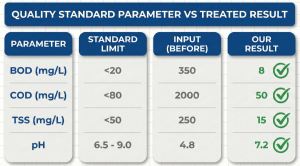
Building and managing a WWTP in the dense and strictly regulated Tangerang industrial areas is not a simple job. It requires a combination of civil engineering expertise, chemical engineering, and a deep understanding of microbiology as well as legal regulations.
As a Tangerang WWTP Contractor committed to quality, PT Mizui Osmosa Teknovisa is here to provide end-to-end solutions. Starting from waste characteristic analysis, precise anaerobic and aerobic system design, safe hazardous chemical waste handling, to assistance with environmental document legality. We ensure your environmental investment is not merely fulfilling an obligation, but becomes a reliable system, cost-efficient in operations, and provides peace of mind for company management.
Don’t let waste problems hinder your factory’s productivity in Cikupa, Balaraja, or Millenium. Contact our engineering team for technical consultations and field audits.
Butuh bantuan? Tim kami siap membantu.