The tourism industry in Bali, particularly in exclusive areas like Nusa Dua, Uluwatu, and Seminyak, is now facing an increasingly urgent latent challenge: a clean water availability crisis. For Hotel General Managers and Resort owners, relying on PDAM (municipal waterworks) supplies that frequently experience disruptions, or using groundwater with depleting discharge, is no longer a sustainable option.
This is where the crucial role of PT Mizui Osmosa Teknovisa comes in. As an experienced Bali SWRO Contractor, we understand that water supply stability is not just an operational issue, but the main foundation for guest comfort and the sustainability of five-star hospitality businesses.
The reality on the ground shows that Bali’s coastal areas often lack adequate access to fresh groundwater. Seawater intrusion has damaged aquifer quality in many spots, forcing industry players to seek more reliable alternatives. Sea Water Reverse Osmosis (SWRO) or seawater desalination technology is now transforming from an expensive technology into a strategic necessity. This article will deeply dissect the technical, financial, and legal aspects of SWRO installation, providing a comprehensive guide for you, decision-makers in the hospitality sector, to secure your property’s future.
The classic problem faced by properties on the South Bali coastline is the quality of brackish groundwater. Geologically, areas like Uluwatu and Jimbaran have unique limestone structures where freshwater pockets have often been contaminated by seawater seepage due to excessive groundwater extraction over the past decade. As a Bali seawater desalination installation service, we frequently encounter cases where hotels try to survive by treating brackish water using standard filtration systems, which ultimately fail to significantly reduce salt levels.
Ignoring water quality with high TDS (Total Dissolved Solids) and chloride levels is a fatal mistake for Chief Engineering. Brackish water is highly corrosive. Imagine the long-term impact on your hotel’s plumbing systems, boilers, and cooling towers. Metal pipes will corrode faster, increasing the risk of leaks that damage building structures.
Furthermore, luxury sanitary fixtures from renowned brands like Kohler, Toto, or Grohe, which are standard in five-star resorts, will quickly lose their shine. White scaling and rust stains will appear on faucets and shower heads, creating a dirty and unkempt impression that is very difficult for the Housekeeping team to clean. The replacement cost of these assets is far greater than a preventive investment in the right water treatment system.
In the digital era, a hotel’s reputation heavily depends on guest reviews. Complaints about water feeling sticky on the skin, soap not lathering, or a salty taste when brushing teeth are rating “killers” on TripAdvisor or Booking.com. Guests paying premium prices in Nusa Dua or Seminyak expect perfection. Bali hotel seawater distillation equipment providers like PT Mizui Osmosa Teknovisa help you eliminate the risk of these complaints by guaranteeing freshwater output (permeate) that meets world-class clean water standards (TDS < 500 ppm), equal to or even better than bottled water.
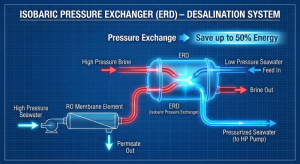
One of the biggest myths hindering hotels from switching to SWRO is the assumption that this technology consumes massive amounts of electricity. This might have been true a decade ago. However, modern desalination technology innovations have birthed incredible efficiencies. As a Nusa Dua & Uluwatu clean water contractor focusing on efficiency, we implement systems integrated with energy recovery technology.
The Reverse Osmosis process requires high pressure (between 55 to 70 bar) to push seawater through a semi-permeable membrane, separating water molecules from salt. In the past, the residual pressure from the rejected water (brine/reject) was simply discarded, meaning a massive waste of potential energy.
This is where Energy Recovery Device technology plays its role. This device, often called a Pressure Exchanger, captures high-pressure energy from the reject water stream and transfers it back to the incoming fresh seawater stream (feed water). With this mechanism, the High Pressure Pump does not need to work from zero to reach operational pressure. The pump’s workload is drastically reduced.
Implementing ERD in the SWRO systems we design can reduce specific energy consumption from around 5-7 kWh/m³ to only 2.5-3.5 kWh/m³. For a resort with a water requirement of 500 m³ per day, these savings amount to hundreds of millions of rupiah per year in PLN electricity bills. This is proof that being a quality Denpasar Sea Water Reverse Osmosis machine vendor is not just about selling machines, but providing engineering solutions that minimize clients’ Operational Expenditure (OPEX).
Besides cost savings, using this energy-efficient technology aligns with the Green Hotel and Sustainability principles heavily campaigned by PHRI (Indonesian Hotel and Restaurant Association) and serves as a unique selling point for environmentally conscious foreign tourists.
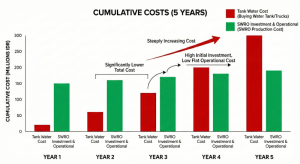
Speaking of CAPEX (Capital Expenditure), transparency is key. Many hotel owners hesitate because they lack a clear picture of the cost structure. The SWRO investment cost for hotel capacity varies greatly depending on production capacity (m³/day), raw water (intake) quality, and installation location. However, let’s break down the structure so you get a logical overview.
Initial investment covers several main sectors:
Intake System: Costs for constructing a beach well or open intake pipeline to extract seawater.
Pre-treatment System: Multimedia filters, cartridge filters, and chemical dosing systems to prevent membrane clogging.
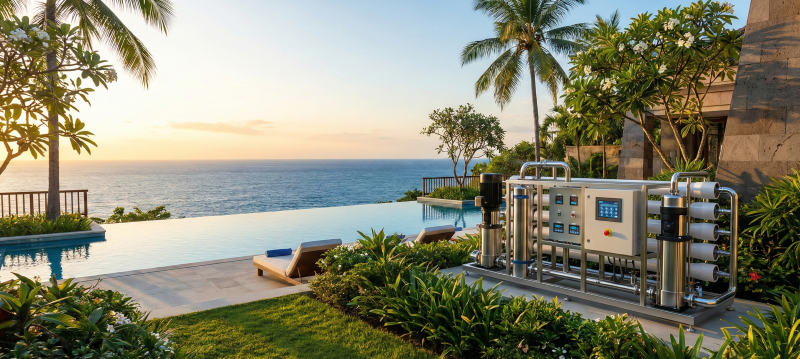
SWRO Unit: The heart of the system consisting of the High Pressure Pump, Membrane Housing, and the RO Membrane itself.
Energy Recovery Device: An optional but highly recommended component for long-term savings.
Installation & Commissioning: Costs for experts, high-grade piping (usually Duplex Stainless Steel for rust resistance), and electrical/control panel systems.
Let’s do a simple comparative analysis. Many hotels in Nusa Penida or Uluwatu currently buy water from tanker trucks to meet needs during the dry season or because their groundwater is salty. Tanker water prices in Bali continue to rise, ranging from IDR 40,000 to IDR 70,000 per m³, not including the risks of delivery delays and inconsistent water quality.
Conversely, by owning your own SWRO unit, production costs (electricity + chemicals + consumables) usually fall between IDR 15,000 – IDR 25,000 per m³ (depending on electricity rates). Although there is a large initial investment, this difference in operational costs means the Return on Investment (ROI) for a 100-300 m³/day capacity SWRO system is usually achieved within 1.5 to 2.5 years. Once the ROI period is reached, your hotel essentially enjoys the “profits” of massive water cost savings for years to come. As a Water Maker specialist for resorts, PT Mizui Osmosa Teknovisa is ready to help you calculate specific ROI calculations based on your property’s water consumption data.
Investing in an SWRO machine is a long-term investment, and much like a luxury car engine, it requires precise maintenance. One of the biggest mistakes hotels make is handing over the operation of these advanced machines to untrained technicians, resulting in premature membrane failure. Seawater RO membrane maintenance is a critical aspect that determines the equipment’s lifespan.
Seawater is a “soup of life.” It contains microorganisms, plankton, algae, and high dissolved minerals. Without proper maintenance, an RO membrane, which has microscopic pores (0.0001 microns), will quickly become clogged by biofouling (biological slime) or scaling (mineral crusts). If this happens, pump pressure will rise drastically, water production will decrease, and water quality will deteriorate.
We implement strict protocols for our clients. An SWRO system must be equipped with a CIP (Cleaning In Place) unit that allows for chemical cleaning of the membrane without having to dismantle the unit. The CIP frequency should be determined based on monitoring daily operational parameters (such as differential pressure and normalized permeate flow), not just a calendar schedule.
Additionally, using correctly dosed antiscalant chemicals is highly crucial. As a trusted partner, we ensure your hotel’s engineering team receives intensive training, or we can provide regular service contracts. Remember, SWRO membranes are quite expensive. Keeping them in good condition to last 3-5 years is our priority.
In running water infrastructure projects, regulatory compliance is non-negotiable. Bali has strict environmental rules to preserve its nature. As a responsible contractor, PT Mizui Osmosa Teknovisa not only installs equipment but also provides assistance regarding commercial seawater extraction permits.
The use of water resources, including seawater for commercial purposes, is regulated by the Water Resources Law and local regional regulations. You need a SIPPA (Water Use Business Permit) or a similar permit applicable in Bali Province.
Local governments highly prioritize two things:
Intake Method: Seawater extraction must not damage coral reef ecosystems or disrupt public coastlines. Using a Beach Well is often preferred by regulators over open intake pipes because its visual and environmental impacts are more minimal.
Brine Disposal: The residual water from distillation (brine) has a higher salt concentration than normal seawater. Its disposal must be managed properly—dispersed through a diffuser so it quickly dissolves back into the sea—so it does not kill marine life around the discharge point.
Ignoring these legal aspects can risk your hotel’s operational closure or environmental fines. We advise you to always consult with an environmental consultant or refer to the latest regulations from the Ministry of Energy and Mineral Resources (ESDM) or the Bali Environmental Agency before starting a project. Our expertise includes eco-friendly system designs to simplify your permitting process.
Bali’s water crisis is a reality that will not improve on its own. Waiting for rain or hoping for PDAM pipe repairs is not a wise business strategy for a hospitality industry that demands 24/7 certainty. Switching to desalination technology is not just about meeting water needs, but about securing assets, enhancing guest satisfaction, and ensuring long-term operational sustainability.
PT Mizui Osmosa Teknovisa, as a leading Bali SWRO Contractor, is ready to be your strategic partner. We don’t just sell machines; we provide integrated solutions from feasibility studies, energy-efficient custom designs, professional installations, to reliable after-sales support.
Don’t let brackish water problems or water scarcity erode your hotel’s profitability and reputation. Invest your property’s future in the right technology with the right experts.
Next Steps for You: Do you want to know the potential water cost savings at your property? Contact our expert team today to get a Free Site Survey and a specific ROI Calculation Analysis for your hotel. Let’s realize clean water independence on the Island of the Gods.
Butuh bantuan? Tim kami siap membantu.