Surabaya, as the economic heart of Eastern Indonesia, plays a crucial role in the national industrial supply chain. However, along with the rapid growth of the manufacturing sector in this region, challenges to environmental management are becoming increasingly strict. For factory owners and operational managers, finding competent Surabaya wastewater treatment services is no longer just about fulfilling administrative regulations, but a vital strategy for business continuity. PT Mizui Osmosa Teknovisa is here as your strategic partner, ensuring every drop of effluent leaving your facility meets the strict standards set by the government.
In a complex industrial ecosystem—from the Rungkut area to the heavy industrial zones in Gresik—managing a Wastewater Treatment Plant (WWTP) requires a precise engineering approach. Failure to manage liquid waste not only impacts the pollution of the Brantas River or the northern coast of Java but also poses a high risk of corporate operational permit revocation through administrative to criminal sanction mechanisms. Therefore, a deep understanding of treatment technology and legal compliance is the core foundation we offer.
The first step in designing an effective wastewater treatment system is understanding the “finish line” that must be achieved. In this region, the main reference is not only national regulations but specific regional regulations that are often stricter.
The East Java Provincial Government has a long history of enforcing environmental discipline. The legal basis often used as a reference is the East Java Governor Regulation (Pergub) No. 72 of 2013 concerning Wastewater Quality Standards for Industries and/or Other Business Activities. However, as a Surabaya environmental consultant who constantly monitors regulatory dynamics, we also refer to the latest updates from the Republic of Indonesia Minister of Environment and Forestry Regulation (PermenLHK) Number 68 of 2016 for specific domestic and certain industrial parameters.
The current regulatory paradigm shift does not only focus on pollutant concentration (mg/L), but also on maximum pollution load (kg/day). This means that even if your waste concentration is low, if the volume of wastewater discharged is very large, you still have the potential to violate the river’s pollution load capacity. This requires every industrial player to have a real-time and accurate water discharge and quality monitoring system. For full details regarding this regulation, you can refer to the official website of the East Java Province Environmental Agency.
In the context of Surabaya WWTP construction services, the “trinity” of parameters that must be controlled are Biological Oxygen Demand (BOD), Chemical Oxygen Demand (COD), and Total Suspended Solids (TSS).
COD (Chemical Oxygen Demand): Describes the amount of oxygen required to chemically break down organic matter. High COD values are often found in chemical industries in Gresik or textiles. If the COD exceeds the quality standard (e.g., > 100-300 mg/L depending on the industry type), this indicates the oxidation process in the WWTP is not running optimally.
BOD (Biological Oxygen Demand): Indicates the organic load that can be broken down by bacteria. The BOD/COD ratio determines whether your waste can be treated biologically or requires chemical assistance (physico-chemical).
Ammonia & pH: For the fertilizer or food & beverage industries in Sidoarjo, Total Ammonia and pH parameters are also the main focus of DLH inspections.
Inability to keep these parameters below the threshold often results in the sealing of the discharge outlet channel by the authorities.
The SIER Industrial Estate (Surabaya Industrial Estate Rungkut) has unique characteristics that demand a different engineering approach compared to other areas. As a mature and dense industrial estate, the main challenge in Rungkut is footprint limitations.
Many factories in Rungkut that have stood for decades are now facing an increase in production capacity, but their utility areas are not expanding. An experienced Surabaya WWTP contractor must be able to retrofit or modify existing WWTPs so their capacity increases without expanding the land. Conventional methods such as large aeration ponds (lagoons) are no longer relevant here.
PT Mizui Osmosa Teknovisa frequently implements Advanced Oxidation Process (AOP) technology or intensive biological systems to overcome this problem. With precise process engineering, Hydraulic Retention Time (HRT) can be shortened without compromising the quality of the treated effluent.
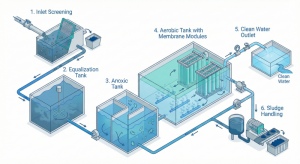
One of the best solutions for the Rungkut area is Membrane Bioreactor (MBR) technology. MBR combines biological treatment processes (activated sludge) with physical membrane filtration. Its main advantages are:
Clarifier Elimination: Does not require a space-consuming secondary sedimentation tank.
High Effluent Quality: The treated water is very clear and can often be recycled (water recycling) for non-process needs such as gardening or cooling tower makeup water.
High MLSS: Capable of operating at a much higher biomass concentration (MLSS) (8,000 – 12,000 mg/L) compared to conventional systems, so the reactor volume can be reduced by up to 50%.
The implementation of MBR in Rungkut is tangible proof of how Surabaya industrial wastewater treatment services can adapt to spatial constraints through technological innovation.
Shifting from Surabaya, the waste characteristics in satellite areas like Gresik and Sidoarjo demand different technical specifications. A “one size fits all” approach does not apply in wastewater engineering.
Gresik is dominated by heavy industry, petrochemicals, metal smelting, and supporting manufacturing. The resulting wastewater often contains heavy metals (such as Cr, Pb, Cu), high oil and grease, and extreme temperatures. Here, biological processes alone will not be enough.
We apply Physico-Chemical Treatment systems as a pretreatment stage before entering the biological unit. This process includes:
Coagulation & Flocculation: Using chemicals (such as PAC or Polymers) to bind colloidal particles and heavy metals into flocs that can be settled.
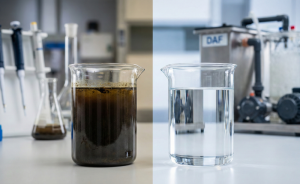
Dissolved Air Flotation (DAF): Highly effective for separating oil, grease, and light solids commonly found in palm oil or food processing industries in Gresik. With strong pretreatment, the toxic load (toxicity) on bacteria in the biological unit can be minimized, maintaining overall system stability.
Conversely, Sidoarjo has many food, beverage, and seafood processing industries. This type of waste has a very high organic load (BOD/COD) but is generally biodegradable. The challenge is the sudden load fluctuations (shock loading).
The solution we offer includes the use of Anaerobic Digester technology before entering the aerobic stage. The anaerobic process is not only able to efficiently reduce COD in high concentrations but also produces biogas that can potentially be utilized as alternative energy. This is the added value of a modern East Java STP (Sewage Treatment Plant) vendor; converting waste to energy.
Perfect technical aspects will be in vain if not supported by legal validity. In the era of the Online Single Submission Risk-Based Approach (OSS-RBA), the environmental permitting process has undergone a significant transformation. The Wastewater Discharge Permit (IPLC) is now integrated into the Wastewater Discharge Technical Approval (Pertek).
Many industrial players get trapped in bureaucracy because they lack an understanding of the technical flow of document preparation. The process begins with the preparation of a Technical Study Document containing the water balance, engineering design, and impact predictions. This document is submitted to obtain Technical Approval from the relevant agency (City/Regency or Provincial DLH, depending on the risk class).
After the Pertek is issued and the WWTP is built, the next crucial step is obtaining an Operational Adequacy Certificate (SLO). The SLO is issued after the WWTP facility is tested and proven to consistently meet quality standards. The Surabaya IPLC permit processing services we offer include end-to-end assistance:
Preparation of Technical Studies & UKL-UPL/AMDAL.
Construction supervision to ensure alignment with the approved design (as a condition for SLO).
Assistance during field verification by DLH officers.
Routine post-operation semi-annual reporting.
Ignoring small details in technical documents can cause files to be returned repeatedly, which means delays in your factory operations. Further information regarding national licensing regulations can be accessed through the Ministry of Environment and Forestry.
One of the most frequently asked questions by clients is: “How much investment is needed?” As professionals, we must convey that WWTP costs are highly variable (customized), but transparency in the cost structure is your right.
Capital cost or CAPEX is influenced by the flow rate (m³/day), inlet characteristics, and outlet targets. The main components include:
Civil Works: Construction of equalization basins, concrete aeration tanks, and operator houses. (Around 30-40% of the total cost).
Electromechanical Equipment: Blowers, submersible pumps, dosing pumps, mixers, and control panels. Using high-quality equipment (e.g., European or Japanese-made pumps) will increase initial costs but guarantee durability.
Bacterial Media & Filtration Material: Honeycomb, Bioball, or MBR membranes.
Pipe Installation & Instruments: Flow meters, pH sensors, and online DO meters.
Although the cost of building a wastewater treatment plant with modern technology (like MBR) looks higher initially compared to conventional systems, the smaller footprint (saving on expensive land prices in Surabaya) must be included in the Total Cost of Ownership calculation.
A cheap investment can become a trap if the operational costs (OPEX) swell. Electricity costs (power consumption) and chemicals are the biggest contributors to OPEX. PT Mizui Osmosa Teknovisa designs systems with energy efficiency as a priority:
Using Variable Frequency Drives (VFD) on blowers to adjust the oxygen supply according to the actual needs of the bacteria (based on DO sensors), rather than running 100% continuously.
Automating chemical dosing to prevent coagulant/flocculant waste.
Efficient sludge dewatering systems to reduce the volume of hazardous sludge that must be disposed of via third parties (which is very expensive per kilogram).
With this approach, the ROI (Return on Investment) of the WWTP system is not calculated from direct profit, but from water operational cost savings, prevention of environmental fines, and production stability without legal disruptions.
Managing industrial wastewater in Surabaya, Gresik, and Sidoarjo is not just about fulfilling legal obligations, but maintaining business sustainability amidst global competition and the spotlight on environmental issues. The complexity of East Java’s quality standard regulations and specific technical challenges in each industrial estate demand the presence of an expert and high-integrity partner.
PT Mizui Osmosa Teknovisa is ready to be your trusted partner, not only as a contractor but as a technical consultant providing holistic solutions—from design, and construction, to licensing. Don’t let waste problems hinder your company’s growth. Contact us today for an initial technical audit and in-depth consultation regarding your WWTP needs.
Butuh bantuan? Tim kami siap membantu.