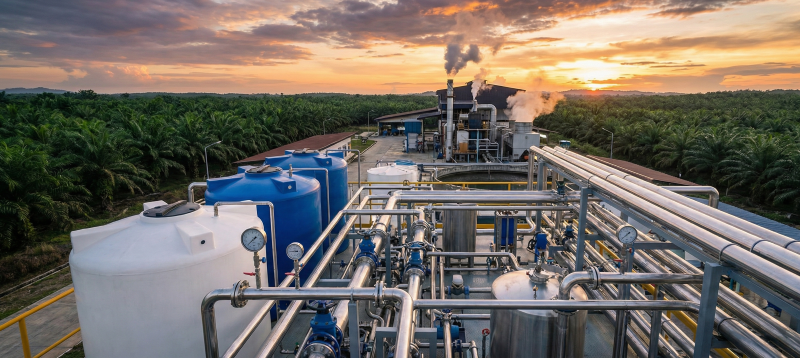
In the vegetable oil extraction industrial ecosystem, particularly in the Sumatra region which serves as the largest plantation center in Indonesia, water utility is the “blood” of factory operations. For Mill Managers and Factory Heads in the Medan, Riau, to Jambi regions, the biggest challenge is often not just the availability of Fresh Fruit Bunches (FFB), but the reliability of supporting utility systems. Sumatra palm oil mill water treatment becomes a fundamental key in ensuring the continuity of the sterilization process and power generation through steam turbines.
Without precise water management, Palm Oil Mills (POM) face the risk of unplanned downtime due to boiler damage or turbine efficiency decline. Given the highly fluctuating characteristics of surface water in Sumatra—ranging from low pH peat water to high turbidity river water—an advanced chemical engineering approach is highly necessary. PT Mizui Osmosa Teknovisa presents a deep understanding of ASME (American Society of Mechanical Engineers) standards to answer specific challenges in this region.
POM operational areas in North Sumatra, Riau, and Jambi generally take raw water from major rivers such as the Batanghari River, Siak River, or Kampar River. The hydrological characteristics of these rivers present unique challenges different from water sources on Java island.
First, extremely high turbidity levels, especially during the rainy season where Total Suspended Solids (TSS) increase drastically due to upstream erosion. Second, the presence of high organic content and color (tannin/lignin) in areas adjacent to peatlands. Third, and most crucial for thermal systems, is the content of colloidal or reactive silica (SiO2) which often escapes standard treatment.
If Batanghari/Siak River turbid water solutions are not handled correctly from the initial stage, these impurities will carry over into the Boiler Feed Water (BFW) phase, causing insulating scale that kills heat transfer efficiency.
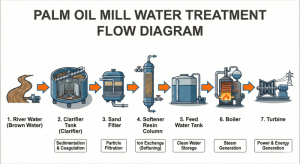
The most critical initial stage in the water treatment cycle is external treatment or pre-treatment. Many failures in boiler systems are rooted in the inability of Clarifier and Sand Filter systems to withstand suspended solid loads.
River water filtration systems for palm oil mills must be designed with adequate retention time in coagulation and flocculation basins. The use of chemicals such as Polyaluminium Chloride (PAC) and anionic/cationic polymers must be dosed based on daily Jar Tests, not just static routines. At PT Mizui Osmosa Teknovisa, we emphasize the importance of monitoring Silt Density Index (SDI) and turbidity (NTU) output from multimedia filtration units.
Technical Note: For medium pressure boilers (20-40 bar) commonly used in POMs, feed water turbidity should be maintained below 1 NTU. The escape of colloidal particles at this stage is a major precursor to sludge deposit formation in the boiler mud drum.
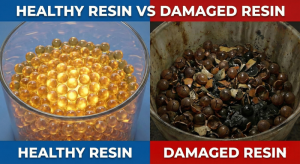
After passing the physical clarification stage, water must be free from hardness which is the main enemy of boiler pipes. This is where the role of the ion exchange unit becomes vital.
Once raw water is successfully clarified physically, the next challenge is water chemistry. POM boilers generally use shell and fiber fuel. Although this fuel is abundant, combustion efficiency will be in vain if boiler pipes are obstructed by scale. Scale just 1 mm thick can increase fuel consumption by 4-8%, or in the worst case, cause local overheating leading to pipe rupture (tube rupture).
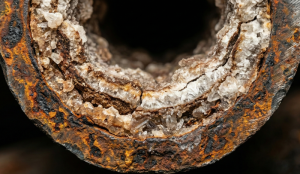
Among various types of scale, silica is the most dangerous and hardest to clean. Preventing silica scale on boilers is a top priority for Engineers in the Sumatra region, where groundwater and rivers are often rich in volcanic silica or dissolved silica from rock weathering.
Silica scale (SiO2) or complex silicates (such as Acmite or Analcite) have very low thermal conductivity, much lower than calcium carbonate scale (CaCO3). This means heat from the combustion chamber cannot be absorbed by water quickly, causing pipe metal to heat up beyond its metallurgical limits.
Mitigation strategies must be layered:
pH Control: Maintaining boiler water alkalinity at pH 10.5 – 11.5 helps keep silica soluble and prevents it from precipitating as glass.
Blowdown Management: Regulating Cycles of Concentration (COC) so that silica concentration in the boiler does not exceed its solubility limit (usually max 150 ppm as SiO2 at certain operating pressures).
Internal Treatment: Using modern synthetic dispersant polymers capable of dispersing silica and iron oxide particles to remain suspended and be removed via blowdown, instead of sticking to pipe surfaces.
Further references regarding silica limits and boiler water chemistry standards can be found in the ASME Section VII: Recommended Guidelines for the Care of Power Boilers guideline which serves as a global reference.
Water entering the boiler will turn into steam. This steam quality is directly proportional to boiler water quality. In the palm oil industry, steam is not only used to boil fruit (sterilizer) but also spins turbines to generate electricity.
Problems often occur when carryover takes place—where boiler water droplets containing dissolved solids are carried along with steam to the turbine. Water quality analysis for steam turbines becomes a critical parameter that must be monitored by Laboratory Assistants and Factory Heads.
Silica, once again, is the main antagonist here. At high pressure and temperature, silica can vaporize (volatilize) and be carried in the gas phase. When that steam passes through the turbine nozzle and undergoes pressure and temperature drops, silica will solidify again and stick to turbine blades.
Silica deposits on turbines are very hard and difficult to clean. Impacts include:
Unbalance: Causing high vibration that can damage turbine bearings.
Efficiency Drop: Changing blade aerodynamic profiles, so electrical energy generated per ton of steam decreases.
Corrosion: Salt deposits in blade crevices can trigger pitting corrosion during turbine shutdown.
For the palm oil industry, Steam Purity targets must be strictly maintained, with very low condensate steam Cation Conductivity. Good POM operational standards align with sustainability practices encouraged by GAPKI (Indonesian Palm Oil Association), where energy efficiency is part of sustainability pillars.
Although prevention systems are running, there are times when boilers experience performance decline due to annual deposit accumulation or upset conditions (e.g., condenser leaks or undetected softener failures). In these conditions, chemical cleaning action is the only way to restore efficiency to original levels.
Performing chemical cleaning on a boiler is not a casual job. It is a high-risk procedure involving the use of strong acids (such as inhibited Hydrochloric Acid) or strong bases, high temperatures, and chemical circulation in pressure vessels. Procedural errors can cause corrosion to the boiler base metal.
Therefore, professional Sumatra boiler chemical cleaning services are highly needed. PT Mizui Osmosa Teknovisa offers a systematic approach:
Deposit Analysis: Before cleaning begins, scale samples are taken for laboratory analysis. Is it dominant Carbonate? Silica? Or Iron Oxide? Deposit type determines the effective chemical solvent type.
Controlled Circulation: Using external circulation pumps with real-time pH and iron (Fe) concentration monitoring to know when the scale dissolution process is complete.
Passivation: Crucial final stage to form a protective layer (magnetite layer, Fe3O4) on the newly cleaned metal surface to prevent immediate re-rusting.
Waste Handling: Handling cleaning residue waste in accordance with environmental regulations, considering POM locations are often near water bodies.
This service covers a wide area ranging from Medan CPO industrial WTP services, to remote areas in Jambi and Bengkulu. Technical team response speed becomes our added value to minimize factory downtime.
Managing water utilities in a Palm Oil Mill is not just about clarifying turbid river water. It is about protecting billions of rupiah in asset investments—Boilers and Turbines—and ensuring Mill Throughput targets are achieved without interruption.
From upstream to downstream, starting from POM Boiler Feed Water treatment to turbine maintenance, every step requires chemical engineering precision. Water characteristics in Sumatra demand specific technology adaptation, not generic solutions.
PT Mizui Osmosa Teknovisa is committed to being a strategic partner for the palm oil and pulp & paper industries. With a combination of expertise in engineering design, consumables supply (resin, chemicals), and corrective maintenance services, we ensure your factory utilities operate at peak efficiency. Don’t let silica scale or poor feed water erode your factory’s profitability.
Butuh bantuan? Tim kami siap membantu.