The South Kalimantan region, with its extremely high annual rainfall (often exceeding 2,500 mm per year), presents unique hydrological challenges for the coal mining industry. In operational areas such as Tanah Bumbu, Tabalong, to Banjarbaru, run-off water management is not merely a regulatory obligation but a vital operational sustainability strategy. When rainwater reacts with overburden material containing sulfide minerals (such as pyrite, FeS2), Acid Mine Drainage (AMD) is formed. Without proper handling, pH parameters can plummet drastically below 3, accompanied by spikes in dissolved metals such as Manganese (Mn) and Iron (Fe).
In this context, South Kalimantan acid mine drainage treatment service becomes a fundamental need for every Chief Mine Technical Officer (KTT) and HSE manager oriented towards environmental compliance and operational cost efficiency. PT Mizui Osmosa Teknovisa is present with an integrated engineering approach, understanding that mine wastewater management in South Kalimantan cannot be solved merely by manually pouring lime, but requires a precise fluid management system.
This article will dissect the technical aspects of pH neutralization methods, physical settling pond designs, to strict regulations applicable in South Kalimantan Province.
As an operational foundation, every mining site in Indonesia must adhere to a strict legal hierarchy. Compliance with coal mining environmental quality standards regulation is an absolute requirement to avoid administrative sanctions, permit freezing, to environmental criminal charges.
Nationally, we refer to the Decree of the State Minister of Environment No. 113 of 2003 concerning Wastewater Quality Standards for Coal Mining Businesses and or Activities, as well as the Minister of Environment Regulation No. 5 of 2014. These standards establish key parameters mandatory for daily monitoring, namely pH (6-9), Total Suspended Solids (TSS < 400 mg/L), Iron (Fe < 7 mg/L), and Manganese (Mn < 4 mg/L).
However, challenges for industry players in South Kalimantan do not stop there. Regional autonomy grants authority to the provincial government to set stricter standards to protect swamp ecosystems and major rivers like the Barito River and Martapura River.
The South Kalimantan Provincial Government has specific regulations that often become a “trap” for companies solely referring to national rules without considering the local context. Referring to the South Kalimantan Governor regulation on liquid waste (such as South Kalimantan Governor Regulation No. 04 of 2007 and its updates), there is significant emphasis on pollution load control.
The South Kalimantan Provincial Environment Agency (DLH) is very strict in monitoring compliance points at Settling Pond outlets. In field inspections frequently conducted in mining areas around Banjarbaru and Tanah Laut, the TSS parameter is often the main highlight. Extreme rainfall in South Kalimantan can cause massive erosion in stockpile and waste dump areas, instantaneously increasing water turbidity. Therefore, the treatment system must not only focus on pH but also be capable of drastically reducing suspended solids before water is released into receiving water bodies.
For PT Mizui Osmosa Teknovisa, deep understanding of these local regulations is a value-added. We ensure the WWTP (IPAL) designs we offer not only “pass” paper tests but are resilient facing field audits and PROPER assessments (Company Performance Rating Program in Environmental Management).
Regulation Reference: Coal Wastewater Quality Standards – KLHK
Moving to the technical engineering aspect, coal mine wastewater handling requires adequate infrastructure. Mining wastewater treatment installation or often called mining Water Treatment Plant (WTP), must be designed based on maximum water discharge (Q max) calculated from return period rainfall of 10 to 25 years.
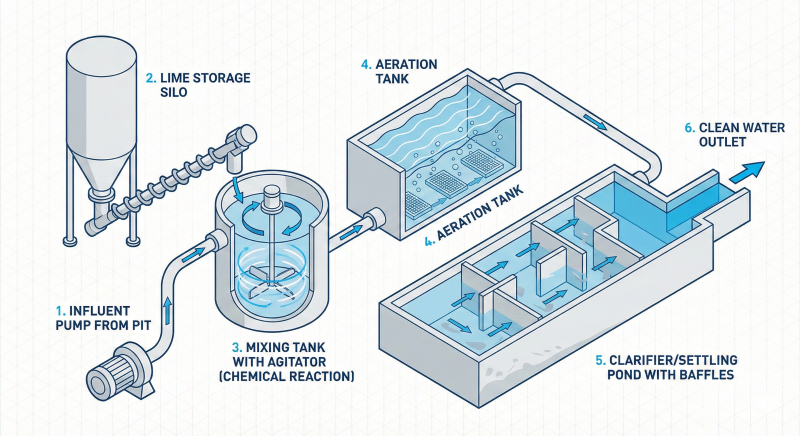
In South Kalimantan, where rain can fall with high intensity for hours, manual systems (pouring sacks of lime into ponds) are no longer relevant and carry high risks of human error. PT Mizui Osmosa Teknovisa recommends an automated Active Treatment system. This system generally consists of an inlet unit, neutralization unit (chemical reactor), flocculation unit (if needed), and sedimentation unit.
The key to this installation is precise pH control. An automatic dosing system equipped with online pH meter sensors and dosing pumps will regulate chemical injection according to incoming water acidity fluctuations. If inlet pH drops drastically due to acid water flush from old waste dumps, sensors will command pumps or screw feeders to increase alkali dosage in real-time.
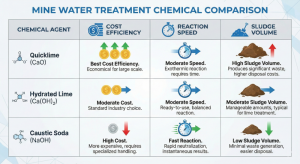
In acid mine drainage chemical engineering, reagent selection is a strategic decision affecting OPEX (Operational Expenditure). There are several options for chemicals to raise mine water pH commonly used, but each has different reaction kinetics characteristics:
Caustic Soda (NaOH):
Pros: Very fast reaction, high solubility, does not produce much additional sludge.
Cons: Very expensive per unit cost, handling hazards (highly corrosive), and risk of pH overshoot (pH rising too high quickly).
Application: Usually only for polishing or emergency situations where instant pH increase is needed.
Soda Ash (Na2CO3):
Pros: Safer to handle than NaOH.
Cons: Less effective for precipitating heavy metals, medium cost.
Hydrated Lime (Ca(OH)2):
Pros: Most cost-effective, very effective in precipitating heavy metals, abundantly available.
Cons: Produces large volumes of gypsum sludge (CaSO4 · 2H2O), low solubility requiring strong mechanical mixing.
In the South Kalimantan region, lime logistics availability is quite adequate. However, the main challenge is maintaining lime quality to remain reactive when used.
The option most frequently recommended by us for large-scale operations in South Kalimantan is the use of quicklime for neutralization. Quicklime (CaO) has a higher neutralization density compared to hydrated lime. This means, for the same weight, CaO is capable of neutralizing more acid than Ca(OH)2.
Stoichiometrically, the reaction is exothermic (produces heat) when CaO meets water to form calcium hydroxide: CaO + H2O → Ca(OH)2 + Heat Then, this Ca(OH)2 reacts with sulfuric acid in mine water: Ca(OH)2 + H2SO4 → CaSO4 + 2H2O Additionally, hydroxide ions (OH–) will react with dissolved metal ions (such as Iron) to form stable metal hydroxide precipitates: Fe3+ + 3OH– → Fe(OH)3 (precipitate)
Using quicklime requires a slaker unit at the installation site. PT Mizui Osmosa Teknovisa designs closed silo systems to store CaO preventing reaction with South Kalimantan’s humid tropical air before use. From the silo, quicklime is fed into a mixing tank to become slurry (lime slurry) before injection into ditches or mixing ponds. This method proves most efficient in lowering chemical costs per cubic meter of treated water.
After the chemical process is complete, the next challenge is separating solids from water. Lime neutralization reaction produces gypsum and metal hydroxide precipitates. Added to this are clay particles and fine coal carried by erosion. Without good physical separation, TSS will remain high even though pH is neutral.
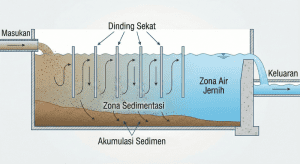
Many South Kalimantan mining environmental contractors fail to understand pond hydrodynamics, causing settling ponds to function sub-optimally. Mining mud settling pond design must account for Stokes’ Law, stating that particle settling velocity (Vs) is directly proportional to the square of particle diameter and density difference.
Vs = g(ρp – ρf)d2) / 18µ
Where:
g = gravitational acceleration
ρp = particle density
ρf = fluid density
d = particle diameter
µ = fluid viscosity
To maximize settling in mining areas with clay soil like in Tabalong, pond design must meet the following criteria:
Sufficient Retention Time: Water residence time inside the pond must be longer than the time needed for particles to settle to the bottom. If incoming water discharge is too fast (due to heavy rain), turbulence will occur and sediment at the bottom can be stirred up again (resuspension). We recommend double compartment or terraced designs to break water flow energy.
Zig-Zag Design (Baffle): To prevent short-circuiting (water entering and exiting directly without spreading throughout the pond), installing partitions or baffles is highly recommended. This forces water to travel a longer path, giving more time for TSS particles to descend.
Maintenance Zone (Dredging): A good settling pond must have access for excavators or sludge pumps to perform routine maintenance. Allowed sludge accumulation will reduce effective pond volume, drastically reducing water residence time.
PT Mizui Osmosa Teknovisa uses hydrological modeling to determine optimal pond dimensions, ensuring that even during peak rainfall in December-January, the pond outlet continues to meet quality standards.
Authority Reference: South Kalimantan Provincial Environment Agency
Active methods (chemical dosing) are very effective for operation/production phases where monitoring is conducted daily. However, what about remote areas rarely monitored or preparation towards mine closure? Active method operational costs will become a perpetual cost.
This is where the role of passive acid mine drainage treatment technology lies. This method utilizes natural processes—biological and geochemical—to treat acid water without continuous chemical dosing or electricity supply.
Some passive methods applicable in the tropical climate of Kalimantan include:
Constructed Wetland: Using aquatic plants (like Typha or Phragmites) and organic substrates to filter heavy metals and slowly raise pH. Plant roots provide an environment for sulfate-reducing bacteria to work.
SAPS (Successive Alkalinity Producing Systems): Combining limestone drainage with organic compost layers. Acid water flows vertically down through compost (to remove oxygen and reduce iron) then through limestone (to add alkalinity).
Open Limestone Channel: Lining long drainage channels with coarse limestone. Although less efficient than active methods due to armoring (limestone coated with iron crust), this is a good supporting method to reduce acidity load before entering the main pond.
PT Mizui Osmosa Teknovisa often recommends a hybrid approach: using Active Treatment to handle high loads during operations, while building and maturing Passive Treatment systems for post-mining preparation.
Managing acid mine drainage in South Kalimantan is a battle against pyrite chemistry and intense tropical rainfall. Errors in settling pond design or chemical selection not only impact swelling costs but also company reputation risks in the eyes of government and society.
From the discussion above, it is evident that acid water pH neutralization systems require integration between regulatory understanding, precise chemical engineering, and mature civil hydrology design. There is no single solution suitable for all locations; rock characteristics in Satui might differ from those in Tanjung.
PT Mizui Osmosa Teknovisa is ready to act as your strategic partner. We do not just sell chemicals or equipment; we provide turn-key solutions starting from water quality audits, WWTP design, automatic dosing system installation, to technical assistance for PROPER achievement.
For Chief Mine Technical Officers and Environmental Managers facing persistent issues with wastewater quality standards, it is time to switch to a more scientific and measurable approach. Contact our expert team for in-depth technical consultation regarding your mine water management needs.
Butuh bantuan? Tim kami siap membantu.