As a fellow practitioner in the world of wastewater treatment, I understand the pressure you face every day in the field. When COD (Chemical Oxygen Demand) and BOD (Biological Oxygen Demand) parameters spike beyond regulatory standards, or when pungent odors trigger protests from local residents, the WWTP (Wastewater Treatment Plant) operator is the first person sought for answers. Often, the root of the problem lies not in your blowers or pumps, but in the “invisible workers” within your biological tanks. Wastewater degrading bacteria are the heart of the secondary treatment system, and when they become “sick” or die off, your entire system becomes paralyzed.
At PT Mizui Osmosa Teknovasi, we don’t just sell products; we provide solutions based on environmental microbiology science. I have written this article specifically for you—WWTP managers in the food, textile, hospital, and industrial estate sectors—who are struggling to stabilize the performance of your biological systems. Let’s take an in-depth look at how these microorganisms work, why they fail, and how the right biological intervention (bio-augmentation) can save your WWTP from an operational crisis.
A biological WWTP system, whether it is activated sludge, aerated lagoons, or anaerobic reactors, is essentially a massive microbial “farm.” Like any other living creature, the bacteria in your ponds require specific environmental conditions to live and work optimally. When these conditions are drastically disturbed, a mass biological death occurs, triggering a domino effect of problems.
The most common and distressing indicator of biological system failure is odor. However, as engineers, we must understand the type of smell to diagnose the problem.
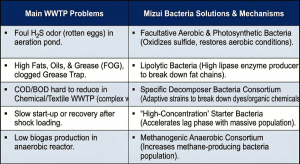
If an aeration pond (which should be aerobic/oxygen-rich) emits a foul smell like rotten eggs (H2S) or a sharp septic odor, it is a danger sign that anaerobic conditions are occurring where they shouldn’t. Metabolically, this happens because the Dissolved Oxygen (DO) supply is insufficient to meet the needs of aerobic bacteria in decomposing the incoming organic load. Consequently, aerobic bacteria die or become dormant, and facultative anaerobic bacteria take over, producing foul-smelling gas byproducts through incomplete fermentation.
Simultaneously, the death of aerobic bacteria means the oxidation of organic matter stops. This is why COD and BOD levels in your effluent (outlet) remain high and refuse to drop. Organic pollutants that should have been “eaten” by the bacteria instead escape the system.
One of the greatest enemies of biological stability in industrial WWTPs is extreme fluctuations in waste load, known as shock loading. This can be a sudden spike in wastewater flow or the entry of waste with pollutant concentrations far higher than the original design.
In technical terms, this disrupts the F/M Ratio (Food-to-Microorganism Ratio). Imagine suddenly feeding 100 portions to 10 workers; they won’t be able to finish it (leftover food = high COD at the outlet). Worse, if that shock loading contains toxic substances such as heavy metals, high doses of disinfectants, or extreme pH levels, it will kill the bacterial population within hours.
Overcoming WWTP shock loading isn’t as simple as waiting for the system to recover naturally. Indigenous (natural) bacterial populations often lack the resilience or the specific enzymes needed to degrade such sudden surges. This is where external intervention is required to restore the balance of your microscopic ecosystem.
To operate a WWTP successfully, you must “think” like a bacterium. Choosing the right WWTP bacterial seeds depends heavily on the design of your treatment unit. A fatal mistake often made is adding the wrong type of bacteria to the wrong tank.
Aerobic bacteria are the primary workhorses in most conventional WWTPs. They live in aeration ponds and form what we call Activated Sludge. The key to their survival is Dissolved Oxygen (DO).
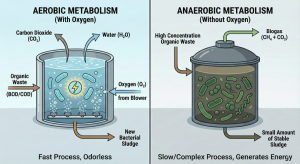
Simply put, aerobic bacteria use free oxygen in the water to “burn” (oxidize) organic matter (their food) into energy for growth and reproduction. The end products of this process are very environmentally friendly: Carbon Dioxide (CO2), Water (H2O), and new bacterial cells (sludge).
Key Characteristics: Requires a constant air supply from blowers (ideally 2.0 mg/L DO).
Applications: Aeration Tanks, Oxidation Ditches, SBR (Sequencing Batch Reactor) aeration phase.
Advantages: Very fast decomposition process; no foul odors if oxygen is sufficient.
Conversely, waste-degrading microbes of the anaerobic type work in environments completely devoid of oxygen. This process is much more complex and involves a consortium (collaboration) of various types of bacteria in several stages (hydrolysis, acidogenesis, acetogenesis, and methanogenesis).
Because they do not use oxygen as the final electron acceptor, anaerobic bacteria perform fermentation. The end products are methane gas (CH4) and carbon dioxide—known as biogas—and a small amount of sludge.
Key Characteristics: Must be in airtight, closed tanks. Highly sensitive to the presence of oxygen and changes in pH/temperature.
Applications: Equalization Tanks (initial anaerobic processes often occur here), UASB (Upflow Anaerobic Sludge Blanket), Sludge Digesters, Septic Tanks.
Advantages: Capable of handling very high COD loads (thousands to tens of thousands of mg/L) and generating energy (biogas).
Many operators ask me, “Sir, aren’t there already natural bacteria in sewage or factory waste? Why do I need to buy WWTP starter bacteria?”
It’s a good question. The answer is: Specialization and Concentration.
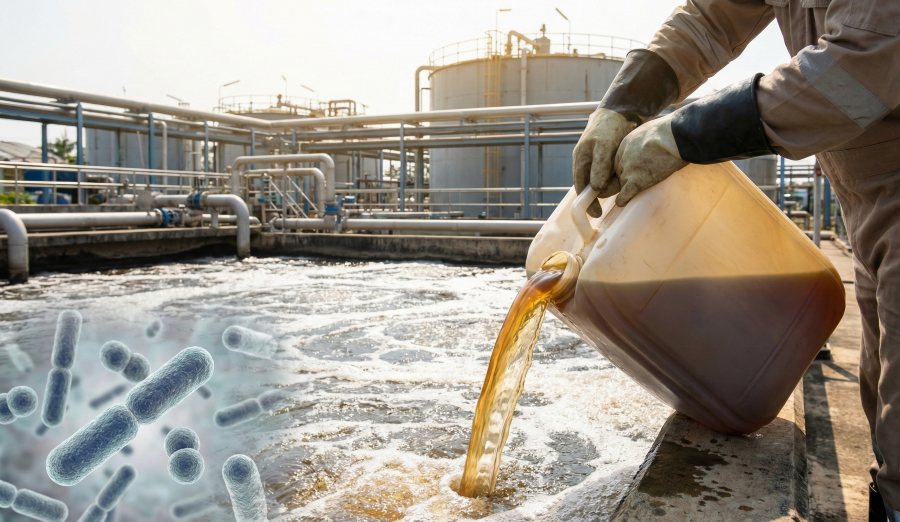
Natural bacteria carried in the waste stream are often insufficient in number (low concentration) or are not the right type to rapidly degrade your specific industrial pollutants. Bio-augmentation is the process of adding selected, specialized bacterial strains in very high concentrations to enhance the performance of the existing system.
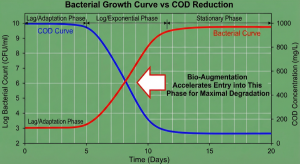
For new WWTPs or those that have just been completely drained, building a bacterial population from scratch (the seeding process) naturally can take 4 to 8 weeks to reach a steady state. During this period, your effluent will almost certainly fail to meet regulatory standards.
By using high-concentration bio-starter products, you introduce trillions of “ready-to-work” microbes into the system. This significantly cuts down the adaptation phase (lag phase). Our field experience proves that using quality starter bacteria can accelerate the biological commissioning period to just 2-3 weeks.
One of the most stubborn problems in the food industry, restaurants, and hotels is FOG (Fats, Oils, and Grease). Regular bacteria often struggle to break down the complex carbon chains of fats. Undegraded grease will coat the Activated Sludge, inhibiting oxygen transfer, causing bulking (floating sludge), and clogging pipes and pumps.
For these cases, you need specialized grease-degrading microorganisms. These bacteria (usually from specific Bacillus or Pseudomonas genera) produce large amounts of extracellular lipase enzymes. These enzymes act like “chemical scissors,” cutting large fat molecules into simpler fatty acids and glycerol, which are then easily digested by other bacteria. Regular application of these lipolytic bacteria in Grease Traps or equalization tanks is proven to be highly effective in preventing clogs and reducing the organic load in downstream units.
Buying the best aerobic and anaerobic bacteria will be useless if the application method is wrong. Bacteria are living organisms, not chemicals that can just be poured in. The success of bio-augmentation depends heavily on preparation and environmental conditions.
Just as humans need carbohydrates, protein, and vitamins, bacteria need macronutrients to grow and reproduce. Carbon (C) is usually abundantly available from the organic waste itself (the COD/BOD source). However, industrial waste often lacks Nitrogen (N) and Phosphorus (P).
A deficiency in N and P will inhibit bacterial growth even if carbon is plentiful, leading to poor sludge formation (such as filamentous bulking sludge that is difficult to settle).
As a rule of thumb, the ideal C:N:P ratio is:
Aerobic Process: 100 : 5 : 1 (For every 100 kg of BOD to be removed, 5 kg of N and 1 kg of P are required).
Anaerobic Process: 250 : 5 : 1 (Nutrient requirements are lower due to slower cell growth).
To meet these needs, the addition of waste bacteria nutrients (urea/DAP) is often necessary. Urea is a cheap source of Nitrogen, while DAP (Diammonium Phosphate) is a source of both Phosphorus and Nitrogen. The correct dosage must be calculated based on the daily BOD load entering your WWTP.
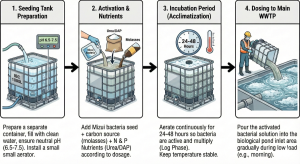
This is the most common mistake made by operators. Pouring probiotic bacteria that have just woken up from their dormant state (in packaging) directly into a WWTP pond full of harsh waste is a recipe for failure. The bacteria will experience “shock” due to differences in temperature, pH, and toxic concentrations, causing mass death before they even have a chance to work.
The correct WWTP bacterial seeding process requires an acclimatization or adaptation stage. This is the process of gradually habituating the bacteria to your waste environment in a separate tank before releasing them into the main pond.
PT Mizui Osmosa Teknovasi understands that every industry has unique waste characteristics. Therefore, we do not offer a “one-size-fits-all” approach. We sell aerobic and anaerobic bacteria specifically formulated with strains relevant to your challenges.
Our products contain a microbial consortium in liquid or powder form with very high concentrations, reaching billions of Colony Forming Units per milliliter (CFU/ml).
Strain Superiority: We use naturally selected (non-GMO) bacterial strains that have high adaptability to extreme environments and produce specific enzymes (amylase, protease, lipase, cellulase) to degrade various types of complex organic pollutants.
Stability: Our products are formulated to have a long shelf life in a dormant state and reactivate quickly during the acclimatization process.
Determining the correct bacterial and nutrient dosage can be confusing. Too small a dose will be ineffective, while an excessive dose is a waste of money.
As part of our service commitment, PT Mizui Osmosa Teknovasi provides free technical consultations to help you determine the right bio-augmentation strategy. Our team of engineers will analyze your WWTP design data (flow rate, tank volume, inlet COD/BOD characteristics) to recommend:
The most suitable bacterial product type.
Calculation of initial dosage (seeding) and maintenance dosage.
Calculation of additional nutrient requirements (Urea/DAP).
Here is a quick summary of common problems and the bacterial solutions we offer:
Managing a WWTP without paying attention to the health of the bacteria inside is like running a factory without caring for the welfare of its workers. Problems will recur, operational costs will swell, and the risk of environmental sanctions will loom.
Using quality wastewater degrading bacteria from PT Mizui Osmosa Teknovasi is a smart investment to ensure the operational stability of your WWTP. With the right bio-augmentation approach, you can transform a problematic, smelly, and inefficient WWTP into a robust, clean, and regulatory-compliant treatment system.
Don’t let your WWTP biological issues linger. Contact the expert team at PT Mizui Osmosa Teknovasi today to discuss microbiology solutions tailored to your industrial needs.
Scientific References:
Butuh bantuan? Tim kami siap membantu.