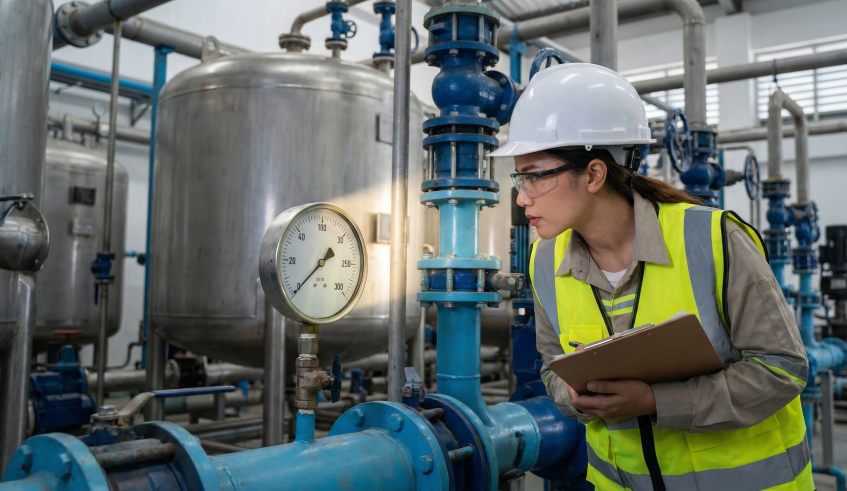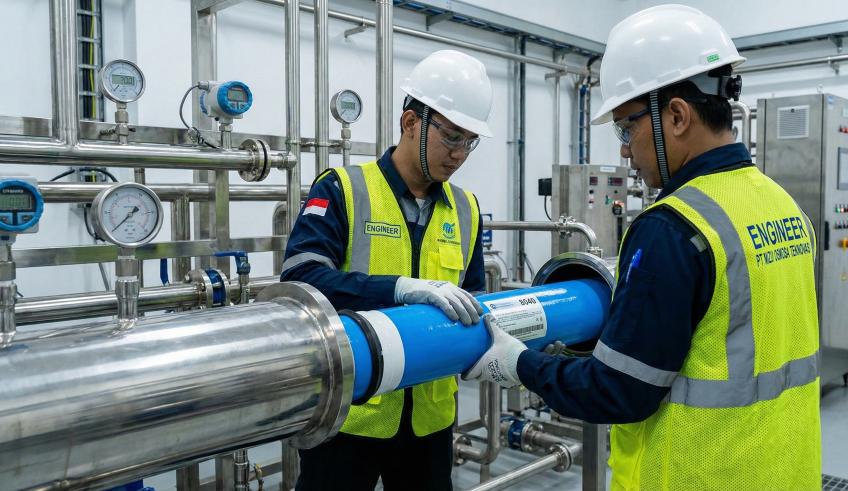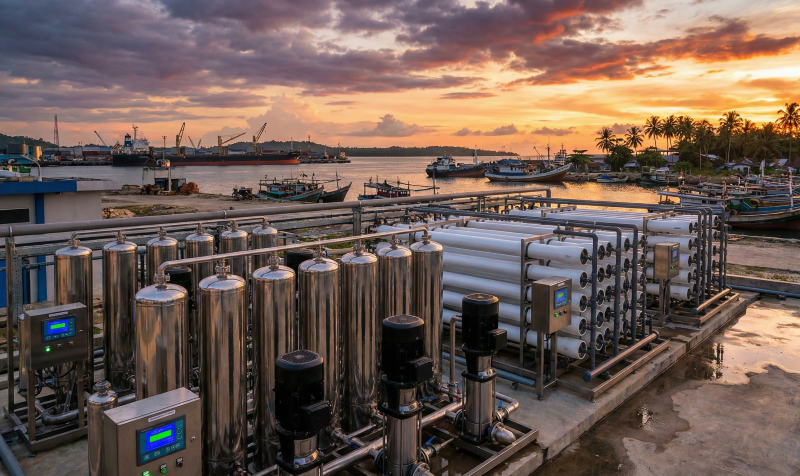
Water quality is the lifeblood of industrial continuity in coastal areas like North Kalimantan. For players in the fishery industry, seafood processing (cold storage), and the mining sector in this region, accessing stable fresh water is often the biggest challenge. High seawater intrusion into soil aquifers renders well water brackish, corrosive, and unfit for use. As a proven technical solution, Tarakan reverse osmosis installation service is here to answer that challenge with the latest membrane technology capable of efficiently separating salt content from raw water.
PT Mizui Osmosa Teknovisa understands that in Tarakan, water is not just a utility, but a production asset. Relying on tank water from the local water utility (PDAM) or outside suppliers often significantly burdens operational costs (OPEX). Therefore, the transition toward water independence through the installation of a Brackish Water Reverse Osmosis (BWRO) system is a strategic step. This article will thoroughly dissect the technical aspects of how this technology works, why brackish water damages your multi-billion rupiah assets, and how we implement precision engineering standards to turn salty water into pure fresh water (permeate) that meets industrial standards.
Tarakan and the coastal areas of North Kalimantan have unique hydrogeological characteristics. As an island surrounded by the sea, the balance between fresh groundwater and seawater is very fragile. Excessive exploitation of groundwater often leads to seawater intrusion, where saltwater seeps into freshwater aquifer layers. Consequently, the water you pump to the surface has a high Total Dissolved Solids (TDS) level, often ranging between 1,500 to 10,000 ppm (parts per million).
For industry, this condition is not just a matter of salty taste. It is a serious technical threat. Brackish water contains high concentrations of chloride, sulfate, calcium, and magnesium ions. When this water is used for industrial processes without adequate treatment, the domino effect is devastating.
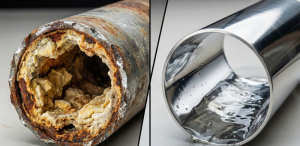
The biggest technical problems faced by our clients in the Cold Storage and shipping sectors are corrosion and scaling. Let’s break this down from an engineering perspective:
Corrosion in Piping Systems and Condensers: High chloride levels in brackish water accelerate the oxidation rate of metals. Carbon steel pipes, weld joints, and heat exchangers in cooling systems will experience pitting corrosion which can cause fatal leaks in a short time. Maintenance and downtime costs due to pipe replacement are far more expensive than the initial investment in water treatment.
Scaling in Boilers and Cooling Towers: High calcium and magnesium content (hardness) in brackish well water will precipitate when heated or subjected to evaporation. In boilers, this scale acts as a heat insulator, drastically lowering thermal efficiency, and can even trigger explosions due to local overheating on fire tube walls.
Declining Fishery Product Quality: For the export shrimp or fish processing industry in Tarakan, washing products with water containing bacteria or heavy metals from brackish water is a huge risk. Furthermore, making block ice or flake ice using brackish water will produce ice that is “mushy,” melts quickly, and has suboptimal freezing points, thus failing to maintain fish freshness for long durations.
Therefore, the need to install a Tarakan brackish water RO machine is no longer just an option, but a crucial necessity to protect machine assets and keep your end-product quality competitive in the global market.
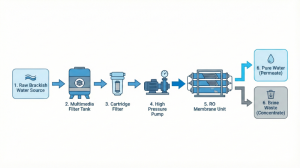
Unlike conventional filtration such as Sand Filters or Carbon Filters which are only capable of filtering suspended particles (mud, sand, odor), Reverse Osmosis (RO) technology works at the molecular level.
Simply put, Reverse Osmosis (RO) is the process of forcing a solvent (water) from a high-concentration solution (brackish water) to a low-concentration solution (fresh water) through a semi-permeable membrane by applying osmotic pressure that is greater than the natural osmotic pressure.
In the industrial context in Tarakan, PT Mizui Osmosa Teknovisa applies a BWRO (Brackish Water Reverse Osmosis) system specifically designed to handle TDS up to 15,000 ppm. This system consists of several critical stages:
Pre-Treatment: A vital stage to protect the RO membrane. This involves multimedia filtration to remove macro particles, chemical injection (such as chlorination or coagulants), and activated carbon to remove chlorine residues that can damage the membrane.
High-Pressure Pump: The heart of the RO system. This pump provides pressure (usually between 150 to 300 PSI for brackish water) to “push” water molecules through the extremely small pores of the membrane (0.0001 microns).
Membrane Assembly: This is where the separation happens. Fresh water (permeate) passes through, while salt, bacteria, viruses, and dissolved minerals (concentrate/reject) are retained and discarded.
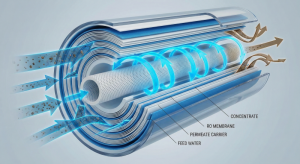
One of the key parameters in the success of this system is real-time TDS monitoring. An industrial standard water TDS meter must be installed on your RO system control panel. This device measures the electrical conductivity of water, which is directly proportional to the amount of dissolved solids.
Feed Water: In Tarakan, well water TDS often reads at 3,000 – 5,000 ppm.
Permeate (Product Water): After passing through the RO installation from PT Mizui Osmosa Teknovisa, the target TDS can be reduced to below 50 ppm, or even approaching 0-10 ppm depending on needs (for example, for boiler feed water requiring ultrapure water).
The technical advantage of our system lies in the selection of membrane types. We do not use generic membranes. We select Thin Film Composite (TFC) membranes that have a salt rejection rate of up to 99.7%. This ensures that even if fluctuations in salinity occur due to tides in Tarakan, your production water output remains stable and fresh.
However, using advanced membranes without monitoring is futile. This is why we integrate digital flow meter sensors and pressure gauges at every stage to monitor flux (flow rate) performance and detect early signs of clogging (fouling).
Many North Kalimantan (Kaltara) Brackish Water RO vendors fail to deliver maximum results because they ignore the Pre-treatment stage. Often, clients come to us with complaints: “I already installed RO, but the membrane clogged in just a month.”
The main problem is not the RO machine itself, but how to overcome salty/brackish well water before it enters the membrane. Groundwater in Kalimantan often contains high levels of iron (Fe), manganese (Mn), and organic matter (peat). If this water is shot directly into the RO membrane:
Iron will oxidize and permanently clog membrane pores.
Organic matter will become food for bacteria (biofouling) on the membrane surface.
PT Mizui Osmosa Teknovisa applies a multi-barrier approach. Before water touches the RO membrane, it goes through a series of Pre-treatments calculated based on the client’s raw water lab test results:
Manganese Greensand Filter: Specifically to lower iron and manganese levels that often cause water to turn yellow.
Antiscalant Dosing System: Injection of special chemicals (food grade) that prevent calcium and magnesium ions from crystallizing into limescale inside the membrane. This is far more efficient and space-saving than using a Water Softener resin for large industrial capacities.
Micron Cartridge Filter (Security Filter): The final fortress with a density of 1-5 microns to ensure no dust particles, no matter how small, escape into the high-pressure pump.
Without pre-treatment that is custom-designed according to the water conditions at your location (for example in Juata Laut or port areas), your RO machine investment will be short-lived. We do not sell “off-the-shelf packages” blindly; we sell engineering solutions based on your water quality data.
Important: Clean Water Quality Standards (Permenkes RI) require a maximum TDS of 1000 mg/l for hygiene sanitation purposes. However, for specific industrial needs like boilers, the figure must be much lower.
Another challenge in coastal Kalimantan is the high level of turbidity and Silt Density Index (SDI). Water that looks clear does not necessarily have a low SDI value. Extremely fine colloidal particles can pass through ordinary sand filters but will destroy RO membrane performance.
For raw water conditions that have high biological or organic fouling (clogging) potential, PT Mizui Osmosa Teknovisa recommends the use of Anti-Fouling RO Membranes for turbid water.
This Low Fouling or Fouling Resistant membrane technology features a surface that is chemically modified to have a more neutral charge and be more hydrophilic (water-loving). This makes it difficult for dirt, bacteria, and organic matter to adhere to the membrane surface.
Advantages of using Anti-Fouling Membranes in our installation:
Less Frequent CIP (Clean-in-Place): You don’t need to stop production too often to wash membranes with chemicals.
Longer Membrane Lifespan: Standard membranes might last 1-2 years in extreme conditions, while anti-fouling membranes can last 3-4 years with proper maintenance.
Energy Savings: Because the membrane doesn’t clog quickly, the required pump pressure remains stably low, so the electricity consumption of the High-Pressure pump does not spike.
We also equip the system with an Auto-Flushing feature. Every time the machine stops or starts, the system will automatically rinse the membranes with high-velocity fresh water to sweep away dirt adhering to the membrane surface, keeping performance prime every day.
Choosing a contractor for shrimp/fish Cold Storage clean water filters or mining camp clean water needs in Tarakan requires caution. Many service providers are just “tool sellers,” not “technical experts.” PT Mizui Osmosa Teknovisa positions itself as your engineering partner. Here are the reasons why major industries in Indonesia entrust their water treatment needs to us:
1. Data-Based Design (Engineering Design) We don’t guess. Our process begins with water sampling and complete laboratory analysis. From that data, our engineering team uses projection simulation software (such as ROSA or WAVE) to design the system. We can predict product water quality, chemical needs, and energy consumption even before a single bolt is installed.
2. Industrial Quality Material (Heavy Duty) For corrosive environments like coastal Tarakan, we do not use ordinary painted iron frames. We use Skid Frames made of Stainless Steel 304 or SS316 (for seawater applications) that are rust-resistant. High-pressure piping uses Stainless Steel Schedule 40 or hydraulic standard high-pressure flexible hoses, ensuring the safety of your operators.
3. After-Sales Service & Spare Part Availability We understand that in Tarakan, waiting for spare parts to arrive from Jakarta for weeks means production loss. PT Mizui Osmosa Teknovisa guarantees the availability of consumables (filter cartridges, antiscalant, membrane cleaning chemicals) and technical support. We also provide intensive training to your local operators so they can operate and perform basic maintenance independently.
4. Capacity Flexibility Do you need a small unit with a capacity of 2,000 liters per day for employee mess needs, or a giant plant with a capacity of 50,000 liters per hour for factory process needs? We have experience in Engineering, Procurement, and Construction (EPC) for various capacity scales according to specific needs and land availability (footprint) at your location.
Many business owners hesitate because the initial investment in an RO machine feels expensive. However, let’s calculate rationally.
If you buy fresh water from barges or tank trucks in Tarakan, the cost per cubic meter (1000 liters) can be very volatile and expensive, not to mention the risk of delivery delays during bad weather.
With an independent RO installation:
Electricity Cost: Around Rp 3,000 – Rp 5,000 per m³ of product water (depending on pump efficiency).
Consumables Cost (Chemicals & Filters): Around Rp 1,000 – Rp 2,000 per m³.
Total Production Cost: Estimated Rp 4,000 – Rp 7,000 per m³.
Compare this with the price of buying industrial water which can reach tens of thousands of rupiah per cubic meter. Return on Investment (ROI) or break-even for industrial-scale RO installation is usually achieved within just 8 to 18 months. After that, you enjoy significant efficiency gains for years. Additionally, you have full control over the quality and quantity of your water supply, free from third-party dependence.
For further reference regarding desalination technology and energy efficiency, you can read international technical journals on Desalination and Water Treatment.
Water quality is the foundation of product quality. Don’t let brackish water erode your business profit and reputation. In the midst of increasingly fierce competition in the fishery and mining industries in North Kalimantan, operational efficiency is the key to victory.
Tarakan reverse osmosis installation service from PT Mizui Osmosa Teknovisa offers more than just water filtering machines. We offer certainty. Certainty that your boilers are scale-free, certainty that your ice for fish is hygienic, and certainty that water is no longer a problem in your production chain.
Are you ready to turn problematic brackish well water sources into valuable clean water assets?
Consult your Water Treatment needs today. Our expert team is ready to conduct a site survey and water sampling in the Tarakan area and its surroundings to provide the most efficient technical proposal for your company.
PT Mizui Osmosa Teknovisa – Leading Water Engineering Solution for Indonesian Industry.
Butuh bantuan? Tim kami siap membantu.