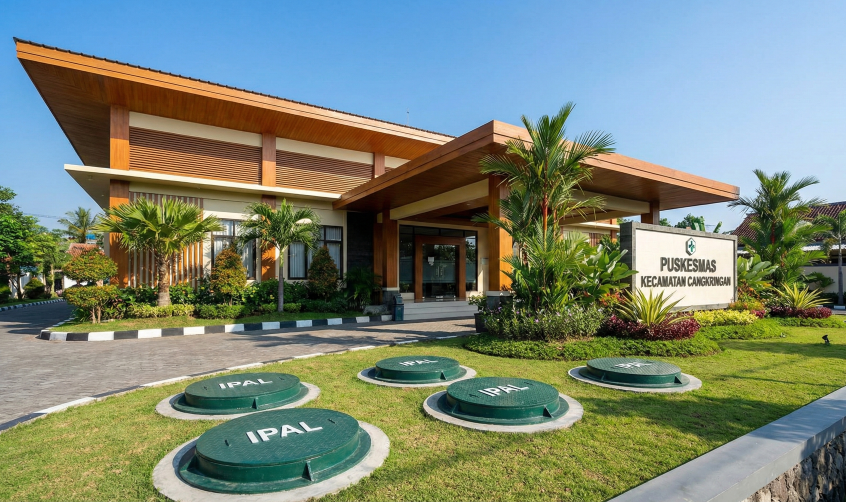
Public Health Centers (Puskesmas) play a vital role as the frontline of healthcare services in Indonesia. Along with the elevation of Puskesmas status to a Regional Public Service Agency (BLUD) and the presence of Inpatient facilities, the volume of wastewater generated has also increased significantly. This liquid medical waste contains pathogens, chemicals, and organic pollutants that must be treated before being discharged into receiving water bodies. In the context of sanitation infrastructure planning, the selection of public health center biofilter WWTP technology becomes a strategic decision that must be taken by the Commitment Making Officer (PPK) and the Head of the Puskesmas to ensure compliance with environmental quality standards.
This article will thoroughly explore why the anaerobic-aerobic biofilter system is considered the most rational and efficient solution for the characteristics of domestic and medical waste in first-level Health Care Facilities (Fasyankes).
The Urgency of Waste Treatment in First-Level Health Facilities (FKTP)
Wastewater management in FKTP is not merely a fulfillment of administrative obligations, but rather a fortress of defense for public health around the facility. Referring to the Regulation of the Minister of Environment and Forestry Number 68 of 2016 concerning Domestic Wastewater Quality Standards as well as derivative regulations related to Fasyankes waste, every drop of wastewater from medical, laboratory, and domestic activities (patient/staff bathrooms) must meet strict parameters for pH, BOD, COD, TSS, Oil & Grease, Ammonia, and Total Coliform.
Classic Puskesmas Challenges: Limited Operational Human Resources & Budget
In reality on the ground, the biggest challenge faced by Puskesmas—especially in areas far from the city center—is not at the construction stage, but at the operations and maintenance (O&M) stage. Many wastewater treatment plants are abandoned or do not function optimally just a few months after project handover.
The main problems boil down to two things:
-
Absence of Specialized Operators: Puskesmas rarely have technical staff or specialized WWTP engineers. This task is often burdened on sanitarians (Kesling) who already have a high administrative and fieldwork workload.
-
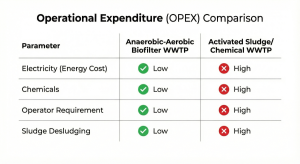
Limited Operational Budget: Overly sophisticated systems often require large electricity consumption and routine chemicals (coagulants/flocculants).
Therefore, a simple WWTP system for public health centers is needed, yet it must remain technically robust. The system must be able to run independently with minimal human intervention (autopilot). This is where biofilter technology engineering plays its role as a solution that bridges the gap between high technical needs and limited resource availability.
Compliance with Health DAK Technical Guidelines & Environmental Regulations
For implementing contractors and related agencies who are preparing procurement planning using the Physical Special Allocation Fund (DAK) for the Health Sector, compliance with the Technical Guidelines (Juknis) is an absolute must.
In addition, in the preparation of public health center WWTP technical guidelines, the biofilter system is often recommended because of the stability of its biological process in dealing with waste discharge fluctuations that often occur in Puskesmas (peak discharge in the morning and low at night). Failure to select technology that complies with the Technical Guidelines does not only risk becoming an audit finding but also has the potential to cause serious environmental pollution.
Why is Anaerobic-Aerobic Biofilter Technology the Gold Standard?
Technically, biological waste treatment is divided into two main regimes: aerobic (with oxygen) and anaerobic (without oxygen). Anaerobic-Aerobic Biofilter Technology combines the advantages of both regimes in one compact process sequence.
Working Principle of Biofilm on Honeycomb Media
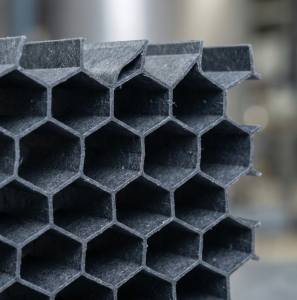
The core of the public health center biofilter WWTP technology lies in the “home” for decomposing bacteria. Unlike the activated sludge system that lets bacteria float in the water, the biofilter system provides a support media (attached growth media) so that bacteria can attach and grow to form a slime layer called a biofilm.
The most effective and commonly used media in PUPR (Ministry of Public Works and Public Housing) technical specifications is the honeycomb type media or honeycomb biofilter. This media is usually made of PVC or rigid plastic materials that are corrosion-resistant.
The advantages of using honeycomb media include:
-
High Specific Surface Area: The honeycomb structure allows for a very large contact area within a small tank volume (150-240 m2/m3). This means the population of decomposing bacteria is much higher compared to conventional systems.
-
Anti-Clogging: The vertical and cross-flow structure on the honeycomb minimizes the risk of clogging by suspended solids, so water flow remains smooth without the need for frequent backwashes.
Advantages of the Combined Process: High BOD/COD Reduction Without Odor
The combination of Anaerobic and Aerobic processes works synergistically to decompose organic pollutants. Here is the technical mechanism of
how wastewater biofilters work in this system:
-
Anaerobic Zone (Without Air): In this zone, wastewater flows through the biofilter media without any oxygen supply. Anaerobic bacteria will decompose complex organic pollutants (proteins, carbohydrates, fats) into simpler compounds as well as methane gas and CO2. The advantage of this phase is the ability to reduce BOD (Biological Oxygen Demand) and COD (Chemical Oxygen Demand) loads by up to 60-70% without requiring electrical energy (blowers).
-
Aerobic Zone (With Air): The water, having reduced its pollutant load, enters the aerobic zone. Here, an air diffuser blows oxygen, and aerobic bacteria attached to the honeycomb media will prey on the remaining organic pollutants. This phase is also highly effective for the nitrification process (converting odorous ammonia into nitrate), so the effluent (treated water) does not emit a pungent odor.
This synergy makes the biofilter system very resilient. If relying solely on aerobic processes, electricity costs for blowers will swell. If only anaerobic, the effluent quality often does not yet meet quality standards and is still odorous. The combination of both is the sweet spot of efficiency and effectiveness.
Design & Technical Specification Breakdown According to Government Standards
As a planning consultant, specification details are crucial in bidding documents as well as construction implementation. A good public health center wastewater treatment plant must have complete compartments in accordance with technical principles.
WWTP Compartments: From Equalization to Chlorination Tank
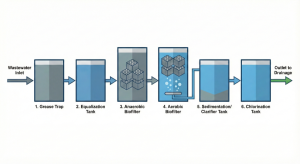
A fabricated or site-built Biofilter WWTP unit must have the following sequence of compartments:
-
Grease Trap: Mandatory, especially for wastewater lines from the nutrition kitchen/canteen. Grease can clog the pores of the biofilter media and kill bacteria.
-
Equalization Tank: Functions as a buffer to uniform the flow rate and quality of wastewater. This prevents shock loading (sudden load spikes) that can damage the biological system.
-
Primary Sedimentation Tank: Settles coarse solid particles so they do not enter the biological reactor.
-
Anaerobic Biofilter Reactor: Contains honeycomb media, the flow is usually up-flow or down-flow by gravity.
-
Aerobic Biofilter Reactor: Contains honeycomb media and an aeration system (diffuser). This is where the remaining pollutants are “finished off”.
-
Final Sedimentation Tank (Clarifier): Settles biological sludge (dead bacteria) so that the outgoing water is clear. A portion of the activated sludge is returned (return sludge) to the initial tank to maintain the bacterial population.
-
Chlorination/Disinfection Tank: A crucial final stage to kill pathogenic bacteria (such as E. coli) using chlorine tablets or liquid before the water is discharged into the city sewer.
Tank Material: Fiberglass (FRP) vs. Concrete (Pros & Cons)
In the anaerobic aerobic biofilter WWTP design, the choice of tank material largely determines the lifetime and construction speed.
Reinforced Concrete (Cast):
-
Pros: Very strong, can be designed to fit irregular land shapes (L-shaped or trapezoidal).
-
Cons: Long construction time (formwork, casting, curing), high risk of leakage if waterproofing is not perfect, difficult to move.
Fiberglass Reinforced Plastic (FRP):
-
Pros: Fabricated (Ready to install), very fast installation (just dig and bury), absolute anti-corrosion against waste chemicals, 100% watertight.
-
Cons: Fixed dimensional shape (cylinder/box) from the factory, requires a flat sand/concrete foundation during burial.
For Physical DAK projects with tight deadlines (usually must be completed before the end of the fiscal year), FRP tanks are often the primary choice because they accelerate the project implementation S-curve.
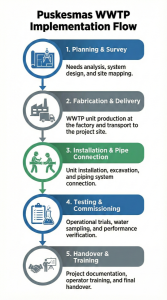
Successful Public Health Center WWTP Project Implementation Strategy
The success of a sanitation project does not stop at the ribbon-cutting inauguration. The true indicator of success is when the system is still operating well 5 to 10 years from now.
Ease of Maintenance (Low Maintenance) for Sanitarian Officers
Specifically for
inpatient public health center biofilter WWTPs, ease of maintenance is a priority. Puskesmas Sanitarians cannot spend all day just taking care of the WWTP. The Anaerobic-Aerobic Biofilter System offers a minimal maintenance routine:
-
Check Blower: Only need to ensure the air blower is on (usually equipped with an automatic timer).
-
Check Chlorine: Add chlorine tablets once a week to the disinfectant tube.
-
Desludging: The sludge produced by the biofilter system is relatively small due to the endogenous respiration process (bacteria eat each other when there is a lack of food). Sludge pumping only needs to be done once every 1-2 years, much less frequently compared to conventional systems which can be every 3-6 months.
-
Infrequent Backwash: The anti-clogging honeycomb media makes the backwash (media washing) procedure almost unnecessary under normal operating conditions.
PT Mizui Osmosa Support for Contractors & Health Agencies (TKDN & Certification)
As a strategic partner for the government and private sector, PT Mizui Osmosa Teknovasi understands the administrative complexity in government goods/services procurement. We do not just sell tanks, but provide end-to-end solutions.
In order to support the Increasing Use of Domestic Products (P3DN) program, the WWTP products we offer have been designed to meet the Domestic Component Level (TKDN) required in DAK and APBD tenders.
In addition, our support includes:
-
Engineering Design: Provision of working drawings (Shop Drawings) and technical calculations for the approval of the supervising consultant.
-
Certification & Lab Testing: Guarantee that the treated wastewater meets environmental quality standards (provided the inlet is according to design).
-
Operator Training: Transfer of Knowledge to Puskesmas sanitarians during commissioning so they are able to perform basic troubleshooting.
The selection of public health center biofilter WWTP technology with an anaerobic-aerobic honeycomb media system is the wisest investment decision for the Health Agency and Puskesmas management. This technology balances the obligation to meet strict environmental regulations with the reality of limited operational budgets and human resources on the ground.
With low operational costs, high process stability, and minimal maintenance, the Puskesmas can focus on its main task: serving public health, without having to worry about environmental pollution issues.
PT Mizui Osmosa Teknovasi is ready to be your technical partner in realizing reliable, regulatory-compliant, and sustainable sanitation infrastructure.