Time is your biggest enemy right now. When laboratory results show red parameters or a warning letter from the Environmental Agency (DLH) has landed on your desk, your plant’s operations are in the danger zone. As a practitioner who has handled wastewater for decades, I understand the panic you are feeling. However, panic will not lower your COD (Chemical Oxygen Demand) levels. What you need is an accurate diagnosis and a systematic, measurable, and science-based problematic WWTP repair.
PT Mizui Osmosa Teknovasi is here not just as a contractor, but as a “specialist doctor” for your critical Wastewater Treatment Plant (WWTP). We understand that a WWTP is not just a holding pond, but a complex biological reactor. The failure of one parameter is often a symptom of a deeper systemic disease.
Nothing disturbs an Operations Manager’s sleep more than uncertainty regarding environmental compliance status. The WWTP is your plant’s last line of defense before residual production water is released into public water bodies. When this defense is breached, the consequences are not just technical problems, but an existential threat to your business.
In Indonesia, environmental regulations are becoming increasingly strict. Referring to the Minister of Environment and Forestry Regulation No. 68 of 2016 concerning Domestic Wastewater Quality Standards, or other industry-specific regulations, tolerance for violations is growing thinner.
If you ignore early symptoms such as pungent odors or cloudy effluent, you open the door to the following risks:
Government Coercive Administrative Sanctions: The obligation to make repairs within very tight and unrealistic deadlines.
Material Fines: Payment of pollution compensation that can reach billions of rupiah.
Environmental Criminal Charges: According to the Environmental Protection and Management Law (UU PPLH), top management can be dragged into legal proceedings.
Discharge Channel Closure (Blocking): This is the worst-case scenario. If the channel is forcibly closed by the authorities, your plant’s production comes to a complete halt (shutdown).
Therefore, finding a competent wastewater treatment repair consultant is no longer an option, but an urgent necessity.
In a state of panic, many WWTP operators or management take shortcuts. The most fatal mistake we frequently encounter in the field is the indiscriminate use of chemicals.
“Just add more alum!” or “Pour in more chlorine to make it clear!” are dangerous instructions. A WWTP, especially a biological one (activated sludge), is an ecosystem of living organisms. Adding excessive coagulants without stoichiometric calculations or adding chlorine (a disinfectant) to the aeration tank is tantamount to killing your main “workers”: the decomposing bacteria.
As a result of these impulsive actions, mass biomass death occurs. The activated sludge turns black and smells foul, and the COD parameters actually spike drastically because the dead bacteria themselves become a new organic load. This is where you need WWTP repair services that understand chemical and biological balance, not just a chemical salesman.
As a Senior Process Engineer, my approach is similar to a doctor operating on a patient in the ER. We don’t guess. We perform data-driven diagnostics. When your WWTP is “sick,” often the machines (pumps/blowers) are running normally, but the decomposition process inside has completely stopped. This is called a process failure.
Here are the two most common disease diagnoses that cause you to need broken WWTP services:
Biological treatment systems have a certain design capacity, known as the Food to Microorganism Ratio (F/M Ratio). Imagine you have 100 workers (bacteria) capable of consuming 100 plates of food (organic waste) per hour.
Shock loading occurs when plant production suddenly spikes, or there is a raw material spill into the wastewater drain, causing the incoming “food” to jump to 500 plates. The bacteria become “overstuffed,” unable to break down the load, and the system eventually collapses. The indicators are clear: Dissolved Oxygen (DO) drops drastically to near zero, and the treated water becomes cloudy and smells sour.
How to resolve high COD in WWTPs due to shock loading cannot be instantaneous. A step-feeding strategy or flow equalization is required to give the bacteria time to adapt.
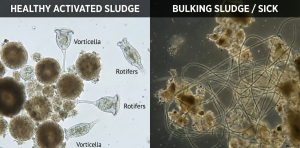
The most frequent cause of WWTP bacteria death, aside from lack of oxygen, is Toxic Shock. Decomposing bacteria, especially the Nitrosomonas and Nitrobacter types responsible for reducing ammonia, are highly sensitive to pH changes and toxic substances.
If the pH of the incoming wastewater (influent) suddenly drops below 5 (acidic) or rises above 9 (alkaline) due to a leak in the washing or CIP (Clean In Place) process, the bacterial cell walls will rupture (lysis). The visual symptoms that appear are usually stiff white foam that is difficult to break on the surface of the aeration tank, or sludge that suddenly floats (rising sludge) while the water underneath is cloudy.
Under these conditions, your WWTP is essentially comatose. The non-compliant wastewater solution in this case requires immediate detoxification and bacterial reinoculation.
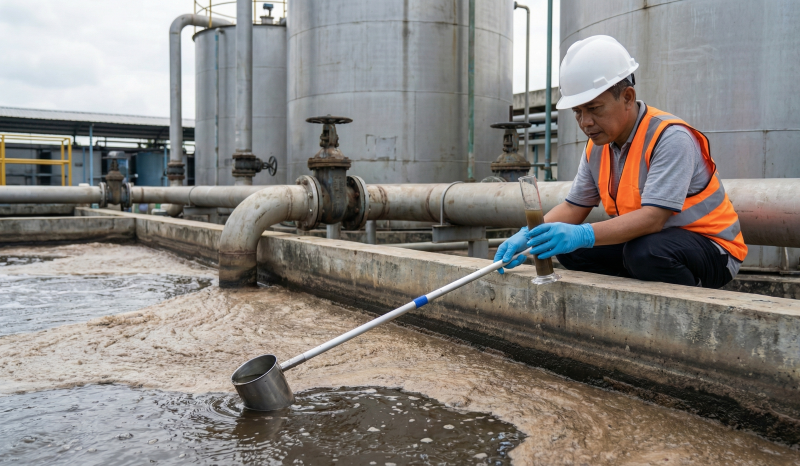
After a diagnosis is established through visual observation, field parameter checks (pH, DO, Temperature), and microscopic analysis, the Mizui Osmosa team will execute a rescue protocol. We do not use trial-and-error methods. Every step is calculated for cost efficiency and speed of results.
Here is our service workflow:
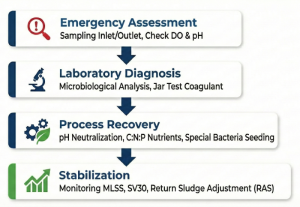
Often, the problem of high TSS (Total Suspended Solids) and COD is caused by a failure in the physical-chemical treatment stage. The coagulant (PAC/Ferric) and flocculant (Polymer) doses used a year ago may no longer be relevant to your wastewater characteristics today.
Our team performs an on-site Jar Test. This is a laboratory-scale simulation of the coagulation-flocculation process to determine:
The most effective type of chemical.
The optimum dose (ppm) to achieve perfect settling.
The optimal pH for the reaction.
With the Jar Test, we eliminate speculation. We can prove right before your eyes how pitch-black wastewater can become clear in minutes if the chemistry is right. This is the foundational step to reducing the load before it enters the biological stage.
If the diagnosis indicates mass bacterial death (biomass washout), then WWTP bacteria seeding services are the primary curative action. However, Mizui Osmosa doesn’t just pour in instant powdered bacteria.
Our protocol includes:
Environmental Neutralization: Ensuring the pH is between 6.5 – 7.5 and the temperature is ideal.
Phased Inoculation: Introducing superior bacterial strains resistant to your industry’s specific waste characteristics.
Nutritional Balancing: Adding Urea and DAP to ensure the nutrient ratio (C:N:P = 100:5:1) is met, so bacteria can multiply rapidly.
Acclimatization: An adaptation period for the bacteria to prevent shock.
We monitor the development of activated sludge through SV30 (Sludge Volume 30 minutes) and MLSS (Mixed Liquor Suspended Solids) parameters. The goal is to return the biomass concentration to the ideal level (usually 2000-4000 mg/L for Extended Aeration).
Once the emergency is resolved and the effluent parameters are green again (meeting quality standards), our job is not over. We want to make sure you never have to call us again for the same problem. Prevention is the key to cost efficiency.
Many WWTP operators only work as “number recorders,” not “data analyzers.” We train your team to independently perform troubleshooting for activated sludge.
The three “pulse” parameters of a WWTP that must be monitored every hour/shift:
Dissolved Oxygen (DO): Dissolved oxygen must be maintained at 2.0 – 4.0 mg/L in the aeration tank. Less than that, anaerobic bacteria will emerge and cause foul odors. More than that wastes electrical energy and can shear the bacterial floc.
pH: The health indicator of the bacteria’s environment. pH fluctuation is the number one killer of biomass.
Visual SV30: By simply taking an aeration water sample into a 1-liter measuring cylinder and letting it sit for 30 minutes, operators can see if the sludge settles well, if bulking occurs, or if denitrification (clumping) happens.
(For more technical guidance on these parameters, you can refer to the guidelines from the US EPA Wastewater Technology Fact Sheets, which is one of our international standard references).
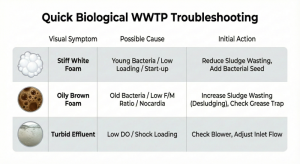
Managing a WWTP requires a combination of chemical, biological, and mechanical engineering knowledge. Often, the plant’s internal team has dual roles that split their focus on the WWTP.
PT Mizui Osmosa Teknovasi offers a Maintenance Contract solution. In this scheme, we don’t just repair when it’s broken, but conduct routine visits (weekly/monthly) to:
Evaluate bacterial performance microscopically.
Calibrate measuring instruments (pH meter, DO meter).
Provide efficient chemical dosing recommendations.
Create WWTP performance reports for internal and external audit purposes (PROPER).
With this assistance, we act as a strategic partner who guarantees your peace of mind. No more surprises of red lab results at the end of the month.
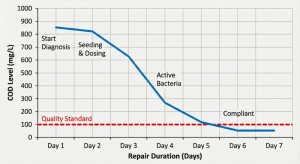
WWTP problems will not heal on their own. The longer you delay professional treatment, the worse the biological damage becomes, and the more expensive the recovery costs will be.
If you are currently seeing indicators of unnatural water color, disturbing odors, or daily data creeping up, consider it a code red.
PT Mizui Osmosa Teknovasi is ready to deploy a team of experts to conduct an emergency audit and execute repairs. Restore your WWTP’s performance, secure your operating permit, and refocus on production.
Contact the Mizui Osmosa Team Now or Request a Free Survey Visit Schedule for an initial diagnosis of your WWTP problems. Let us handle the sludge, so you can handle the business.