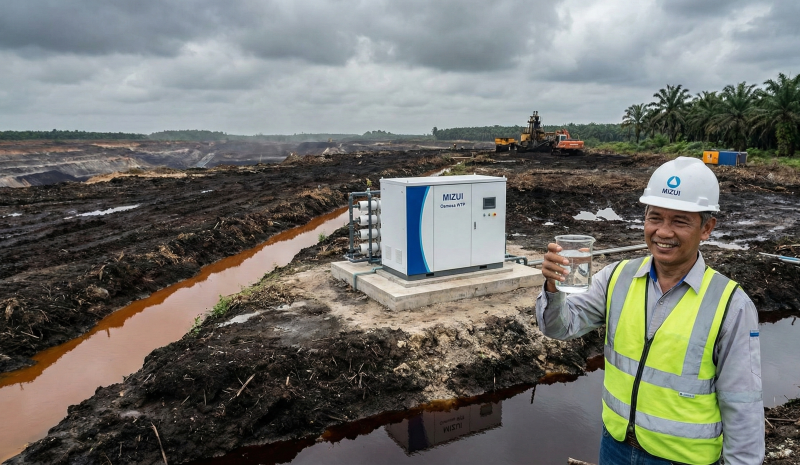
As a Site Manager or person in charge of operations at mining and plantation sites, you certainly understand the logistical challenges in remote areas such as the interiors of Central Kalimantan, Riau, or South Sumatra. However, there is one challenge that is often more agonizing than poor road access: the lack of clean water. At PT Mizui Osmosa Teknovasi, we understand that peat water & iron treatment services are not just a technical necessity, but a vital requirement to maintain employee morale and the lifespan of your company’s assets.
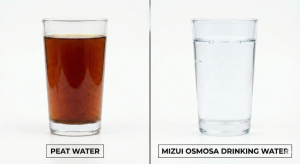
Imagine this scenario: Your employees have just finished an exhausting 12-hour work shift. They want to take a shower to refresh themselves, but the water coming out of the tap is brownish-red like tea, has a pungent earthy odor, and feels slippery. This is not just an inconvenience; it is a health and operational risk. This is where Mizui Osmosa comes in as your strategic partner, transforming “impossible” swamp water into crystal-clear clean water.
Working in the hinterlands means having to make peace with nature. However, when that “nature” is peatland with extreme water characteristics, the impact can be highly destructive. In many sites in Kalimantan and Sumatra, the only raw water source is peat rivers or shallow groundwater exposed to peat leachate.
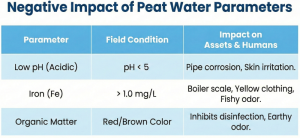
For colleagues living in employee dormitories, water quality is a sensitive issue. Peat water is characterized by a low pH (acidic) and contains high organic matter that gives it a brownish-red color. When this water is used for bathing, skin health complaints such as itching (dermatitis), dry skin, and even eye irritation become a daily occurrence.
Not to mention the problems at the camp laundry facilities. A yellow water and iron odor solution is highly sought after because iron (Fe) and manganese (Mn) dissolved in the water will oxidize when exposed to air or detergent, leaving permanent yellow stains on work uniforms and bed sheets. Psychologically, this reduces worker comfort and morale. Employees who cannot rest comfortably will experience a decline in work productivity.
While the impact on humans is related to health and comfort, the impact on machinery and infrastructure is swelling repair costs. Water with high iron content is the main enemy of piping and boiler systems.
In boiler or engine cooling systems, iron will precipitate to form hard scale. This scale acts as a heat insulator, causing overheating in boiler pipes and drastically reducing heat transfer efficiency. Worse yet, the acidic nature of peat water (pH 3-5) is highly corrosive. Without proper treatment, your iron pipes and submersible pumps could be destroyed by rust in just a few months. This is why understanding the dangers of high iron in boilers and mechanical systems is crucial for the operational continuity of palm oil mills or mining sites.
We often hear complaints from clients who have tried to make their own water filters but failed. “Sir, we’ve added tons of chlorine, but the water just gets redder and the rust smell gets stronger.” Why does this happen?
Chemically, peat water is one of the most complex types of raw water to treat. The challenge is not just one parameter, but a combination of three interlocking factors:
High Acidity (pH 2-5): Peat water contains humic and fulvic acids resulting from the decomposition of plant residues. At this low pH, the coagulation process (clumping of dirt) is very difficult to occur optimally.
Organic Matter (Color): The red color in peat water is not an ordinary suspended particle, but dissolved organic matter. This substance is highly stable and difficult to settle using just regular alum.
Iron (Fe) & Manganese (Mn) Content: In wetlands, iron is often bound to organic matter (organo-metallic complexes). This bond makes iron difficult to oxidize.
According to data from the National Peatland Map – Ministry of Agriculture, the distribution of peatlands in Indonesia covers a very large area in Sumatra, Kalimantan, and Papua, which are the centers of extractive activities. This means you cannot avoid this water; you must conquer it with the right technology.
A fatal mistake often made by non-specialist contractors or internal maintenance teams is directly injecting chlorine or other strong oxidizers without paying attention to the pH.
It needs to be understood that knowing how to neutralize peat water pH is a key step before any other process. If you add chlorine to low-pH water rich in organic matter, you actually trigger the formation of Trihalomethanes (THMs) compounds which are carcinogenic (cancer-causing). Furthermore, iron oxidation will not proceed perfectly at an acidic pH. The iron might seem to disappear momentarily, but it will reappear (passing through the filter) and turn yellow in your final storage tank.
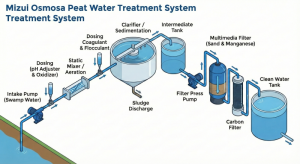
As an experienced peat water WTP contractor, PT Mizui Osmosa Teknovasi does not use a “one size fits all” approach. We use a scientific approach based on raw water laboratory data at your location. Here are the technological stages we apply to guarantee your clean water:
The first step in our system is pH Adjustment. We use precise automatic dosing pumps to inject alkaline solutions (such as Soda Ash or Caustic Soda) to raise the pH to a neutral level (6.5 – 7.5). Why is this important? Because it is in this pH range that the oxidation process of iron and manganese can run optimally.
Once the pH is neutral, we perform an Advanced Oxidation process. We do not solely rely on regular air contact aeration, which is often ineffective for extreme iron levels. We combine aerators with controlled oxidizer injection to break the organo-metallic complex bonds. This process forces dissolved iron and manganese to change phase into solid particles (precipitates) that can later be filtered. This technology also serves as a potent peat water color removal because the color structure of humic acid is broken down at this stage.
The oxidized particles and organic colorants that have “weakened” bonds then enter the Coagulation-Flocculation stage. Here, our swamp water treatment services show their superiority.
We use a specialized coagulant (not regular market alum) formulated for water with a high organic load (high TOC). This coagulant works by attracting small particles into micro-flocs. Next, a polymer flocculant is added to unite these micro-flocs into heavy, large clumps (macro-flocs).
Inside Mizui Osmosa’s specially designed Clarifier (sedimentation) tank, these mud clumps will settle to the bottom of the tank quickly, leaving clear water at the top. The processed water then passes through a Multimedia Filter (Silica Sand & Manganese Greensand) and a Carbon Filter to remove residual micro-particles and odors, ensuring the resulting output meets the Minister of Health Regulation No. 32 of 2017 concerning Environmental Health Quality Standards.
We understand that having good technology alone is not enough if the technology is difficult to build at your location. Building conventional concrete ponds on unstable peatland is a civil engineering nightmare—it is expensive and high-risk (subsiding foundations).
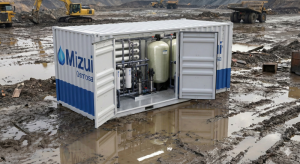
To answer this challenge, PT Mizui Osmosa offers a Containerized WTP solution. We install the entire water treatment system—from reaction tanks, filters, and pumps, to control panels—compactly inside a 20-foot or 40-foot container at our workshop in Jakarta.
The advantages of this system for you:
Plug & Play: The unit arrives at the site, just connect the inlet/outlet pipes and power cables. No need for months of heavy civil works.
Easily Moved (Mobile): If the mining area shifts or the camp changes location, this WTP unit can be lifted onto a truck and relocated.
Weatherproof: The system is protected inside a strong iron container, safe from extreme weather and wild animal disturbances.
We are not just equipment sellers. We are your technical partner. In every peat water WTP installation cost quotation, we always include a comprehensive service package:
Site Survey & Lab Test: Our team is ready to fly to the location (e.g., Berau, Kutai, Muara Enim) to take water samples and analyze them. This ensures our design is accurate.
Installation & Commissioning: Our senior technicians will ensure the system runs perfectly until the output water is clear and meets parameters.
Knowledge Transfer: This is the most important part. We will not leave until your local operators (usually local residents or the general affairs team) understand how to operate the equipment, perform backwashes, and mix chemicals. We equip them with easy-to-understand SOPs and daily Logsheets.
The problem of peat water and iron at the worksite is not a fate that must simply be accepted. With the right technology, corrosive red water can be transformed into a clean and safe source of life.
PT Mizui Osmosa Teknovasi is here to ensure your operations are not disrupted by water issues. We turn employee itchiness complaints into smiles of satisfaction, and turn frequent pipe replacement costs into long-term savings. Don’t let your site’s productivity be eroded by poor water quality.
Contact Our Engineering Team, consult your water problems today. We are ready for technical discussions and field surveys to your location.
Email: jortahim.ambarita@mizuiosmosa.co.id
Website: www.mizuiosmosa.co.id
Service Area: All of Indonesia (Specializing in Remote Areas of Kalimantan, Sumatra, Sulawesi, Papua).
Regulatory References:
Butuh bantuan? Tim kami siap membantu.