Building and operating a mining site in the interior of North Kalimantan (Kaltara) is not just about deploying heavy equipment for overburden removal or managing coal transport fleets. For experienced Site Managers and Camp Bosses, the real challenge often lies in the basic life support aspect: the availability of clean water. As an experienced North Kalimantan mining WTP contractor facing extreme terrains, PT Mizui Osmosa Teknovisa understands that water is the operational lifeline of a camp. Without a hygienic and consistent water supply, the risk of skin disease outbreaks to diarrhea can paralyze workforce productivity within days.
Operational areas in Kaltara, ranging from Malinau, Bulungan, to Nunukan, possess unique and challenging hydrological characteristics. Unlike mines in South or East Kalimantan where infrastructure might be more established, sites in Kaltara are often truly isolated. Logistics access that depends on river tides or pioneer flight weather makes utility independence a non-negotiable requirement. This article will dissect in depth the technical strategies for clean water provision in this region, ranging from handling fast-flowing river water to desalination solutions in coastal areas.
North Kalimantan is traversed by major rivers with strong current characteristics and highly fluctuating turbidity levels. The Kayan River or Sesayap River, for example, can change from relatively clear to dark brown with Total Suspended Solids (TSS) reaching thousands of ppm just hours after rain upstream.
For a Water & Mining Engineer, this condition demands a Water Treatment Plant (WTP) design that is not generic. We cannot simply install standard residential filter systems. Upstream like in Malinau, the challenge is mud sediment that is “hostile” to filter membranes. Meanwhile, moving downstream or to coastal areas like Tarakan and Bunyu, the challenge changes drastically to seawater intrusion causing groundwater or surface water to become brackish.
Therefore, technology selection must not be based on assumptions, but on raw water quality data and physical location conditions. Errors in initial assessment often lead to high operational costs due to overly frequent cartridge filter replacements or damage to intake pumps hit by river debris.
The heart of every water treatment system is the intake unit. At Kaltara mining locations, errors in designing the position and type of intake are the main cause of water supply failure to the mess or workshop. Given that river water level fluctuations in the interior can reach a difference of 3 to 5 meters between the dry and rainy seasons, fixed intake systems (permanent concrete intakes) often become ineffective or submerged in mud floods.
Facing river characteristics in Malinau or upstream Bulungan, the use of fast-flowing river water intake pumps requires special specifications. Ordinary submersible pumps are often not a wise choice if the river carries a lot of abrasive silica sand or drifting wood waste. Sand can erode the impeller in a short time, while wood waste can clog the suction strainer.
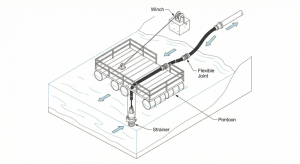
The technical solution we recommend and often implement is the use of a Floating Pontoon Intake system. This pontoon is designed to be flexible, following the rise and fall of the river water surface. On top of the pontoon, we place a Self-Priming Centrifugal type pump positioned above the water surface (dry mount), not submerged. The technical advantages are clear: maintenance is much easier because mechanics do not need to dive to repair the pump, and the risk of the pump drifting away or being buried by riverbed sedimentation can be minimized.
Additionally, the strainer design on the suction pipe must feature passive backwash or self-cleaning utilizing the river current, so that leaf litter does not accumulate causing cavitation in the pump. For sites with steep river cliffs, the installation of a winch system or slide rails is necessary to safely raise and lower the pontoon position during flash floods, a scenario very common in North Kalimantan river water filter operations.
Given the isolated location, pontoon material must also be considered. The use of HDPE plastic drums or fabricated steel pontoons must account for resistance to impacts from drifting logs. The physical durability of this installation is just as important as the chemical quality of the water produced.
Moving from upstream areas to coastal areas such as around Tarakan or small surrounding islands, the challenge shifts from physical turbidity to chemical contamination, especially chloride (salt) and organic substances from peat water. Here, conventional coagulation-flocculation methods (using PAC/Alum) alone will not be enough to produce potable water or even water suitable for bathing, because the salty taste and corrosive nature of the water will not disappear.
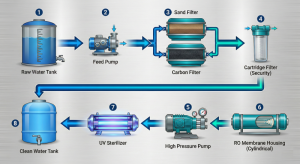
For site locations where raw water has a Total Dissolved Solids (TDS) content above 1,000 ppm (brackish), the mandatory technology to apply is Reverse Osmosis (RO). In the context of processing brackish water into fresh water (Brackish Water Reverse Osmosis – BWRO), pre-treatment is the key to membrane longevity. Peat water commonly found in coastal swamps contains high organic substances that can cause biofouling on RO membranes within weeks if not handled correctly.
The system we offer usually integrates Ultrafiltration (UF) as a pre-treatment before entering the RO unit. UF is effective in filtering colloidal particles and bacteria down to 0.01 microns, ensuring the water entering the RO membrane is free from physical impurities, so the RO membrane’s workload is purely to separate salt.
However, Site Managers must understand that investment in desalination systems (SWRO/BWRO) is always directly proportional to energy consumption. The High Pressure pump used to overcome osmotic pressure requires significant electrical power from the camp Genset. Therefore, the calculation of Power Consumption per cubic meter of water produced must be mature so as not to burden the camp’s operational fuel ratio excessively. As a Tarakan water treatment service provider focused on efficiency, we always simulate energy needs before proposing designs to clients.
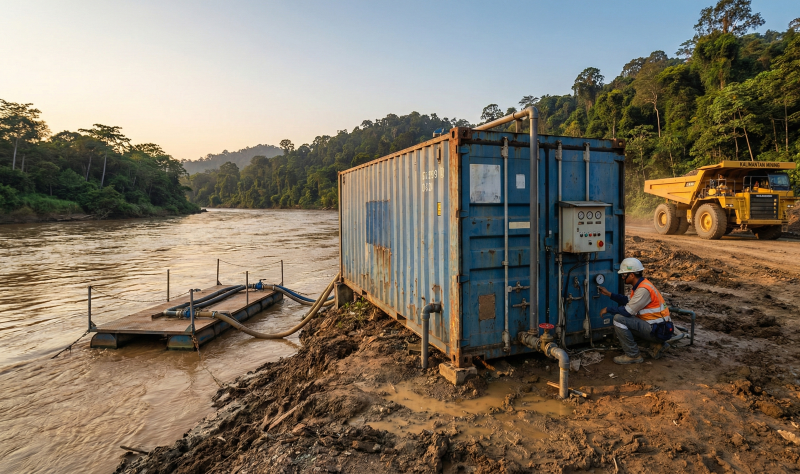
Mining dynamics demand high flexibility. Today the basecamp is at point A, next year it might have to move 10 kilometers to point B approaching a new pit. Building a permanent WTP with massive concrete civil construction is a waste of Capital Expenditure (CAPEX) for short-lived projects or exploration phases. This is why the containerized or skid-mounted concept becomes the prima donna.
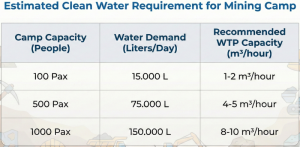
When talking about mobile WTP package prices, many procurement practitioners fall into the trap of comparing unit prices alone without looking at the technical specifications inside. The price of a WTP containerized system varies greatly depending on:
Capacity (Liters per Second/Lps): Is it for the needs of 50 people or 500 people?
Tank Material: The use of Fiberglass Reinforced Plastic (FRP) is certainly more economical than Stainless Steel (SS304), but its resistance to impact during mobilization differs.
Automation: Systems with PLC (Programmable Logic Controller) and HMI (Human Machine Interface) that allow automatic monitoring certainly have a higher investment value than manual systems, but reduce operator labor costs in the field.
As an illustration, a Mobile WTP unit with a capacity of 5-10 m³/hour packed in a 20-foot container, complete with chemical injection systems, media filtration (Sand & Carbon), to UV sterilization, offers value in the form of “Plug and Play”. Upon arrival at the location, the unit only needs connection to a power source and inlet/outlet pipes. There is no civil work taking weeks. This installation time efficiency is actually the biggest saving for mining companies. You can immediately focus on coal production without worrying about water warehouse construction.
Additionally, Mobile WTPs have better asset value. If the project is completed, this unit can be transported (demobilized) to another site or resold as a company asset, unlike concrete basins that must be abandoned.
Advanced technology is useless if spare parts are not available when needed. This is a bitter reality in the interior of Kalimantan. We often encounter cases where a client’s Malinau clean water treatment installation stops operating simply because they ran out of chlorine stock or a pump impeller broke, and it takes 2 weeks to bring a replacement from Jakarta or Surabaya.
Mining clean water logistics management is an integral part of PT Mizui Osmosa Teknovisa’s services. We understand that Tarakan functions as the main logistics hub for the Kaltara region. Our strategy includes preparing a stockpile of chemicals (coagulants, flocculants, disinfectants) and fast-moving spare parts at the nearest transit warehouse or directly at the client’s site with a consignment scheme.
Clean water logistics is not just about shipping goods, but about forecasting. Site Logistics Managers must be assisted to calculate the chemical burn rate based on seasonal river water quality. During the rainy season, PAC (Poly Aluminium Chloride) consumption will spike drastically because water turbidity increases. Without good buffer stock planning, the WTP will experience a forced shutdown.
We also emphasize the importance of component standardization. In designing systems for remote areas, we avoid using rare proprietary components. We prioritize the use of pumps, valves, and instruments that have extensive distribution networks and are easily substituted. The goal is simple: minimize Downtime. In mining operations that run 24 hours, clean water for workshops (washing LV/HD units) and employee sanitation needs must not stop.
Providing clean water in the work area is not just a facility, but a legal obligation regulated by the government. Referring to the Minister of Health Regulation No. 32 of 2017 concerning Environmental Health Quality Standards and Water Health Requirements, companies are obliged to guarantee that water used for hygiene and sanitation purposes meets physical, chemical, and biological parameters.
Failure to meet these standards has serious consequences. In addition to potential administrative sanctions, health impacts such as diarrhea outbreaks or skin diseases can significantly increase employee sick leave rates. In closed environments like mining sites, infectious diseases spread very quickly. As a professional mining site clean water provider, we ensure the water output from our WTP systems is routinely tested in accredited laboratories to ensure compliance with these regulations as well as international standards from WHO.
Besides the health aspect, good water management is also related to environmental permits. Disposal of processing sludge from the WTP must be managed so as not to pollute the river again, in accordance with mining environmental management directives often socialized by the North Kalimantan Provincial Energy and Mineral Resources (ESDM) Office.
Managing a mine in North Kalimantan is about conquering logistical and natural challenges. regarding clean water, you need a partner who is not only good at theorizing on paper, but also understands how difficult it is to mobilize heavy equipment across the Bahau river rapids or how corrosive the seawater vapor is at Tarakan port.
PT Mizui Osmosa Teknovisa positions itself as a strategic partner offering end-to-end solutions. Starting from water source assessment, engineering design adaptive to fast rivers or brackish water, tough mobile system fabrication, to after-sales support guaranteeing operational logistics availability.
Don’t let clean water problems hinder your black gold production targets. Ensure your camp has a proper water supply, so your team can work healthily, comfortably, and productively.
Butuh bantuan? Tim kami siap membantu.