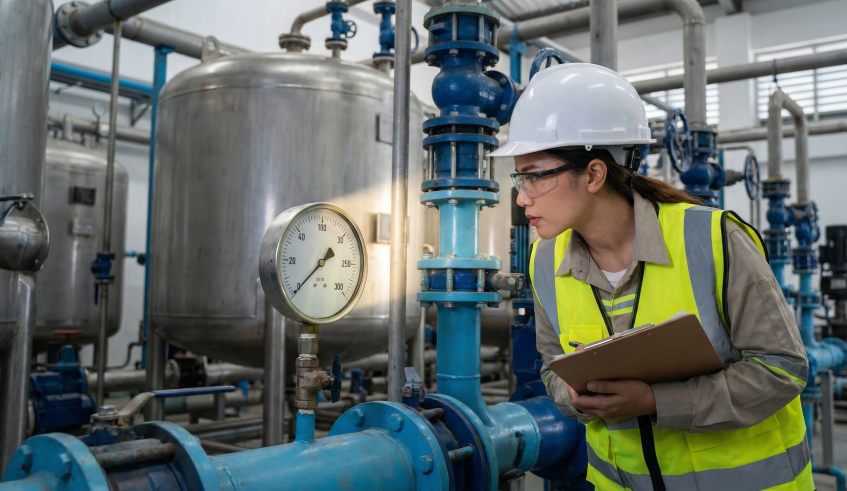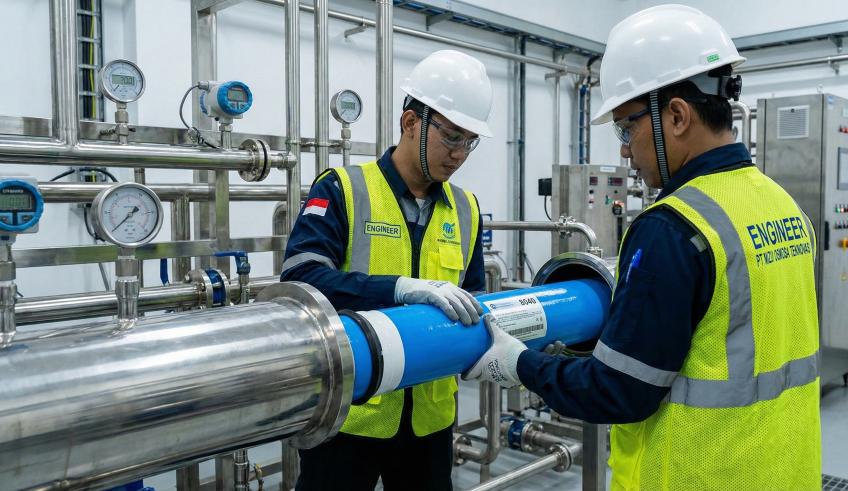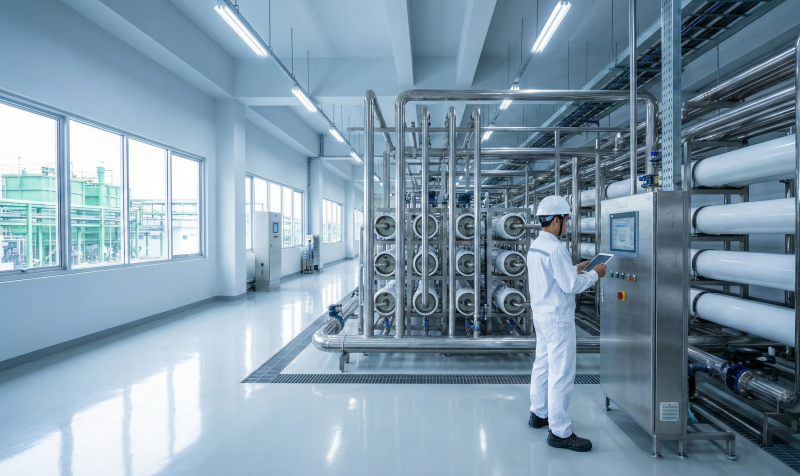
The MM2100 Industrial Area in Cibitung, Bekasi, has long been known as one of Indonesia’s most vital manufacturing hubs, housing hundreds of multinational companies (MNCs) from Japan, South Korea, to Europe. In this industrial ecosystem dominated by the automotive, electronics, and FMCG sectors, water utilities are not merely a supporting resource, but a critical component that determines the final quality of products. For Factory Managers and Utility Managers operating in this zone, the challenge of managing MM2100 industrial area water treatment revolves not only around water debit availability but also around consistent quality, energy efficiency, and compliance with increasingly strict environmental regulations.
PT Mizui Osmosa Teknovisa understands that raw water in the Bekasi region has challenging specific characteristics, ranging from fluctuating turbidity levels to organic content that requires special handling. As a strategic engineering partner, we realize that globally-standardized companies need solutions that go beyond conventional methods. This is where precision technology and data-driven operational management become the differentiator between a system that merely runs and a system that provides a competitive edge.
The geographic and hydrological characteristics of the Cibitung and West Bekasi regions demand extra attention in the pre-treatment process. Raw water sources, whether from the estate management or deep wells (with special permits), often contain Total Dissolved Solids (TDS) and Hardness parameters that can trigger scaling in boiler systems or fouling in Reverse Osmosis (RO) membranes if not handled properly.
For precision industries like semiconductors or automotive painting, a minor deviation in water conductivity can be fatal to production output. Microscopic defects on car body paint or circuit failures on electronic components can often be traced back to unstable rinse water quality. Therefore, MM2100 clean water treatment services must be able to guarantee a continuous supply of High Purity Water, regardless of raw water quality fluctuations during rainy or dry seasons.
The reliability of this utility system is the backbone of factory operations that apply Just-In-Time principles. A Water Treatment Plant (WTP) system failure means downtime, and in the calculations of an MNC industry, downtime equates to massive financial losses. PT Mizui Osmosa Teknovisa positions itself as a Cibitung factory WTP vendor that doesn’t just sell equipment, but sells a guarantee of operational continuity through mature engineering.
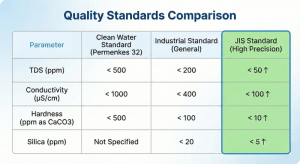
Discussing MM2100 cannot be separated from the dominance of Japanese companies bringing strict quality standards from their home country. One of the primary references often used as a benchmark is the Japanese factory clean water standards (JIS Standard), specifically JIS K 0101 and JIS K 0102, which regulate testing methods and water quality for industrial purposes.
Compliance with JIS demands more than just hitting numerical parameters; it demands process stability. In Japan, industrial water quality is often classified into several grades depending on its application, from cooling water to Ultra Pure Water (UPW). For example, for high-pressure boiler feed water needs, JIS standards require extremely low silica content and conductivity to prevent corrosion and scaling in turbine pipes.
PT Mizui Osmosa Teknovisa adopts an engineering approach aligned with the Kaizen (continuous improvement) philosophy embraced by our clients. We understand that a WTP system is not a static installation. Over time, membranes will experience performance degradation, and pumps will drop in efficiency. By applying the PDCA (Plan-Do-Check-Action) cycle, we routinely evaluate system performance to ensure the water output continues to meet JIS standards, even when raw water conditions change.
Furthermore, implementing these standards is also closely related to risk management. In MNC corporate audits, water quality data transparency is a crucial point. The monitoring system we offer can provide real-time data regarding pH, ORP, Flow Rate, and Conductivity, which can be integrated with the factory’s SCADA system, giving management peace of mind that their water quality standards are maintained 24/7. You can learn more about industry standard details at the Japanese Industrial Standards Committee.
Responding to technical challenges in the field, PT Mizui Osmosa Teknovisa provides custom-designed industrial water purification systems in Bekasi tailored to the specific needs of each factory. We do not believe in a “one cure for all diseases” approach. Every industry has different pain points.
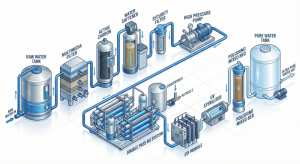
For the electronics and pharmaceutical industries in MM2100, single-pass Reverse Osmosis technology is often insufficient to achieve target conductivities below 1 µS/cm. Therefore, we implement a Double Pass RO system combined with Electrodeionization (EDI). EDI technology eliminates the need for hazardous and messy chemical regeneration (as in conventional Mixed Bed systems), making it more environmentally friendly and aligned with ISO 14001.
In designing this system, we account for the Silt Density Index (SDI) of Bekasi raw water, which tends to be highly colloidal. Using Ultrafiltration (UF) as a pre-treatment before the RO unit has proven to significantly extend the life of RO membranes and reduce the frequency of Cleaning in Place (CIP), which ultimately lowers annual operational expenses (OPEX).
Often, the main problem lies not in the RO unit, but in pre-treatment failure. As an experienced West Bekasi water treatment contractor, we emphasize the importance of a robust media filtration system. Using modern, high-quality filter media like Ferrolite or Manganese Greensand is crucial for tackling the iron and manganese content commonly found in this area’s groundwater. Without effective removal in the initial stage, iron will oxidize the RO membrane, causing expensive permanent damage.
Having an advanced system is only half the success equation; the other half is maintenance. The MNC corporate WTP maintenance services we offer are based on the 5S principles (Seiri, Seiton, Seiso, Seiketsu, Shitsuke). We believe the physical condition of the utility room reflects the quality of the water produced. A clean, neat, and organized WTP room minimizes the risk of cross-contamination and facilitates the early detection of leaks or anomalies.
Our maintenance services cover a broad spectrum, from preventive maintenance to predictive maintenance.
Schedules for replacing cartridge filters, backwashing media, and CIP for membranes must be executed with discipline, not waiting until the system jams (clogs). We provide precise chemical management (antiscalants, biocides, pH adjusters). Incorrect dosing not only wastes money but can also damage the membrane. Our technician team is trained to conduct daily water analysis and adjust dosing pumps to always be at the optimal efficiency point.
Unlike other MM2100 area clean water engineering partners, we push for the use of data logging to predict breakdowns. By analyzing Normalized Permeate Flow and Differential Pressure trends on the RO membrane, we can predict when fouling will occur long before alarms sound. This allows utility managers to plan maintenance shutdowns during periods of low production, avoiding disruptions to shipping schedules.
Many factories in MM2100 have been operating for over 10 or 15 years. Often, production needs increase (new line expansion), but utility land is limited. Building a new WTP is often not a viable option due to space constraints. The solution is to upgrade existing WTP capacity through design and technology optimization.
Membrane technology has advanced rapidly over the past decade. We can increase clean water production capacity by up to 20-30% without adding more vessels or pumps, simply by replacing old membrane elements with High-Surface Area or Low Energy Elements types. This is a smart solution for factories experiencing bottlenecks in water supply but hindered by the utility area’s footprint.
Energy costs are the second-largest component in WTP operations after raw water costs. Older installations often use throttling valves to regulate flow, which is highly inefficient. We upgrade control panels by integrating Variable Frequency Drives (VFD) on the main pumps. The VFD automatically adjusts the pump motor’s RPM based on actual flow needs, which can save electricity consumption by up to 40%. This is not just about cost savings, but also your company’s tangible contribution to reducing its carbon footprint, supporting global sustainability targets.
An MNC’s corporate responsibility does not end with clean water; wastewater management is a legal and ethical mandate. In the MM2100 area, regulations regarding factory domestic wastewater treatment (Domestic WWTP) are strictly overseen by estate management and environmental agencies. Wastewater from factory canteens, toilets, and prayer rooms contains organic loads (BOD/COD) and ammonia that must be reduced before discharge into area drains or receiving water bodies.
Conventional septic tank systems are no longer adequate to meet modern quality standards (in accordance with LHK Ministerial Regulation No. 68 of 2016). PT Mizui Osmosa Teknovisa implements aerobic biological treatment systems with Moving Bed Biofilm Reactor (MBBR) or Extended Aeration technology. This technology allows decomposing microorganisms to work more effectively in compact tanks, producing clear effluent that meets quality standards.
We ensure that your WWTP installation does not become a new source of problems, such as unpleasant odors that disrupt work comfort. With engineering controls on the aeration and sludge circulation systems, we guarantee the WWTP area remains hygienic and does not invite complaints from employees or external auditors. This compliance is vital for maintaining your company’s ISO 14001 certification. (Read more about wastewater quality standard regulations on the Ministry of Environment and Forestry Website).
In the competitive industrial landscape of the MM2100 Industrial Area, water is a strategic asset. Choosing the right vendor isn’t just about comparing unit prices; it’s about choosing a partner who understands the technical language and global quality standards you uphold.
PT Mizui Osmosa Teknovisa is here as a trusted MM2100 industrial water filtration system provider, bridging the need for advanced technology with responsive local service. From meeting JIS standards for process water and 5S-based maintenance management to waste regulatory compliance, we provide end-to-end solutions that allow you to focus on what matters most: producing high-quality goods.
We invite you to discuss further how we can optimize the water utility system in your factory. Together with PT Mizui Osmosa Teknovisa, let’s create a robust, efficient, and world-class water treatment system.
Butuh bantuan? Tim kami siap membantu.