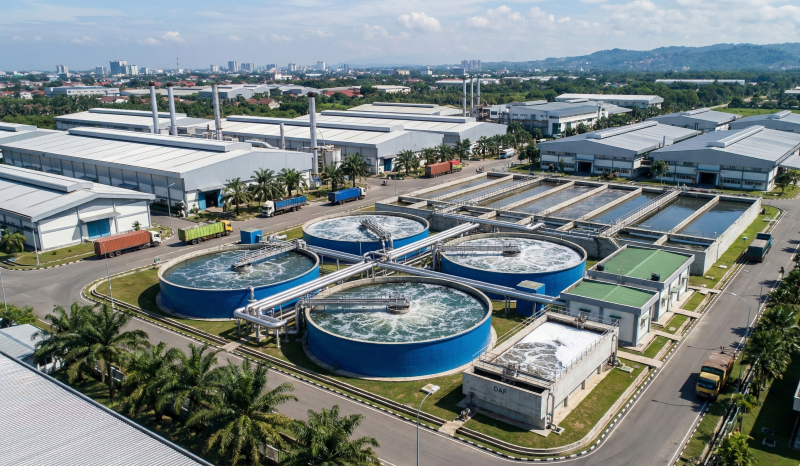
Medan is the economic heart of Sumatra. Its buffer zone, specifically the Medan Industrial Estate (KIM) Mabar in Deli Serdang, has now become a vital manufacturing ecosystem. Hundreds of factories operate here, ranging from oleochemical industries and food processing to rubber factories. However, this rapid growth brings serious consequences. The volume and complexity of liquid waste continue to rise. For factory owners, finding competent Medan industrial WWTP services is a necessity. This is not just about permits, but business strategy. You need to keep operations running amidst strict regulations.
PT Mizui Osmosa Teknovisa is here as your partner. We use a profound environmental engineering approach. We understand that every factory’s waste has unique characteristics. This article will discuss waste management challenges in KIM and their solutions.
The Medan Industrial Estate (KIM) Mabar faces a dual challenge. Industrial land is becoming increasingly limited, yet waste characteristics are becoming more fluctuating. Unlike domestic waste, industrial waste often experiences sudden load spikes (shock loading).
Consequently, biological systems can fail within hours if the WWTP (Wastewater Treatment Plant) is not designed with the correct safety factor.
The government is becoming increasingly firm. The Ministry of Environment and Forestry (KLHK) has set high quality standards. The main reference is Permen LHK No. 5 of 2014. Industries are required to keep key parameters safe. These parameters include BOD, COD, pH, and TSS.
In KIM Mabar, this challenge is even more real because the types of industries are diverse:
Rubber Industry: Produces waste with a pungent ammonia odor and high nitrogen content.
Food Industry: Waste often has extreme pH levels. This occurs due to the machine washing process (Cleaning in Place) using strong acids.
Oleochemical Industry: Waste has high temperatures. Additionally, the oil content is massive.
Therefore, KIM Mabar factory liquid waste treatment requires a special approach. We cannot simply use standard designs. Accurate laboratory data is required before construction begins.
The oleochemical industry is the prima donna in North Sumatra. However, its liquid waste (Palm Oil Mill Effluent) is a heavy challenge for conventional WWTPs. The main enemy is Oil & Grease.
Oil has a detrimental impact on treatment systems. First, oil can coat filter media. Second, oil clogs oxygen diffusers. As a result, oxygen transfer to bacteria becomes obstructed. Biologically, the oil layer also blocks bacteria from absorbing nutrients.
Many factories in Medan still use simple Grease Traps. Unfortunately, these devices are ineffective for large discharge volumes, especially if the oil is already emulsified (mixed with water).
Emulsified oil will not float on its own. Eventually, the oil escapes into the aeration unit. This causes septic conditions (foul odors) and makes sludge difficult to settle. To overcome this, PT Mizui Osmosa Teknovisa uses emulsion-breaking technology. We separate the oil before it enters the biological process.
Choosing a working partner is a vital decision. As an experienced Deli Serdang WWTP contractor, we often see WWTP failures. Often, the cause is not machine damage. The main cause is initial design flaws.
For example, general civil contractors often miscalculate Retention Time. Consequently, wastewater flows too fast. Bacteria do not have time to decompose pollutants thoroughly.
PT Mizui Osmosa Teknovisa fills this gap. We combine Civil, Chemical, and Biological Engineering. We also ensure materials are corrosion-resistant. Regulatory compliance is our absolute target.
How do you turn concentrated waste into clear water? We use a “Multi-Stage Barricade” method. First, we separate physical pollutants. Next, we destroy dissolved pollutants biologically.
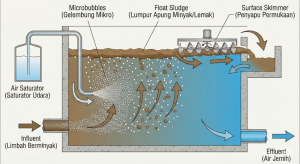
Gravity sedimentation often fails for the oleochemical industry. The best solution is the DAF (Dissolved Air Flotation) System. Unlike settling downwards, DAF floats impurities upwards.
Here is how it works:
Air Saturation: Treated water is saturated with high-pressure air.
Pressure Release: This water is released into the DAF tank. The pressure change creates millions of micro-bubbles.
Flotation: Bubbles attach to oil particles. The oil then rises to the surface.
Skimming: The oil layer on the surface is swept away by a mechanical device.
This technology is highly effective. DAF is capable of removing up to 95% of oil. The workload of bacteria in the next stage becomes much lighter.
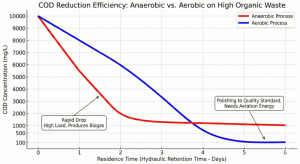
After the oil is gone, the next challenge is lowering BOD and COD. This is where aerobic & anaerobic biological technology plays a role. We adjust it to your waste concentration.
1. Anaerobic Technology (Without Oxygen) This technology is suitable for waste with high COD (> 3,000 mg/L). Examples include palm oil or concentrated food waste. Bacteria work without oxygen to convert organic matter into Biogas. The advantage is electricity savings. Additionally, the residual sludge produced is very minimal.
2. Aerobic Technology (With Oxygen) This is usually used as the final stage. The goal is water polishing. We use the Activated Sludge system. Air is supplied through diffusers at the bottom of the tank. This oxygen keeps the bacteria alive to eat the remaining pollutants.
We monitor these parameters strictly so that the bacterial colony remains healthy and works optimally.
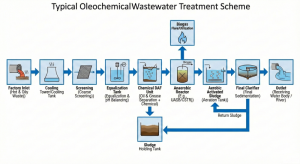
We do not just sell equipment. We offer guaranteed system performance. Our services cover all project stages.
Every project begins with a site survey. Our engineering team designs a detailed Process Flow Diagram. The WWTP layout is also created to be space-saving.
Next is the construction stage. Piping and control panel installation is carried out by expert technicians. However, the work does not end there. The most crucial stage is Commissioning.
At this stage, we perform bacterial seeding. We also train the bacteria to adapt to your factory’s waste. We accompany operators until the treated water is stable and meets quality standards.
Does your factory already have a WWTP but the results are poor? As a North Sumatra WWTP Consultant, we provide audit services. We can fix your old system.
Often, old WWTPs do not need to be totally demolished. Through an audit, we can find the root cause. Maybe the blower is not strong enough, or bacterial nutrients are unbalanced. Our solution could be equipment upgrades or SOP improvements. This is far more cost-effective than building new.
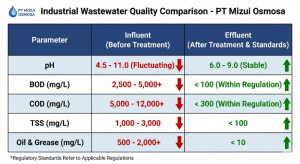
Industrial waste in Medan is not just production residue. It is a serious legal responsibility. Mishandling can be fatal to your business license.
PT Mizui Osmosa Teknovisa is ready to be your partner. We combine DAF technology and modern biological systems. We ensure your WWTP investment provides peace of mind.
Do not let waste problems hinder your business.
Want a free consultation or site survey? Contact PT Mizui Osmosa Teknovisa’s expert team today. Let’s create a complete and sustainable water treatment solution.
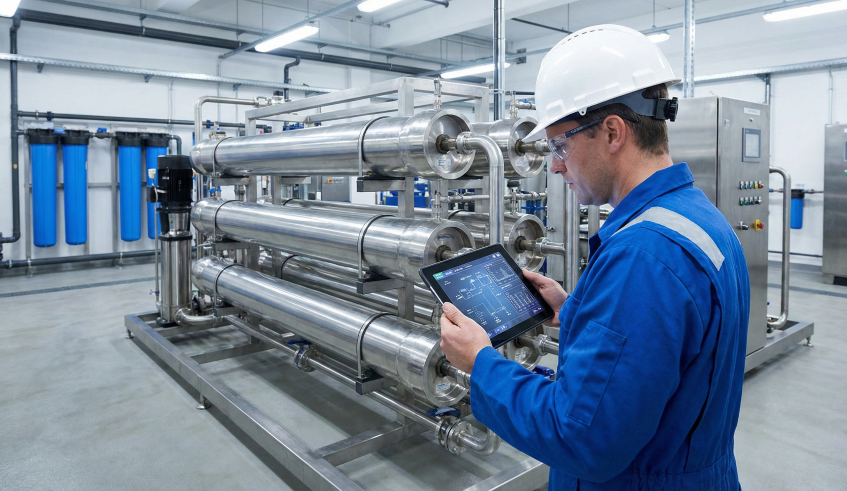
Butuh bantuan? Tim kami siap membantu.