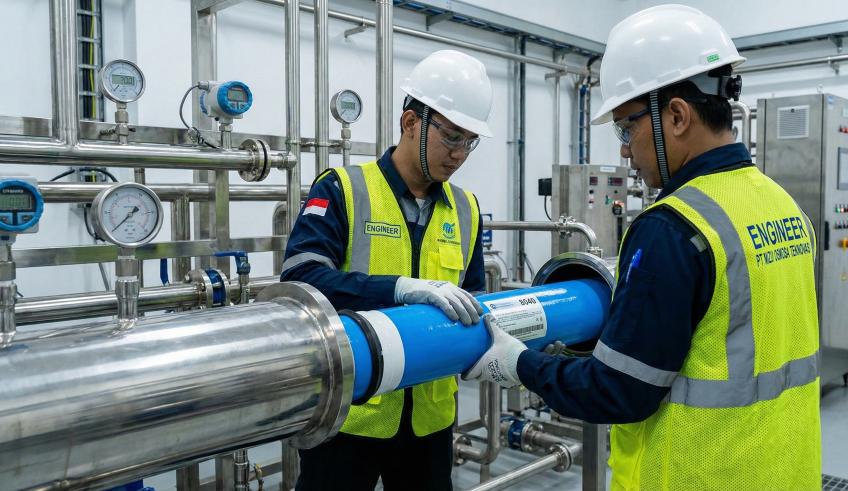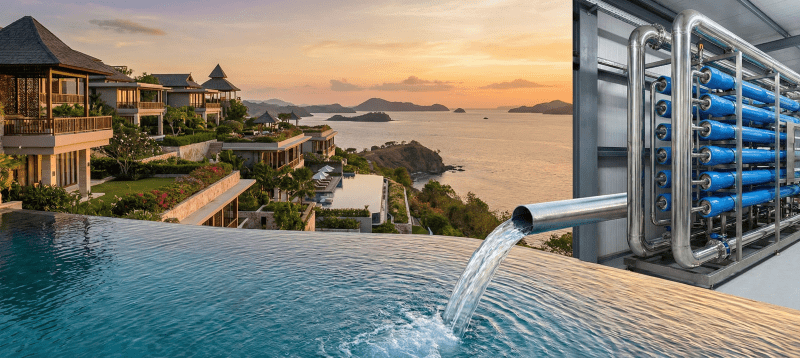
Labuan Bajo, the gateway to the ancient wonders of Komodo National Park, has transformed into a world-class tourism destination. Rows of five-star resorts and fleets of luxury Phinisi ships now adorn the West Flores landscape, promising unforgettable experiences for international travelers. However, beneath this visual luxury lies a fundamental and critical operational challenge: the availability of high-quality freshwater.
As a Senior Environmental Engineer with decades of experience in industrial water treatment, I understand that for luxury properties, water is not merely a utility commodity—it is a core element of the guest experience. This is where the crucial role of a competent Labuan Bajo SWRO Contractor, such as PT Mizui Osmosa Teknovisa, comes in to bridge the gap between limited natural water supplies and the rigorous demands of international hotel standards.
This article provides an in-depth analysis of why Sea Water Reverse Osmosis (SWRO) technology is no longer just an option, but a mandatory strategic investment for the sustainability of hospitality businesses in the East Nusa Tenggara islands.
The narrative of Labuan Bajo’s natural beauty often masks its harsh hydrogeological reality. For hotel General Managers and resort owners, ensuring that taps continue to flow with clear water in the height of the dry season is an exhausting and expensive daily battle. Reliance on conventional resources has proven inadequate for supporting large-scale operations requiring hundreds, or even thousands, of cubic meters of water per day.
Geographically, the East Nusa Tenggara region, including Labuan Bajo and its satellite islands, is dominated by karst topography and a tropical savanna climate with low rainfall. Global climate phenomena such as El Niño exacerbate the duration and intensity of extended dry seasons, causing surface water sources to dry up rapidly.
Furthermore, the hydrogeological conditions of small islands and coastal areas around Komodo National Park make groundwater exploration highly problematic. Deep well drilling often yields brackish water (high salinity) due to natural seawater intrusion. For island resorts, freshwater groundwater is practically non-existent in significant quantities. This is the greatest irony of marine tourism: being surrounded by a vast ocean yet experiencing extreme freshwater scarcity. In this context, desalination technology emerges as the most reliable freshwater solution for extended dry seasons, utilizing an infinite resource—seawater—to guarantee year-round operational resilience.
Before adopting SWRO technology, many hotel operators in Labuan Bajo relied on freshwater supplies delivered via water trucks or barges from mainland Flores. While appearing to be a quick fix, this logistics model has fatal flaws for five-star standards:
Inconsistent Quality: Water purchased from third parties often fluctuates in quality. Turbidity, hardness, and microbiological contamination are difficult to control strictly, risking violations of international hotel hygiene standards.
Skyrocketing Operational Costs: The price of bulk water in Labuan Bajo is among the highest in Indonesia, especially when barged to remote islands. This becomes a massive and increasing OPEX (Operational Expenditure) burden.
Supply Uncertainty: Water delivery logistics are highly vulnerable to bad weather, high waves, and transport fleet breakdowns. For a hotel with 90% occupancy during peak season, a 24-hour delay in water delivery is an operational disaster.
Carbon Footprint: The continuous use of diesel trucks and ships contradicts the sustainable tourism image increasingly sought by premium travelers today.
Therefore, transitioning from a water-purchase model to self-sufficient water production is a strategic move to secure your business assets and reputation.
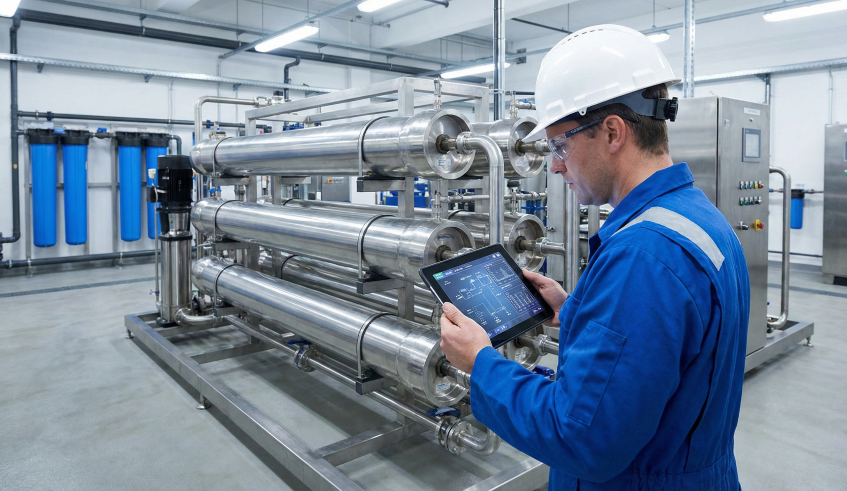
Sea Water Reverse Osmosis (SWRO) is currently the most mature and energy-efficient membrane-based desalination technology. This system is designed to separate dissolved salts, minerals, and impurities from seawater, producing high-purity freshwater. As a consultant, I emphasize that implementing SWRO in tropical marine environments like Labuan Bajo requires high-level, marine-grade technical specifications to withstand corrosion and biofouling.
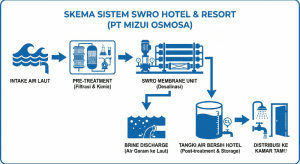
The SWRO process is not merely standard filtration; it is a molecular-level separation process that overcomes natural osmotic pressure. Here are the technical stages of the industrial SWRO systems we implement:
Intake (Raw Water Collection): Intake design is critical. To minimize environmental impact and pre-treatment load, we often recommend beach wells where geological conditions permit, utilizing beach sand as a natural filter. If an open intake is required, specialized marine-biota-friendly screens are used.
Rigorous Pre-treatment: This is the key to membrane longevity. Nutrient-rich Labuan Bajo seawater is prone to biofouling. Our systems include multi-stage filtration—from multimedia filters (silica sand, anthracite) and 5-micron absolute cartridge filters to precise antiscalant and biocide injection.
High-Pressure Pump: The heart of the SWRO system. This pump must overcome seawater’s osmotic pressure (approx. 25-30 bar) and push water through the membrane, often operating at 55 to 70 bar. We utilize Super Duplex Stainless Steel pumps for maximum corrosion resistance.
SWRO Membrane Assembly: We utilize marine-grade Polyamide Thin-Film Composite (TFC) membrane elements from world-leading manufacturers (e.g., DuPont FilmTec or Hydranautics). These membranes feature a salt rejection rate exceeding 99.7%, ensuring the permeate water meets WHO drinking water standards.
Post-treatment: SWRO water is highly pure but can be slightly aggressive (corrosive) and “flat” in taste. For hotel applications, we perform remineralization (adding calcium and magnesium) and pH adjustment to ensure the water tastes fresh, is healthy, and does not damage expensive hotel piping systems.
PT Mizui Osmosa Teknovisa does not just sell equipment; we provide end-to-end solutions. As experienced providers of seawater desalination installation services in NTT, our approach begins with technical and environmental feasibility studies.
For remote island resorts, we analyze seabed bathymetry for the placement of intake and outfall (brine) pipes. Outfall designs must include diffusers to ensure brine is rapidly diluted without damaging the sensitive coral reef ecosystems around Komodo National Park. We also integrate energy demand analysis, often suggesting hybrid systems with solar panels to reduce reliance on diesel generators in remote locations.
Clean water challenges are not limited to land-based resorts. Luxury liveaboard Phinisi operators serving long routes (such as Labuan Bajo – Raja Ampat) face similar dilemmas. Carrying massive freshwater tanks increases the ship’s deadweight, raises fuel consumption, and consumes valuable space that could be used for guest cabins or recreation.
For mobile applications, PT Mizui Osmosa provides Space-Saving Compact SWRO Units, commonly known as “Water Makers.” These are desalination units specifically designed with a minimal footprint, often in skid-mounted or modular configurations tailored for cramped and irregular ship engine rooms.
Key technical features of these marine units include:
Vibration Resistance: All components are mounted with heavy-duty vibration dampeners to withstand constant shocks at sea.
Mobile Energy Efficiency: Designed to operate efficiently using limited power from ship generators, often utilizing highly efficient axial piston pumps.
Operational Ease: Equipped with intuitive touchscreen HMI control panels, allowing crews to operate the system, perform automatic freshwater flushes, and monitor water quality with minimal training.
As a company active in Labuan Bajo water maker sales, we ensure the availability of vital spare parts and chemicals at our local hub to support dynamic Phinisi fleets.
In the luxury hospitality industry, water is a silent amenity. Guests may not praise it when it is perfect, but they will certainly complain loudly if it is problematic. Brackish, odorous, or discolored water can destroy a hotel’s reputation in seconds via online reviews.
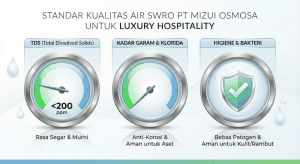
A correctly designed SWRO system ensures consistent 5-star hotel standard water quality, 24/7. Technically, this means:
Low TDS (Total Dissolved Solids): We reduce Labuan Bajo seawater (approx. 35,000 ppm) to below 500 ppm (WHO standard), and for ultra-luxury resorts, we often target below 200 ppm for superior taste.
Chloride and Corrosion Control: Removing chlorides (the cause of saltiness and corrosion) is vital. Low-chloride water protects your expensive investment in sanitary fixtures (e.g., Grohe/Kohler), hot water boilers, espresso machines, and laundry equipment.
Personal Comfort: Soft water (low hardness) provides a much better bathing experience. Soap and shampoo lather more effectively, and skin does not feel sticky or dry—small details highly appreciated by high-end clients.
Operational efficiency is key. While the initial CAPEX for hotel seawater RO machines is significant, the long-term OPEX is much lower than purchasing water. PT Mizui Osmosa integrates Energy Recovery Devices (ERD), such as isobaric chambers, which utilize the high pressure from the brine reject stream to assist in pressurizing incoming seawater. This drastically reduces energy consumption from 6-8 kWh/m³ to just 2.5 – 3.5 kWh/m³, accelerating your Return on Investment (ROI).
Choosing an SWRO contractor is about choosing a long-term technology partner who understands the terrain. Many vendors from Jakarta or Surabaya can sell a machine, but fail in after-sales support in remote locations.
At PT Mizui Osmosa, we believe a sale is the beginning of a relationship. We recognize that SWRO downtime on a remote island is a crisis. Therefore, our resort SWRO maintenance services are designed for maximum reliability:
Local Technical Team: We invest in training local NTT technicians who understand local water characteristics and can respond quickly to emergency calls.
Remote Monitoring System: For large-scale systems, we offer IoT-based remote monitoring, allowing our engineers to detect anomalies before they lead to fatal breakdowns (predictive maintenance).
Comprehensive Service Contracts: We offer packages covering routine Cleaning in Place (CIP), instrument calibration, and filter media replacement, freeing your engineering team to focus on other tasks.
For a resort requiring 100 m³/day in the Labuan Bajo islands:
Scenario A: Purchasing Bulk Water (Barging): At an average price of IDR 150,000 per m³, the annual cost is IDR 5.475 Billion.
Scenario B: Self-Production with SWRO (with ERD): Total OPEX (Energy, Chemicals, Maintenance) is approx. IDR 22,500 per m³. The annual cost is IDR 821.25 Million.
Annual Operational Savings: IDR 4.65 Billion. With a CAPEX ranging from IDR 6 Billion to IDR 8 Billion, the Payback Period is often achieved in less than 2 years.
Labuan Bajo demands the highest standards in every aspect of service. Do not let water supply uncertainty be the weak link in your luxury property’s operations. As a trusted Labuan Bajo SWRO Contractor, PT Mizui Osmosa Teknovisa is ready to transform the abundant seawater of Flores into a sustainable, premium freshwater source for your business.
Contact our expert consultant team today for an initial consultation and a free site survey. Let’s design a tailor-made clean water solution for your resort or Phinisi fleet.
Butuh bantuan? Tim kami siap membantu.