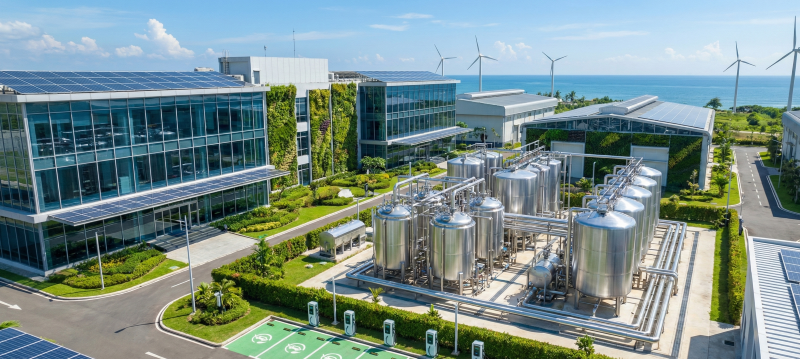
Kendal Industrial Park (KIK), internationally known as Park by the Bay, has transformed into a major investment magnet in Central Java. As a strategic collaboration between PT Jababeka Tbk and Sembcorp Development Ltd (Singapore), this park demands world-class utility infrastructure standards. For foreign and local investors building production facilities here, the availability of water with precise technical specifications is non-negotiable.
This is why Kendal industrial park RO services are among the most crucial searches during the early phases of factory construction (EPC phase). A Reverse Osmosis (RO) system is not just a regular water filter; it is the operational heart of modern manufacturing industries that require mineral-free, sterile, and consistent water.
PT Mizui Osmosa Teknovisa is here as a strategic partner in Water Treatment Plant (WTP) engineering. We understand that industrial relocation—whether in the garment, electronics, furniture, or food sectors—brings unique challenges, especially regarding Kendal’s geographical characteristics on the northern coast of Java. This article will technically dissect how to design an efficient water utility system, mitigate brackish water risks, and ensure your RO machine investment yields a maximum Return on Investment (ROI).
The massive growth in KIK is marked not only by the establishment of grand factory buildings but also by the complexity of their operational needs. As a special economic zone, the standards applied often refer to the International Organization for Standardization (ISO). Industries like semiconductors or electronics require Ultrapure Water (UPW) with conductivity approaching 0.055 µS/cm, while the food industry requires water that complies with BPOM (National Agency of Drug and Food Control) and HAS (Halal Assurance System) regulations.
The main challenge in coastal areas like Kendal is the potential for seawater intrusion and high levels of Total Dissolved Solids (TDS). Even though the park management provides clean water, the specific parameters for boilers, cooling towers, or high-grade production processes often require further treatment (polishing). This is the vital role of a competent Kendal Reverse Osmosis machine supplier. We do not just sell machines; we provide fluid engineering solutions that are adaptive to changes in raw water quality.
Building a factory from scratch (Greenfield Project) in a modern industrial park gives the engineering team the flexibility to design an integrated utility system. However, a fatal mistake that often occurs is placing the water treatment plant (WTP) installation as the last priority after civil construction is complete. In reality, a new factory water utility setup must begin during the Design & Engineering (DED) phase.
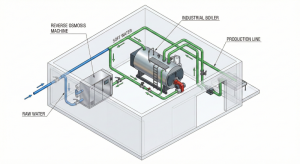
In the context of a new factory in KIK, space efficiency and piping flow are highly crucial. A good RO system must have a P&ID design that minimizes dead-legs (blind pipes) that can become breeding grounds for bacteria. PT Mizui Osmosa Teknovisa recommends a linear integration from the Raw Water Tank, Pre-treatment system, RO unit, down to the Distribution Loop.
For the food and pharmaceutical industries, piping materials must use Stainless Steel 316L with sanitary orbital welding to prevent corrosion and contamination. Meanwhile, for the garment or furniture industries, using Schedule 80 PVC or HDPE might be sufficient, but the working pressure of the High-Pressure pump must still be accounted for.
Given increasingly stringent environmental regulations and the Eco-Industrial Park vision promoted by KIK, many new factories are now requesting hybrid designs. This means a Central Java factory RO installation not only treats clean water into pure water but is also designed to re-treat wastewater from the WWTP (Wastewater Treatment Plant) into process water (Water Recycling). The Zero Liquid Discharge (ZLD) concept is starting to be widely applied, where the reject water (concentrate) from the RO is not simply discarded but is re-treated using evaporators or a second-stage RO (High Recovery RO).
One of the most strategic decisions for a factory operational manager is determining the raw water source. In industrial parks, the choice usually narrows down to two sources: surface water managed by the park (Industrial Water/PDAM) or drilling groundwater (Deep Well). A deep understanding of deep well vs. Kendal municipal water raw water quality heavily dictates the specifications of the RO machine to be installed.
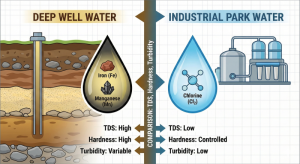
Geologically, Kendal is located on a coastal alluvial plain. Extracting deep groundwater (more than 100 meters) carries a high risk of seawater intrusion, especially if extraction is done massively.
Salinity & TDS: Well water in coastal areas often has a TDS above 1000 ppm and can even be brackish. This requires the use of Brackish Water (BW) or even Seawater (SW) type RO membranes if the intrusion is severe, which naturally increases CAPEX and OPEX.
Iron (Fe) and Manganese (Mn) Content: Groundwater in northern Central Java tends to have high Fe and Mn content. Without adequate pre-treatment (such as a Manganese Greensand Filter or aeration oxidation), the RO membrane will experience fouling (clogging) within weeks.
Conversely, the water supplied by KIK management (usually sourced from treated rivers or reservoirs) has a much more stable quality compared to groundwater.
Stable TDS: Usually ranges between 150-300 ppm.
Low Turbidity: Turbidity has already been handled at the central WTP. However, park water still contains Chlorine (disinfection residue), which is fatal to Polyamide (TFC) type RO membranes. Therefore, a KIK area pure water vendor like us will always recommend the installation of a large-capacity Activated Carbon Filter to neutralize free chlorine before the water enters the RO unit.
In conclusion, although the cost per cubic meter of park water might be higher than pumping your own groundwater (if a SIPA permit is available), its quality stability is much safer for the longevity of your production machines.
Important Note: You can view water infrastructure standards on the official park website or national investment references like the BKPM (Investment Coordinating Board) to understand groundwater utilization regulations for foreign investors.
The textile and garment industry is one of the largest tenants in the Kendal Industrial Park. In wet processing (dyeing, bleaching, and finishing), the biggest enemy is not bacteria, but water hardness. Therefore, implementing a water softening system for the textile industry is a technical mandate that cannot be ignored.
Water with high hardness contains excess Calcium and Magnesium ions. If this water is used directly in the dyeing process, these ions will react with the dyes and soaps, causing:
Uneven Color (Spotting): The dyed results become patchy and do not meet color matching standards.
Chemical Wastage: More detergents and auxiliaries are needed to achieve the desired results.
Scale in Boilers: The textile industry relies heavily on steam. Hard boiler feed water will form scale on the fire tubes, drastically reducing thermal efficiency and potentially triggering a boiler explosion due to overheating.
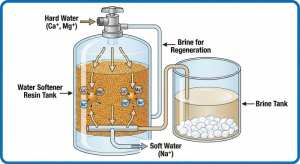
As an experienced Park by the Bay WTP contractor, we implement a Cation Exchange Resin system. This system works by exchanging Ca2+ and Mg2+ ions in the water with Sodium (Na+) ions, which are soft and do not form scale. The modern Softener machines we offer are equipped with Automatic Control Valves (like Fleck or Runxin brands) that automatically regulate the regeneration cycle using a brine solution (NaCl). For textile factories operating 24 hours, we recommend a Twin Alternating or Duplex System configuration, where one tank filters while the other regenerates, guaranteeing an uninterrupted supply of soft water.
When discussing investment, the most frequently asked question by new factory owners is about the budget. However, it must be understood that the price of industrial RO machines 2000 GPD and above varies greatly depending on the component specifications and materials used. A capacity of 2000 GPD (Gallons Per Day) or the equivalent of ±300 liters per hour is entry-level for small-to-medium industries. For large factories in KIK, capacities often reach 10,000 to 50,000 GPD.
As a transparent Kendal industrial water filter installation service, here are the components that influence the price structure:
RO Membrane Type: The membrane is the most expensive component. Renowned brands like Dow Filmtec (Dupont), Toray (Japan), or Hydranautics (USA) are priced higher than generic Chinese membranes, but offer salt rejection up to 99.5% and longer durability against fouling.
Frame and Piping Material: Given Kendal’s location near the sea, the ambient air tends to be corrosive. Using a Stainless Steel (SS304) frame is the minimum standard. For food or pharmaceutical applications, Sanitary Grade SS316 must be used, which can be 30-40% more expensive than PVC-based systems.
High-Pressure Pump: The pump is the largest energy consumer. We use vertical multistage pumps (like Grundfos, CNP, or Ebara) that are energy efficient. Cheap pumps often waste electricity and overheat quickly.
Automation (PLC vs. Relay): Systems with PLC (Programmable Logic Controller) based control panels and touchscreen HMIs (Human Machine Interfaces) allow for real-time monitoring (TDS, Flow, Pressure) and integration into the factory’s SCADA system. This is more expensive than conventional relay-based panels but makes maintenance much easier.
Although the initial investment (CAPEX) looks large, the production cost of independent RO water is much cheaper than buying demin water in tanks or industrial gallon water. The production cost of independent RO water (electricity + consumables) ranges from IDR 15,000 – IDR 25,000 per m³. Compare this to buying industrial water from a third party, which can reach IDR 70,000 – IDR 100,000 per m³ (including transportation). Usually, the Break-Even Point (BEP) is reached within 12 to 18 months of operation.
Investing in advanced machinery will be in vain without the support of disciplined after-sales service. Routine RO filter maintenance is the key to keeping machine performance at peak efficiency for 5-10 years. In highly active industrial parks, water machine downtime means a halt in the production line, leading to massive financial losses.
PT Mizui Osmosa Teknovisa implements standard maintenance procedures that include:
Cartridge Filter Replacement (Sediment Filter): 5-micron or 1-micron spun filters in blue housings (Big Blue) serve as the final guard before the membrane. These must be replaced routinely every 2 weeks to 1 month, depending on raw water turbidity. If replaced late, the Pressure Drop will increase and burden the pump.
Daily Operational Monitoring (Log Sheet): Operators must record daily parameters: Inlet Pressure, Permeate Flow, Concentrate Flow, and TDS. Drastic changes in these parameters are early indications of a problem.
Cleaning In Place (CIP): When water production capacity drops by 10-15% or pressure rises, the membrane needs to be chemically cleaned. We use acidic solutions (for mineral scale) and basic solutions (for organic/biofouling) circulated using a dedicated CIP unit.
Antiscalant Dosing: The correct dosage of antiscalant chemicals is vital to prevent the formation of silica or calcium scale on the membrane surface, especially for raw water with high hardness.
Many factories in KIK are now switching to an annual service contract system. Under this scheme, our technicians perform scheduled periodic visits, water laboratory analyses, and filter media replacements (Sand, Carbon, Resin). This frees up the factory’s operational team to focus on core production, while water matters are handled by experts.
(You can learn more about industrial clean water standards and maintenance parameters through technical guidelines frequently published by international water quality associations or relevant local references.)
Building a production facility in the Kendal Industrial Park is a strategic step for your business toward the global market. However, long-term operational success heavily relies on utility resilience, especially water. From discussing the New factory water utility setup to the technical details of a Water softening system for the textile industry, it is clear that water treatment is a discipline requiring specific expertise.
PT Mizui Osmosa Teknovisa positions itself not just as an equipment seller, but as your technical consultant and long-term partner. With a deep understanding of Kendal’s hydrogeological characteristics and the challenges of Deep well vs. Kendal municipal water raw water quality, we design RO systems that are robust, energy-efficient, and easy to maintain.
Are you in the planning stages for a new factory, or looking to upgrade your existing water system? Don’t let water quality issues hinder your production.
Butuh bantuan? Tim kami siap membantu.