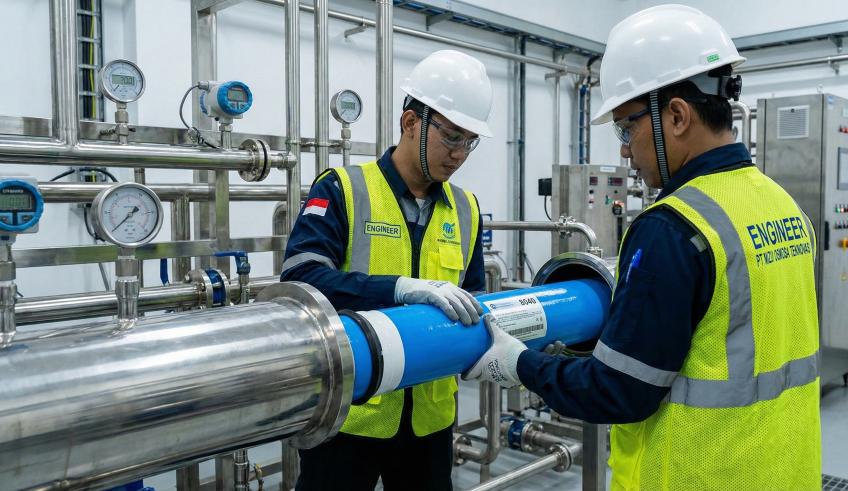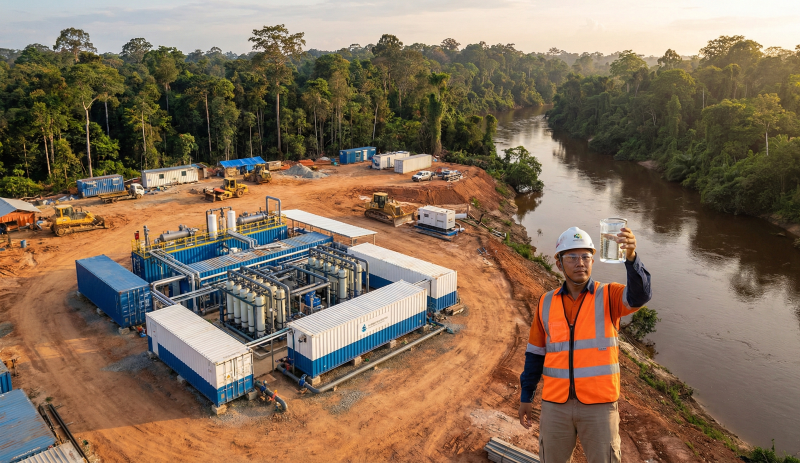
The massive infrastructure development in Ibu Kota Nusantara (IKN) and the expansion of the mining and palm oil plantation sectors in East Kalimantan present unique logistical challenges. One of the biggest challenges, often overlooked during the initial planning stages but becoming critical during field execution, is the availability of clean water. For EPC (Engineering, Procurement, Construction) contractors and site operational managers, finding a viable water source amidst wetlands is a logistical nightmare. Kalimantan peat water treatment services have become a strategic key to ensuring project continuity and the health of thousands of workers operating in remote locations.
PT Mizui Osmosa Teknovisa is here as a strategic partner with a precise engineering approach. We understand that water in Kalimantan is not just “dirty,” but possesses specific chemical characteristics that cannot be resolved with standard conventional water filters. This article will deeply dissect the technicalities of peat water treatment (swamp water treatment), ranging from chemical engineering to increase pH and the removal of organic substances, to installation designs for worker camps.
Before diving into technical solutions, we need to dissect our “enemy”: Peat Water. In the Kutai Kartanegara, Penajam Paser Utara (the location of IKN), and deep within the Kalimantan forests, surface water sources are dominated by swamp water. Visually, this water is brownish-red like tea, but chemically, it contains high complexity.
The brown color is not caused by ordinary mud, but by the high content of dissolved organic substances, particularly humic acid and fulvic acid, resulting from the decomposition of tropical rainforest vegetation buried for thousands of years. This condition creates water with a very low pH (highly acidic), often ranging from pH 3.0 to 5.0.
For Balikpapan swamp water WTP contractors and surrounding areas, the main challenge is not just clarifying the color, but stabilizing the water so it is safe for the skin, non-corrosive to installation pipes, and meets health quality standards. If this type of water is used directly for bathing or washing without proper treatment, the risk of skin irritation (dermatitis) among workers will increase drastically, ultimately decreasing project productivity.
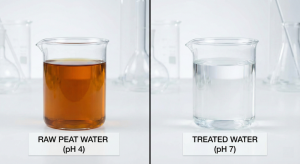
As a reference for Site Managers, here is the general profile of raw water at Kalimantan project locations:
High Acidity: pH < 5 (Highly corrosive).
High Organic Matter: KMnO4 (Organic Substance) values well above the threshold.
True Color: Caused by dissolved materials, not suspended particles.
Metal Content: Often accompanied by Iron (Fe) and Manganese (Mn) bound to organic substances.
The first and most crucial step in a brown/tea-colored water purification system is pH neutralization. Why must this be done first? Because the coagulation process (clumping of impurities) will not run optimally if the water’s pH is still in an extremely acidic condition. Most coagulant chemicals have a specific working pH range. If the pH is too low, the coagulant will fail to react, and the water will remain cloudy even if you pour in tons of chemicals.
In Water Treatment Plant (WTP) engineering, raising the pH is not merely about adding a “base chemical.” Precise stoichiometric calculations are required to determine the alkalinity demand.
PT Mizui Osmosa Teknovisa recommends several chemical options (alkalis) based on field conditions and project budgets:
Soda Ash (Sodium Carbonate / Na₂CO₃): This is the most common and safe option for medium to large-scale WTPs in remote areas. Soda Ash is a white powder, easily soluble, and increases alkalinity without drastically raising water hardness. Its reaction is milder compared to Caustic Soda, meaning the risk of overdosing and causing the pH to spike drastically is smaller.
Caustic Soda (Sodium Hydroxide / NaOH): This chemical is very strong in raising pH. It is usually used in liquid form (dissolved flakes). Its advantages are a very fast reaction and a relatively small required dosage. However, handling it requires strict OHS (Occupational Health and Safety) procedures due to its highly corrosive and exothermic (heat-generating) nature when dissolved.
Limestone (Lime / Ca(OH)₂): The cheapest option, often used in palm oil plantations. However, lime has low solubility and produces a lot of sludge residue in the sedimentation tank. Using lime also increases water hardness (making the water hard/slippery and difficult to lather), which can cause scaling in distribution pipes and boilers later on.
In our WTP design, the neutralization process is carried out in the Rapid Mixing Tank. The pH of the incoming raw water is monitored in real-time using a pH meter. A dosing pump will automatically inject the Soda Ash or Caustic Soda solution based on the desired set-point (usually a target pH of 7.0 – 7.5). This pH change transition is important to prepare the water for the coagulation stage.
The main problem with peat water is not just the pH, but the organic content that gives it its characteristic color and earthy smell. The removal of organic substances in swamp water is the stage that distinguishes advanced IKN Nusantara Peat Water Treatment technology from ordinary well water filters. Organic substances like humic acid are stable colloids with a negative charge, causing them to repel each other and resist settling naturally (by gravity).
Besides aesthetic issues, organic substances are precursors (raw materials) for the formation of carcinogenic compounds called Trihalomethanes (THMs) if they react with chlorine during the final disinfection stage. Therefore, organic substances must be removed before the final chlorination process.
There are two main approaches we implement at PT Mizui Osmosa Teknovisa:
Pre-Oxidation (Optional & Controlled): In cases of highly concentrated organic turbidity, a pre-oxidation process using strong oxidizers like Chlorine (Pre-chlorination) or Potassium Permanganate (KMnO₄) is sometimes necessary. The goal is to break the bonds of organic carbon chains to make them easier to coagulate. However, this dosage must be very precise. If excessive, it will instead cause chemical taste and odor problems.
Activated Carbon Adsorption (Polishing): Although most organic substances will bind and settle during the coagulation-flocculation process, residual color and odor substances will be absorbed (adsorbed) using an Activated Carbon Filter in the final stage. We use coconut shell-based activated carbon with a high Iodine Number (>800-1000 mg/g), which has a very large micro-pore surface area, making it effective for absorbing organic molecules that cause residual odors and colors.
Given these highly acidic conditions and organic loads, a purely physical approach (like passing water through sand) will not work. Smart chemical intervention is needed to separate organic substances from pure water. This is the bridge to the next stage: Coagulant Dosing.
After the pH is raised to near neutral (pH 6.5 – 7.5), the water is ready for the coagulation process. Peat water coagulant chemical dosing (PAC/Alum) is the heart of the physio-chemical purification process. The principle is to destabilize the negative charges on peat water colloidal particles by adding positively charged ions from the coagulant.
In field practices in Kalimantan, debates often occur between using Alum (Aluminum Sulfate) or PAC (Poly Aluminium Chloride). As experts, here is the comparison:
Alum (Aluminum Sulfate / Al₂(SO₄)₃):
Pros: Cheap and easily available in local markets like Samarinda or Balikpapan.
Cons: Works effectively within a narrow pH range. Alum tends to significantly lower the water’s pH when it reacts (consuming alkalinity). This means if you use Alum, you might need to add more Soda Ash to keep the pH neutral.
Performance: The resulting flocs (clumps of dirt) are usually lighter and take a long time to settle.
PAC (Poly Aluminium Chloride):
Pros: It is an inorganic polymer with longer molecular chains and a higher positive charge. PAC works effectively over a broader pH range and does not lower the water’s pH as drastically as Alum.
Performance: Produces larger, denser flocs that settle much faster. This is extremely crucial for compact or mobile WTP units that have limited retention time.
Recommendation: For Kalimantan wetland clean water solutions, PT Mizui Osmosa Teknovisa highly recommends using PAC, especially for peat water with a high organic load. The time efficiency and clearer results are worth the slightly higher price.
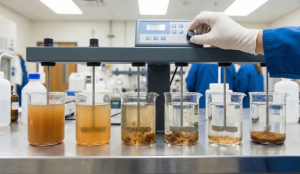
There is no universal “magic dose.” Peat water in Kutai Kartanegara can have different characteristics from peat water in Penajam. Therefore, determining the injection dose (ppm) must be preceded by a Jar Test.
Our engineers will take a raw water sample, then simulate mixing with various doses (e.g., 20 ppm, 40 ppm, 60 ppm, etc.) in laboratory beakers. The optimal dose is the lowest dose capable of producing thick flocs with the fastest clear water (supernatant) separation. Errors in dosing (under-dosing or over-dosing) will lead to sedimentation process failure, where the water remains cloudy or the flocs break apart again.
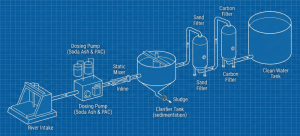
The IKN construction project is a race against time. Thousands of workers are brought in, and barracks (camps) are built in a matter of weeks. The municipal waterworks (PDAM) pipeline infrastructure has not yet entered the area, while the need for water for bathing, washing, and toilets (MCK) as well as drinking water is extremely urgent. This is where Mobile or Containerized WTP installations for IKN construction worker camps become the best solution.
PT Mizui Osmosa Teknovisa designs WTP systems integrated inside containers (20ft or 40ft in size) or mounted on sturdy steel skid frames. We call this the Plug-and-Play concept.
High Mobility: Units are assembled and tested (FAT – Factory Acceptance Test) in our workshop. Upon arriving at the IKN project site, the unit only needs to be connected to the raw water source (river/reservoir) and a power source (Genset).
Terrain Resilience: Designed to withstand transportation shocks on Kalimantan’s off-road tracks and extreme weather.
Flexible Capacity: We provide units with capacities ranging from 5 m³/hour to 50 m³/hour, tailored to the number of workers.
For example, a construction site camp accommodates 1,000 workers.
Estimated domestic clean water requirement: 120 – 150 liters/person/day.
Total requirement: 1,000 people x 150 liters = 150,000 liters/day (150 m³/day).
WTP operational hours: 10 hours/day.
Required WTP capacity: 15 m³/hour.
With peat water to drinking water filter equipment (optional with an additional Reverse Osmosis system), we can divide the output into two lines: 90% clean water for sanitation (MCK) and 10% further processed into safe drinking water, reducing reliance on purchasing expensive bottled water that is difficult to distribute.
The structure of our WTP units generally consists of:
Intake Pump (Mud-resistant suction pump).
Static Mixer (Chemical mixer).
Flocculation & Clarifier Tank (Cone/lamella-shaped settling tank).
Intermediary Tank.
Filter Tank (Sand Filter & Carbon Filter).
Disinfection Unit (Chlorine/UV Dosing).
All the technological engineering above culminates in one thing: Regulatory Compliance. For mining companies and SOE/Private contractors in IKN, environmental health and safety (HSE) issues are an absolute priority. Using raw swamp water without treatments that meet standards is a serious violation.
The main reference we use is the Clean Water Standard of the Ministry of Health of the Republic of Indonesia Regulation Number 32 of 2017 concerning Environmental Health Quality Standards and Water Health Requirements for Sanitation Hygiene, Swimming Pools, Solus Per Aqua (SPA), and Public Baths.
For Sanitation Hygiene purposes (Bathing/Washing), the treated water from PT Mizui Osmosa Teknovisa’s WTP is guaranteed to meet the following parameters:
Physical Parameters:
Turbidity: Maximum 25 NTU. Our treated water usually reaches < 5 NTU (very clear).
Color: Maximum 50 TCU. Peat water originally at 300-500 TCU will be reduced to clear, colorless water.
Odor: Odorless.
TDS (Total Dissolved Solids): Maximum 1000 mg/l.
Chemical Parameters:
pH: Must be in the range of 6.5 – 8.5. This is crucial to prevent skin irritation among workers.
Iron (Fe): Maximum 1.0 mg/l.
Manganese (Mn): Maximum 0.5 mg/l.
Organic Substances (KMnO₄): Maximum 10 mg/l. This is an indicator of successful organic substance removal from swamp water.
Microbiological Parameters:
Total Coliform: Maximum 50 CFU/100ml.
E. Coli: 0 CFU/100ml.
This is achieved through a final disinfection process using Chlorine, with free chlorine maintained at 0.2 – 0.5 ppm at the end of the distribution taps to prevent bacterial recontamination.
It is important to note that for drinking water (potable water) needs, the standard used is different, namely Permenkes No. 492 of 2010. If the client requires drinking water, PT Mizui Osmosa Teknovisa will add Ultrafiltration (UF) or Reverse Osmosis (RO) modules and Ultraviolet (UV) sterilization after the standard WTP unit to guarantee the water is 100% sterile and free of harmful minerals.
Managing water in East Kalimantan, especially to support national strategic projects in IKN Nusantara, requires more than just water filter sellers. It requires a deep understanding of swamp water chemistry, efficient process engineering, and equipment durability in the field. Acidic, colored, and organic-rich peat water can be transformed into clear and healthy clean water through the stages of: pH Neutralization, Organic Oxidation, Coagulation-Flocculation with PAC, Media Filtration, and Disinfection.
PT Mizui Osmosa Teknovisa is ready to be your technical partner. We do not just provide equipment, but offer end-to-end solutions: starting from raw water laboratory analysis, engineering design, fabrication, and installation, to commissioning and local operator training.
Do not let poor water quality hinder project progress or disrupt your team’s health. Ensure the clean water needs of your IKN, mining, and plantation projects are met with the correct engineering standards.
Ready for a consultation regarding peat water problems at your location? Contact our engineering team for a site survey and further technical discussions.
Butuh bantuan? Tim kami siap membantu.