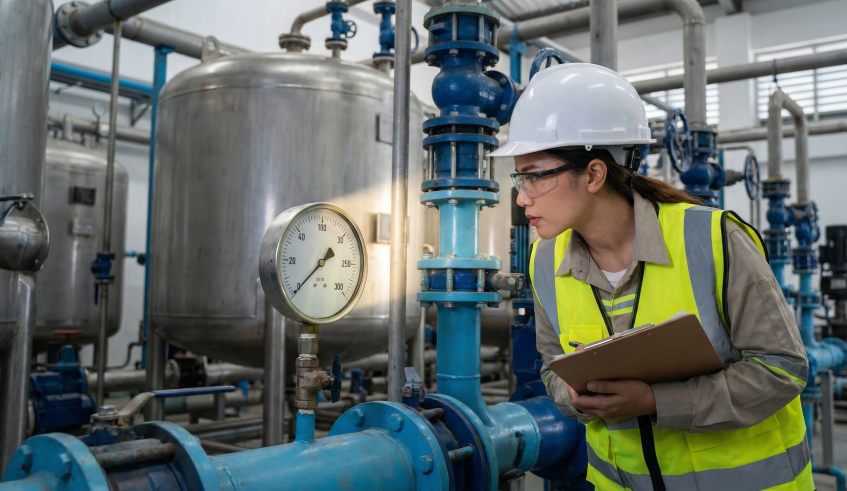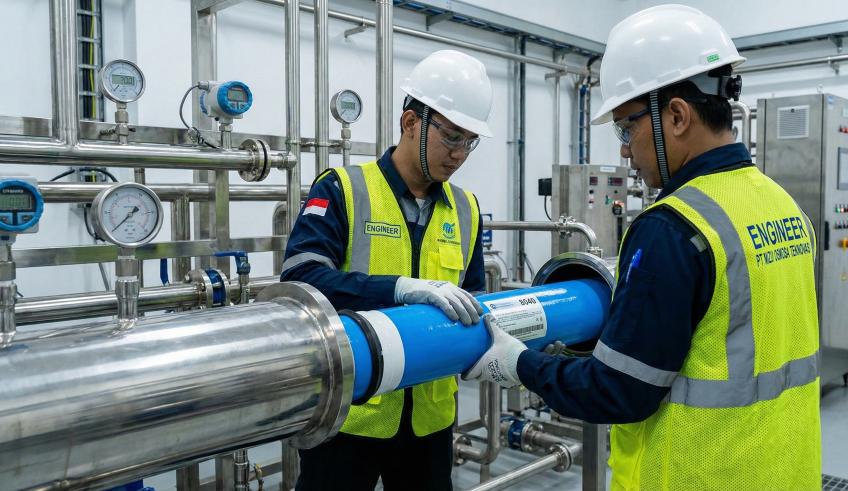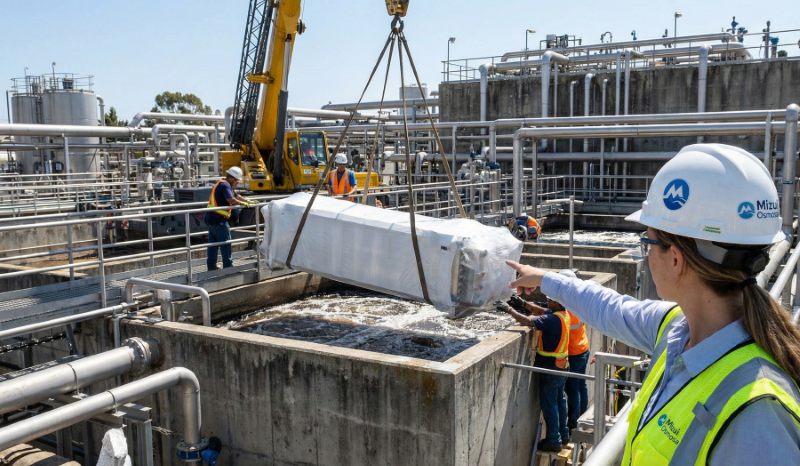
Amidst the dynamics of the manufacturing industry that demand accelerated production, operational decision-makers are often faced with a crucial infrastructure dilemma. When plant output targets are increased, wastewater volume automatically surges. However, existing wastewater treatment infrastructure is often not designed for this future load. This is where PT Mizui Osmosa Teknovasi comes in to provide a solution through precise WWTP capacity upgrade services, turning spatial limitations into efficiency opportunities through advanced process engineering.
As your strategic partner, we understand that building new ponds is no longer a viable option in industrial estates where land prices are skyrocketing. Therefore, our approach focuses on process intensification—maximizing every square meter of your current biological reactor to treat a pollutant load two to three times larger.
For industrial sectors such as Food & Beverage, Textile, and Pharmaceuticals, increased production capacity is a positive sign of business growth. However, technically, this brings serious consequences to the wastewater mass balance. Often, the Wastewater Treatment Plant (WWTP) is designed based on the plant’s initial capacity with a limited safety factor. When expansion occurs, the WWTP becomes the main bottleneck threatening the continuity of operational permits.
Forcing a wastewater flow rate that exceeds the design capacity into a conventional system (like standard Activated Sludge) is a highly risky move. The main problem is not just overflowing water, but the failure of the biological process. When the inlet flow increases drastically, the Hydraulic Retention Time (HRT) in the aeration tank becomes too short.
Consequently, decomposing bacteria do not have enough time to degrade organic pollutants (BOD/COD). Even worse, the high flow velocity causes a sludge washout phenomenon—where the bacterial biomass that should settle in the clarifier is instead carried out with the effluent. If this happens, environmental quality standard parameters will definitely be violated. Therefore, adding WWTP capacity is not just about adding pumps, but rebalancing the biological reaction kinetics within the reactor.
Traditionally, the solution to increasing capacity is to increase tank volume (extensification). However, reality on the ground often dictates otherwise. The plant area is already filled with raw material warehouses, new production lines, or utility areas. There is no remaining land to physically expand the wastewater ponds.
Furthermore, civil works for constructing new concrete ponds take months (3-6 months) and require massive capital expenditure (CAPEX). Not to mention the operational disruptions caused by heavy construction work in an active plant area. In this context, process re-engineering or WWTP re-design services that utilize existing tanks become the only logical and cost-effective way out.
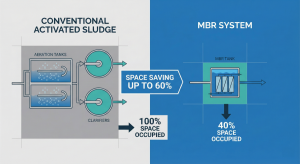
PT Mizui Osmosa Teknovasi applies a Process Intensification approach. The philosophy is simple: if we cannot enlarge the “house” (tank) for the bacteria, then we must increase the “population density” (bacterial population) inside the house so it can consume a larger pollutant load.
In conventional systems, the concentration of active sludge or Mixed Liquor Suspended Solids (MLSS) is usually maintained between 3,000 – 4,000 mg/L. If it exceeds that, the Clarifier will not be able to settle the sludge.
However, with the modern technology we offer, we can increase the MLSS to 8,000 – 12,000 mg/L. With a bacterial population that is 3 times denser, the same reactor can treat an organic load 3 times higher. This is the main key to successful sewage treatment plant uprating. The challenge is how to keep that many bacteria alive and prevent them from washing out. The answer lies in attached growth media and membrane separation technology.
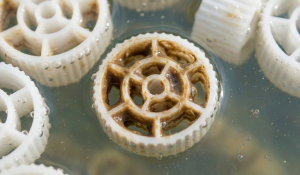
One of our favorite methods for utilizing MBBR technology for WWTP upgrades is to introduce carrier media into the aeration tank. These media are special plastic beads (usually HDPE) with a geometric design that maximizes Surface Area.
Unlike free-floating activated sludge, in an MBBR system, bacteria grow to form a slime layer (biofilm) that attaches firmly to the surface of the carrier media. These media move freely in the aerated wastewater.
The technical advantage lies in the Protected Surface Area. Modern MBBR media can have a specific surface area of up to 800 – 1,000 m²/m³. This means that in 1 cubic meter of tank volume, there are 1,000 square meters of “land” for the bacteria to work on. This makes the system highly resistant to shock loading and extremely effective for nitrification (Ammonia reduction).
(Further references regarding biofilm efficiency in wastewater treatment can be found in publications by the Water Environment Federation (WEF), which consistently highlights the stability of the attached growth process compared to suspended growth.)
If your space constraints are extreme or you require highly clear treated water quality (e.g., for water recycling), then converting a conventional WWTP to a modern one using MBR is the Ultimate Solution.
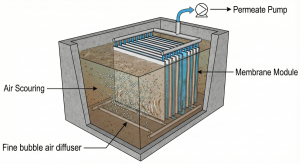
Eliminating the Sedimentation Tank (Clarifier) with Advanced Membranes: In conventional systems, separating clean water and bacterial sludge relies on gravity in a sedimentation tank (Secondary Clarifier). This process is slow and requires a very large pond. MBR replaces this gravity function with physical filtration using micro-porous membranes (usually 0.04 microns for Ultrafiltration). The membrane modules are submerged directly into the aeration tank (Submerged MBR). A permeate pump draws clean water through the membrane pores, while sludge, bacteria, and viruses are completely retained outside. Consequently, a Clarifier tank is no longer needed. The former Clarifier land can be repurposed into an additional aeration tank or even a new production area. This is the most spatially efficient form of WWTP civil engineering.
Superior Output Quality for Direct Utility Water Recycle: A key design parameter in MBR is Flux—the flow rate of water passing through per unit of membrane area (Liters/m²/hour). With precise flux control, MBR produces effluent with turbidity approaching zero and undetectable TSS (Total Suspended Solids). This quality far exceeds government standards. In fact, MBR effluent often qualifies as feed water for Reverse Osmosis (RO) systems or can be directly recycled for utility needs such as cooling tower makeup water or plant watering, providing circular economic added value for your plant. (In-depth research on membrane performance in industrial applications can be studied through leading membrane technology journals.)
We don’t just sell products; we sell a process guarantee. Every WWTP capacity upgrade service project at PT Mizui Osmosa begins with a comprehensive technical audit.
Before a single bolt is installed, our process engineering team performs detailed calculations of industrial wastewater flow and pollutant loads. We analyze the current F/M (Food to Microorganism) ratio and project future F/M needs.
If the organic load (BOD) increases by 200%, we must ensure the supplied oxygen amount (Oxygen Transfer Rate) also increases proportionally. Often, upgrading biological capacity must be accompanied by upgrading the aeration system (e.g., replacing surface aerators with fine bubble diffusers) to support the respiration of the now much denser bacterial population. This simulation ensures that the new system will run stoichiometrically stable.
We understand that your plant cannot stop operating just because the WWTP is being upgraded. Therefore, our construction strategy focuses on Online Retrofitting.
We design temporary bypass scenarios or use portable skid-mounted systems while the main tank is modified. The installation of MBBR media support structures or MBR module frames is done in stages (tank by tank) or using pre-fabrication methods that minimize on-site installation time. With this method, the transition from the old system to the new system runs smoothly with minimal operational disruption.
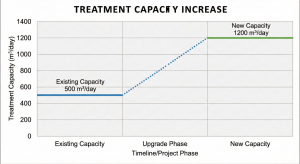
Land limitations should not be a barrier to your company’s expansion. With a combination of deep process engineering expertise and cutting-edge technologies like MBBR and MBR, PT Mizui Osmosa Teknovasi is ready to transform your old wastewater treatment facility into a high-performance and future-proof unit.
We offer solutions that not only solve environmental compliance issues but also provide long-term operational efficiency.
Ready to increase your WWTP capacity without needing to acquire new land? Contact our expert team today for a technical consultation and a free site assessment. Let’s ensure your environmental infrastructure is ready to support your business ambitions.
Butuh bantuan? Tim kami siap membantu.