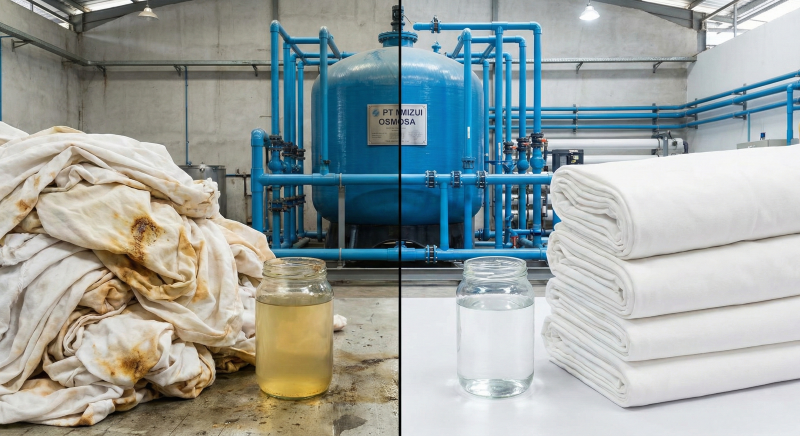
For large-scale manufacturing, textile, and laundry industry players, water is not just a supporting utility; it is a critical raw material. But what happens if your raw water contains invisible dissolved metals? An industrial iron removal water filter is a strategic investment often overlooked until a major problem arises.
As a Senior Process Engineer at PT Mizui Osmosa Teknovasi, I often encounter cases where factories suffer billions of rupiah in losses due to permanent yellow stains on fabrics or boiler machine damage, simply because they ignored the iron (Fe) and manganese (Mn) content in their groundwater.
This article is not just a sales brochure. It is an in-depth technical guide to diagnosing, understanding the chemical reactions behind “rusty” water, and implementing the right filtration solution to stop the financial bleeding in your business.
In the field, I often hear complaints from factory managers: “Sir, when pumped from the borehole, the water is crystal clear. But why does it turn muddy brown and smell fishy after sitting in the storage tank for 2 hours?”
This is a classic symptom. Iron problems in industrial water are often deceptive. The initial clarity catches many business owners off guard, leading them to feed the water directly into the production line without pre-treatment. Yet, at the molecular level, a disaster is waiting to happen.
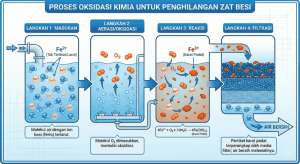
To understand the solution, we must dissect the chemistry. Iron in groundwater usually exists as Ferrous Iron (Fe²⁺). The main characteristic of Fe²⁺ is that it is water-soluble and colorless. This is why the water looks clear right out of the well tap.
However, once this water comes into contact with air (oxygen) in an open storage tank, an oxidation reaction occurs. Oxygen acts as an oxidizer that alters the iron ions. The chemical formula is:
In simpler terms: The “invisible” dissolved iron (Fe²⁺) reacts with oxygen to form Ferric Iron (Fe³⁺) or Ferric Hydroxide (Fe(OH)₃). This is the form we see as brick-red, yellow, or brown solid particles. It is these particles that then settle, stick to fabric fibers, and clog RO (Reverse Osmosis) membranes if you have them.
Without this understanding, many factories try to filter the water directly from the well pump using standard cartridge filters. The result? The filter ruptures within hours because the iron is still in a dissolved state when passing through the filter, and only precipitates after passing through it—right onto your products.
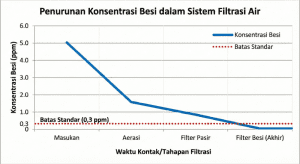
For the dyeing and commercial laundry industries, the characteristics of high-iron water are the primary enemy of quality. Clean water standards for the textile industry are much stricter than drinking water standards regarding metal content. According to the Water Quality Association (WQA), the ideal iron tolerance limit for the textile industry is below 0.1 ppm (mg/L).
If iron levels exceed this threshold, the impacts are highly destructive:
Dyeing Spotting: Rust particles react with chemical dyestuffs, causing fabric colors to become dull or creating permanent stains.
Fabric Fiber Damage: Iron and manganese are oxidative catalysts. The accumulation of metal residue on fabric fibers accelerates decay, making the fabric brittle and reducing the lifespan of the hotel or hospital linens you wash.
Pungent Metallic Odor: High-iron water leaves a highly disruptive fishy smell that often cannot be masked, even with high doses of detergent or fragrance.
Therefore, using industrial iron filter tanks is no longer an optional add-on, but a basic operational necessity to keep your product grade at an ‘A’.
At PT Mizui Osmosa Teknovasi, we don’t just sell tanks. We sell a “Process System.” Removing iron cannot be done with just one magic device; it is a series of chemical and physical processes that must be precisely engineered.
As explained earlier, physical filters can only catch solid particles. Therefore, our first strategy is to force dissolved iron into a solid state as quickly as possible. This is where the function of aeration becomes crucial.
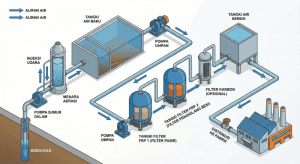
We often integrate aeration towers or venturi injectors before the water enters the storage tank. This equipment massively injects oxygen into the raw water, accelerating the oxidation reaction of Fe²⁺ to Fe³⁺. With proper aeration, the filter media’s workload is lightened because most of the iron is already oxidized before entering the filter tank. The media only has to “catch” the pre-formed precipitates rather than excessively “processing” the chemical reaction.
Many business owners try to save money by using standard silica sand. Does it work? For macro mud particles, yes. For iron? Ineffective.
Silica sand is an inert medium; it only filters impurities physically. It lacks the active capability to oxidize residual iron that hasn’t reacted with the air. This is why you need a specialized iron removal sand filter that uses active media. This active media serves a dual purpose: as a physical filter and as a catalyst (accelerating the oxidation reaction) to ensure 99% of the iron is captured. Due to this reaction, the media becomes coated with manganese oxide, which strengthens its filtration capabilities over time—something standard sand cannot do.
The heart of an industrial iron removal filter is the media inside it. We generally recommend the two best yellow water filter media on the market. The choice depends on your raw water data and operational readiness.
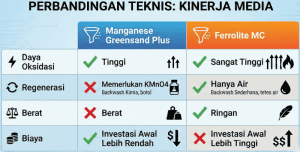
Here is a technical comparison to help you choose:
| Feature | Manganese Greensand | Ferrolite (MC/GC) |
| Working Mechanism | Contact Oxidation & Filtration | Catalytic Oxidation & Filtration |
| Regeneration Need | Mandatory periodic use of Potassium Permanganate (KMnO₄) | No chemicals needed. Only requires clean water backwash |
| Effective pH Range | pH 6.2 – 8.5 | pH 6.0 – 9.0 (More tolerant) |
| Specific Gravity | Heavy (Requires a large backwash flow rate) | Lighter (Saves backwash water) |
| Filtration Speed | Medium | High (Can handle larger flows with the same tank) |
| Our Recommendation | Suitable if there is a dedicated technician familiar with chemical handling | The best choice for low maintenance and high efficiency |
For modern factories prioritizing labor efficiency, we highly recommend Ferrolite. It does not require regeneration with hazardous chemicals like KMnO₄, reducing the risk of workplace accidents and eliminating routine chemical purchasing costs. A strong water backwash is enough to clean the media.
Manganese Greensand remains the top choice for specific cases, especially if the initial CAPEX budget is limited or if Manganese (Mn) levels are highly dominant. However, your operator must strictly inject a KMnO₄ solution every time the media is saturated. If neglected, the media will “die” and the water will turn yellow again.
The system we offer is a turn-key solution. Here are the main components of our industrial systems:
We use high-quality industrial FRP (Fiber Reinforced Plastic) filter tanks lined with food-grade resin on the inside.
Rust-Proof: Since the treated water is highly corrosive, metal tanks risk severe pitting. FRP is resistant to chemical corrosion and extreme weather.
High Pressure: Our tanks are designed to withstand pressures up to 10 bar, making them safe for large-capacity industrial pumps.
One of the biggest failures in filtration systems is human error—operators forgetting to backwash. This causes media clogging, pressure spikes, and dirty water channeling. We equip systems with Automatic Control Valves based on:
Time-Based: Automatic backwash every 2:00 AM when production halts.
Volume-Based: Automatic backwash after treating a specific volume (e.g., 100 m³) of water.
Let’s calculate the economics. Imagine you are a textile entrepreneur:
Fabric production cost: Rp 50,000/meter.
Production capacity: 10,000 meters/day.
If yellow water causes just a 5% reject rate, you lose Rp 25,000,000 per DAY.
In a month (25 working days), your losses reach Rp 625,000,000.
The investment for a 10-20 m³/hour capacity industrial iron removal water filter system from PT Mizui Osmosa is likely only a tiny fraction of your one-month loss.
Generally, our clients reach the Break-Even Point in less than 3 months post-installation, solely from savings on rejected goods and reducing the cost of bleaching agents that previously had to be overused to combat the water’s color.
Every factory’s water problem is unique. The pH, TDS, Iron, and Manganese levels at your site differ from the factory next door. As a first step,
PT Mizui Osmosa Teknovasi offers a technical consultation where we will:
Analyze your raw water lab results.
Calculate the Mass Balance to determine the exact amount of media needed.
Design a system that fits your factory’s budget and available footprint.
Don’t let iron eat away your business profits. Contact our engineering team today for further technical discussions regarding your industrial clean water solutions. Ensure your products are stain-free and your machines are scale-free.
Technical References & Quality Standards:
International water quality standards: Water Quality Association (WQA).
Butuh bantuan? Tim kami siap membantu.