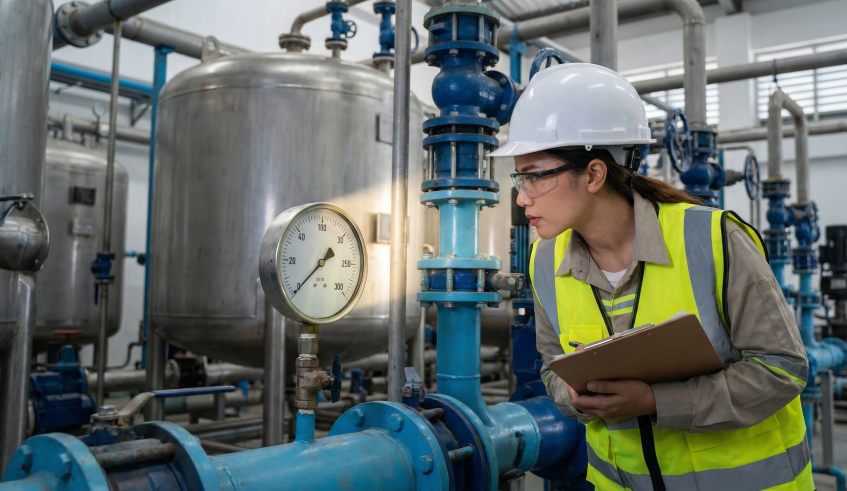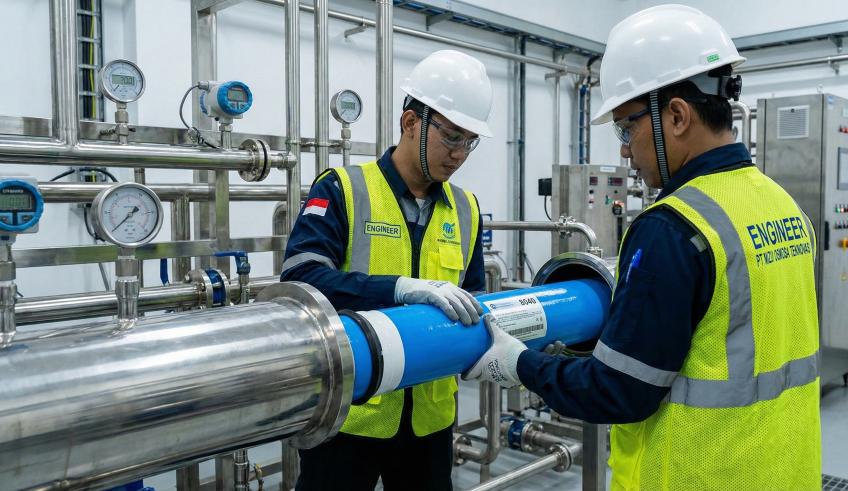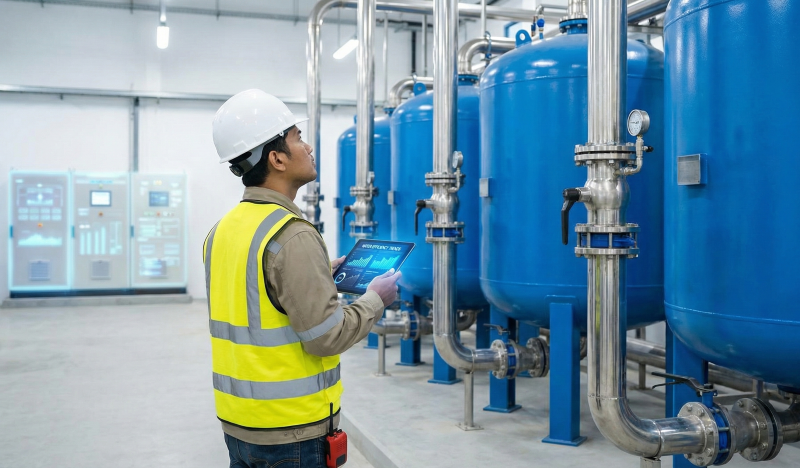
In an industrial economic climate that demands strict efficiency, forcing the purchase of a new system is not the only way out. The smartest, most economical, and technically justifiable solution is to use old water treatment system retrofit services. Retrofitting is not just patchwork repair; it is a re-engineering process to modernize existing systems so their performance is equal to—or even better than—when they were first installed, at a much lower cost compared to investing in new units.
As an engineer who has spent over 15 years in the world of factory utilities and energy efficiency, I often encounter the classic dilemma faced by Plant Managers and Engineering Heads. That dilemma is: having a Water Treatment Plant (WTP) asset that is over a decade old, its performance starting to falter, but the capital expenditure (CAPEX) budget for purchasing new units is highly limited or even frozen.
This article will dissect in-depth why your WTP system experiences performance degradation, how factory clean water installation renovation strategies are carried out technically, and the mathematical calculation of the savings you can achieve.
Water treatment systems, be it Sand Filters, Carbon Filters, Softeners, or Demineralizer Plants, have different component lifecycles. The pressure vessel structure might last 20 years, but internal parts, media, and control systems have shorter lifespans.
Often, industrial water filter system repair is delayed until a total breakdown occurs. In reality, WTP systems provide signals of inefficiency long before a total failure. Here are the technical diagnoses you need to watch out for:
The most obvious symptom of an aging WTP is the inability to reach the initial design capacity. For example, a Multimedia Filter system designed for a flow of 30 m³/hour is now only able to stabilize at 22 m³/hour. If pushed higher, turbidity parameters (NTU) or the Silt Density Index (SDI) will spike drastically.
This decline is often caused by channeling phenomena in the filter media or irreversible fouling on the membrane (if using UF/RO). In resin systems (softener/demin), a decrease in ion exchange capacity often occurs due to resin oxidation or organic fouling that cannot be recovered just by standard regeneration. As a result, regeneration frequency becomes very tight, which actually wastes water and chemicals.
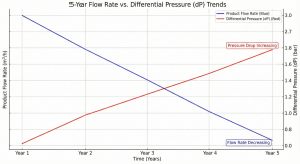
Have you ever checked the ammeter on your feed pump or distribution pump? Old systems often experience problems with pump curve efficiency. Worn impellers or loose wear rings cause the pump to work harder to produce the same pressure, drawing a larger electrical current (kWh) than it should.
Furthermore, old pressure vessel optimization is often neglected. Scaling buildup inside distribution pipes reduces the effective diameter of the pipe, increasing head loss. Consequently, the energy wasted to overcome fluid friction becomes greater. On the chemical side, manual or conventional injection systems (dosing pumps) are often inaccurate, causing overdosing of coagulants or antiscalants which not only wastes money but also accelerates clogging in downstream filters.
The physical infrastructure is the framework of your WTP. In systems that have been operating for 10-15 years, corrosion is the main enemy, especially on Carbon Steel (CS) pipes that are not well-coated. However, a more “silently deadly” problem is internal leaking in the valves.
Manual valve systems (butterfly or ball valves) that are frequently turned during long-term operation will eventually experience wear on the seats. This causes passing—dirty water leaking into the clean water line, or regenerant water leaking into the drainage. In the case of WTP revitalization, replacing these valves is a crucial step to restore process integrity.
Engineer’s Note: To understand the safety standards for pressure vessels that are still viable in the retrofit process, you can refer to the ASME Boiler and Pressure Vessel Code (BPVC) standards.
At PT Mizui Osmosa Teknovisa, we don’t immediately suggest “rip and replace”. We conduct a comprehensive audit to determine which parts are still viable (usually the skids, tanks, and main vessels) and which parts must be upgraded. Here is our technical strategy for carrying out old water treatment system retrofit services:
One of the most popular requests to upgrade sand filter to ultrafiltration recently is driven by the need for higher water quality. Conventional sand filters are generally only able to filter particles down to 20-50 microns. Meanwhile, Ultrafiltration (UF) can filter down to 0.01 microns, effectively removing bacteria, viruses, and colloids.
This retrofit process is done by:
Utilizing Old Tanks (Optional): If the sand filter tank is still good, we can change its function to a coarse pre-filter or Carbon Filter.
UF Module Installation: We design additional skids or modify old skids to install vertical UF modules.
Pipe Modification: Performing re-piping to adjust to the UF operation mode (Filtration, Backwash, CEB – Chemically Enhanced Backwash).
This upgrade allows you to get water with turbidity < 0.1 NTU without having to build a completely new WTP building.
This is a “game changer” in upgrading manual systems to auto valves. Many old factories still rely on operators to turn 5-6 valves sequentially just to perform a backwash process. The risk of human error is very high: the wrong sequence of opening and closing valves can cause filter media to be flushed out, resin to be crushed, or even water hammer that bursts pipes.
PT Mizui Osmosa Teknovisa’s solutions include:
Pneumatic/Motorized Valves: Replacing manual valves with actuator valves controlled by air or electric motors.
PLC (Programmable Logic Controller): Installing a central brain (such as Siemens, Allen-Bradley, or Omron) to control the operation sequence precisely second by second.
HMI (Human Machine Interface): Operators simply press buttons on a touch screen to monitor flow, pressure, and water quality status in real-time.
With automation, water quality consistency is maintained 24 hours a day, and labor can be allocated to more productive maintenance tasks.
Often, the “hardware” (tanks/pumps) is still good, but the “software” (media) is dead. Active sand filter media replacement, activated carbon, or ion exchange resin replacement is the cheapest retrofit step with the biggest instant impact.
However, we don’t just pour in new media randomly. Our process includes:
Old Media Extraction: Removing saturated media via vacuum or manually.
Internal Inspection: Checking the condition of the rubber/epoxy lining inside the tank and the condition of the strainers/nozzles (crepina). Often the bottom nozzles are broken, which is the cause of media frequently escaping.
Sanitization: Cleaning the tank to kill biofilms.
New Media Loading: Filling the media with the correct stratification (layer arrangement), for example, gravel at the bottom, coarse silica sand, then fine sand/anthracite.
Commissioning: Performing initial backwashing and rinsing until water parameters are achieved.
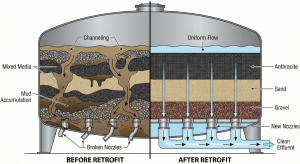
The last but crucial step is water distribution pipe cleaning. We will clean pipes narrowed by scale using chemical cleaning methods (circulating scale-dissolving chemicals) or pigging (if the pipe diameter is large). We also conduct thickness tests on pipe walls and vessels to ensure long-term operational safety.
As an efficiency consultant, I understand that management approval is always based on financial data. Let’s look at the logical comparison between carrying out WTP revitalization (Retrofit) compared to buying a new system (Replacement).
Building a new system means you pay for: Steel (Skid), Tanks (Vessels), Pipes, Pumps, Panels, Instruments, Engineering, and Installation. Meanwhile, in a Retrofit, the most expensive components (Tanks/Vessels and Skid Frames) are usually reused.
Estimated Cost of Buying New: 100%
Estimated Retrofit Cost: 30% – 50% (Depending on the extent of damage).
You can save up to 70% of the CAPEX budget by choosing the retrofit option, especially if your pressure vessels still meet safety standards.
The real savings actually occur after the retrofit is complete (Operational Expenditure):
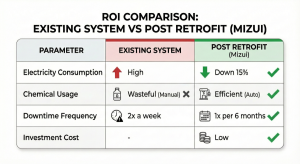
Pump Energy Savings: By cleaning pipe scale and replacing clogged media, the pressure drop (dP) decreases. The pump operates more lightly. According to a study by the Hydraulic Institute, pumping system efficiency can increase by 10-20% after pipe and valve system repairs.
Chemical Savings: With an automatic sensor-based injection system (e.g., pH controller), chemical usage becomes precise, not excessive.
Water Savings: Replacing broken nozzles and using the right media makes the backwash process more efficient, reducing wastewater by up to 30%.
Choosing a partner for old water treatment system retrofit services requires caution. You cannot hand over a vital factory asset to a contractor who only understands “laying pipes” without understanding Process Engineering principles.
PT Mizui Osmosa Teknovisa offers a different approach:
Engineering-Based Solution: We start with a data audit. We calculate mass balance, check hydraulic loading rates, and analyze raw water quality before making recommendations.
Asset Condition Transparency: We will honestly tell you if a tank is no longer viable (e.g., due to severe corrosion) and must be replaced for safety. We will not force a retrofit on dangerous equipment.
Flexible Customization: We can integrate old and new technologies. For example, keeping the old sand filter as a pre-treatment for the new UF system we install.
After-Sales Support: We provide operational training for your team to handle the newly upgraded system, ensuring your investment is safeguarded.
Don’t let your old WTP continue to burden your factory’s operational costs. Even the smallest performance drop is a real “money leak.”
Are you ready to audit your system and plan your factory clean water installation renovation?
Contact the PT Mizui Osmosa Teknovisa Engineering Team today for a free consultation and site survey. We are ready to help you turn your old system into a productive asset again.
Disclaimer: This article is written based on general Best Engineering Practices. Actual conditions in the field may require specific adjustments. Always consult with our experts for precise solutions.
Butuh bantuan? Tim kami siap membantu.