As a practitioner who has been involved for more than 15 years in the world of environmental engineering and project cost estimation (Quantity Surveying), I often encounter clients who are surprised to see the variation in figures in wastewater treatment project quotations. The most frequently asked question is: “Why can the domestic and industrial WWTP construction cost have such a wide price range?”
For business owners, whether they are office building managers, hospitals, or manufacturing plant owners, understanding this cost structure is crucial. This is not just about complying with government regulations; it is about securing long-term investments (CAPEX) and reducing operational costs (OPEX).
In this guide, PT Mizui Osmosa Teknovisa will transparently dissect how the Cost Estimate (RAB) is structured, starting from civil calculations to technology selection, so you do not make a wrong move in making financial decisions.
Determining the WWTP construction budget is not as easy as buying off-the-shelf goods. A WWTP is an integrated system that must be custom-tailored. There are main variables that make the price of one project differ significantly from another, even if the capacity seems the same.
Clients often ask about the wastewater treatment installation price per m³ without including initial laboratory test data. In fact, pollutant concentration is the main determinant of technology.
Domestic waste usually has a Biological Oxygen Demand (BOD) in the range of 200-300 mg/L. Meanwhile, industrial waste can have a BOD above 2,000 mg/L up to 10,000 mg/L, plus heavy metal or oil (FOG) content.
The higher the pollutant load, the more complex the technology required to meet quality standards according to the Minister of Environment and Forestry Regulation No. 68 of 2016. This automatically increases equipment (ME) costs and construction volume.
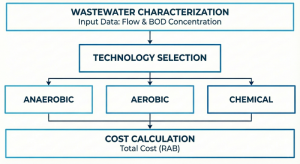
In the construction world, the law of Economy of Scale applies. On a unit calculation basis, the wastewater treatment installation price per m³ for large capacities (e.g., 500 m³/day) will be cheaper compared to small capacities (10 m³/day), even though the total project value is larger.
However, the land factor is often an obstacle. If land is limited, we cannot use space-consuming conventional ponds (extended aeration). We are forced to switch to compact technologies like MBR (Membrane Bioreactor) or build vertical tanks (towers). Vertical structures or membrane technology will significantly increase civil construction and equipment costs compared to horizontal conventional systems.
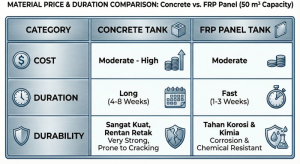
Civil works take up about 40-50% of the total domestic WWTP budget. There are two commonly used material options:
PT Mizui Osmosa Teknovisa often recommends the use of FRP for indoor or basement building locations due to ease of mobilization and clean installation.
The biofilter system is the prima donna for domestic WWTPs due to its low maintenance. Inside, there is a bacterial support media (honeycomb or bioball) that functions as a home for decomposing microorganisms.
The main cost components include:
Biofilter Media: Price per m³ of media.
Piping System: PVC AW pipes, valves, and fittings.
Transfer Pump: Usually a standard submersible pump.
As a rough idea, the communal vs factory WWTP construction cost for a simple biofilter system can be in an investment range that is much more affordable due to the minimal use of heavy machinery such as high-power roots blowers.
Moving to the industrial sector, the cost structure changes drastically. The Mechanical Electrical (ME) cost portion can exceed civil costs, reaching 50-60% of the total project value.
Industrial waste often requires coagulation and flocculation. This means you have to budget for:
Reactor Tanks: Usually Stainless Steel or FRP Coated.
Agitator Mixers: Motors and gearboxes for stirring.
Lamella Clarifiers: Settler plates to accelerate sludge settling.
Without this system, toxins in the waste will kill the bacteria in the biological unit, making your WWTP investment futile. Therefore, a competent WWTP cost estimate calculation consultant service will always include this unit if the waste characteristics demand it, rather than just cheapening the price at the beginning but failing in operation.
This is where the “heart” of the industrial WWTP cost lies. The equipment used must be heavy-duty because it operates 24 hours.
Roots Blower: To supply oxygen. The price of a quality unit (Japan/Europe/Taiwan) is far above standard ring blowers.
Diffuser: Breaks air into fine bubbles. Using high-quality EPDM or silicone membranes affects oxygen transfer efficiency.
Control Panel (PLC): Automation is key. The use of a PLC (Programmable Logic Controller) raises the initial investment but drastically reduces operator labor costs.
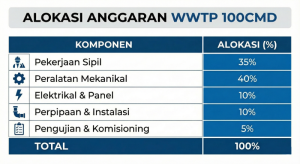
Budget Allocation Simulation for a 100 m³/day Capacity Industrial WWTP (Extended Aeration Technology):
| Work Category | Main Components | Estimated Cost % | Engineer’s Note |
| Civil Works | Excavation, K-300 Concrete, Equalization Basin, Machine Foundation | 30% – 40% | Highly dependent on soil conditions & groundwater level. |
| Mechanical Eqpt. | Blower, Submersible Pump, Dosing Pump, Diffuser, Bar Screen | 35% – 45% | Use proven brands for durability. |
| Electrical & Inst. | Control Panel, Power Cable, Level Switch, Flowmeter | 10% – 15% | Investing in automatic panels reduces human error. |
| Piping & Fitting | PVC/HDPE/Steel Pipes, Valves, Supports | 8% – 10% | Use pipe schedules appropriate for the pressure. |
| Services & Others | Engineering, Commissioning, Training, Environmental Documents | 5% – 10% | Engineering quality determines system success. |
Often, business owners are fixated on CAPEX (Capital Expenditure) or the initial construction price, and forget the WWTP operational cost components. In fact, a WWTP is a “cost center” for the lifetime of the factory’s operation.
In designing a system, PT Mizui Osmosa Teknovisa always calculates the Power Consumption Ratio. The simple formula is:
Electricity Cost = Total kW x Operating Hours x PLN Rate
If you choose a technology that is “cheap” initially but uses inefficient pumps, the monthly electricity bill can swell. The same goes for chemicals (PAC, Polymer, Chlorine). Improper dosing due to poor design will waste chemicals by up to 30-40%.
Other costs that need to be anticipated are:
Sludge Handling: Costs for vacuuming sludge or operating a Filter Press to dry B3 (hazardous) sludge.
Media Replacement: Biofilter WWTP investments require replacing or cleaning media every 5-8 years depending on conditions.
Spare Parts: Diffuser membranes need to be replaced periodically to maintain oxygen efficiency.
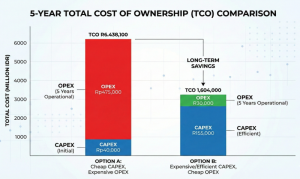
Understanding domestic and industrial WWTP construction costs requires a holistic view of the initial investment and long-term operational costs. Mistakes in determining the WWTP construction budget often occur because people only look at the total price on the bottom line of the quotation, without dissecting the technical specifications and energy efficiency offered.
RAB Transparency: We dissect every material and service cost component, so you know exactly what you are paying for.
Value Engineering: We do not just build; we analyze the most cost-effective technology options for your specific waste characteristics (e.g., replacing wasteful chemical systems with advanced biological systems).
Quality Standard Guarantee: Our designs are guaranteed to pass laboratory tests according to government regulations.
If you are currently in the budgeting stage or need an objective price comparison, do not hesitate to discuss with our expert team.
Do not let inaccurate estimates disrupt your company’s cash flow. Contact PT Mizui Osmosa Teknovisa today to get a free consultation and an honest, efficient, and high-technical-standard wastewater treatment installation price quotation.
Butuh bantuan? Tim kami siap membantu.