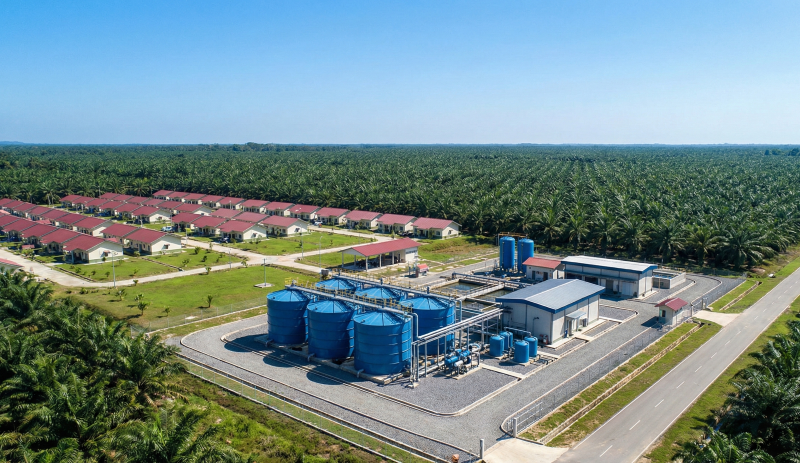
For an Estate Manager or Procurement team in the agribusiness sector, the biggest challenge is not just achieving the Fresh Fruit Bunch (FFB) production target, but ensuring that supporting infrastructure in remote areas can run optimally. One of the most crucial infrastructures is the palm oil plantation clean water treatment system. Without an adequate water supply, the operation of the Palm Oil Mill (POM) will halt, and equally importantly, the welfare of thousands of employees living in the housing complex will be threatened.
PT Mizui Osmosa Teknovasi understands that in the middle of the Kalimantan forest or the interior of Sumatra, water is the lifeblood. This article will discuss in depth how a Water Treatment Plant (WTP) system designed with engineering precision can be a solution to the logistical and geographical challenges in the palm oil plantation sector.
Building infrastructure in palm oil plantation areas (estates) has a very different level of difficulty compared to civil projects in urban areas. Locations far from public access (remote areas), extreme soil conditions, and uncertain raw water sources are daily realities. However, the availability of clean water is non-negotiable.
In the context of plantation operations, water has two vital and inseparable functions: as a domestic need for thousands of people living in the afdeling (plantation division) and as an industrial need to run turbines and steaming processes in the mill. Failure to provide either will have a systemic impact on company profitability.
The majority of palm oil plantations are opened on land close to watersheds (DAS) or peatlands. The logical consequence of this topography is the reliance of raw water sources on river surface water or borehole water which has extreme chemical characteristics.
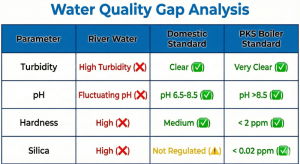
Turbid river water treatment in plantations is a technical challenge in itself. During the rainy season, the turbidity level of river water can spike drastically to over 1,000 NTU (Nephelometric Turbidity Units) due to mud erosion from upstream. Conversely, in the dry season, the water discharge shrinks and pollutant parameters become concentrated.
In addition, in peatland areas, the challenge shifts to high organic matter, very low pH (acidic), and a brownish-red water color resembling tea water. Water with these characteristics cannot be used directly, let alone consumed. If forced without adequate treatment, peat water is corrosive to iron piping and leaves permanent stains on housing sanitation, and is dangerous for skin and digestive health.
Often, plantation management focuses entirely on mill efficiency, but slightly overlooks the social aspects in the housing complex. In fact, harvester productivity highly depends on their physical condition.
Water-borne diseases such as diarrhea, typhoid, and skin diseases (scabies) are the main enemies in employee barracks that do not have access to clean water. When a harvester falls ill due to poor water quality, Man Power Planning (MPP) will be disrupted. Harvest rotation becomes delayed, leftover fruit piles up, and free fatty acids (FFA) increase, which ultimately lowers the selling price of CPO.
Therefore, plantation clean water solutions are not just overhead costs or mere CSR obligations, but strategic investments to keep man-days (working days) optimal. In accordance with ISPO (Indonesian Sustainable Palm Oil) standards, companies are obliged to guarantee workforce welfare, including the provision of proper sanitation and clean water facilities.
Reference Link: Learn more about sustainability principles and corporate social responsibility of palm oil companies on the official website of ISPO – Indonesian Sustainable Palm Oil.
As an infrastructure consultant, PT Mizui Osmosa Teknovasi differentiates its engineering approach based on the water’s intended use. We understand that POM (Palm Oil Mill) water treatment requires vastly different specifications from domestic needs.
For employee housing needs (G1 to G10) and Staff/Manager Messes, the main parameters are health and aesthetics (odorless, tasteless, colorless).
The clean water supply system for palm oil dormitories must meet the quality standards set by the government. Our main focus in designing this system is the removal of physical turbidity, pH neutralization, and bacterial disinfection (usually using chlorination).
The reference we use is the Minister of Health Regulation No. 32 of 2017 concerning Environmental Health Quality Standards and Water Health Requirements.
Reference Link: Details regarding the physical, chemical, and biological parameters of clean water can be found in Minister of Health Regulation No. 32 of 2017.
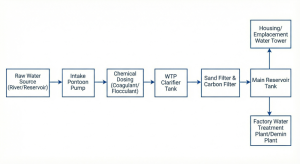
The system we offer usually includes Pre-treatment (sedimentation), multi-stage filtration (silica sand & activated carbon), as well as an energy-efficient gravity distribution system through a water tower.
Unlike domestic needs, water entering the mill, especially as boiler feed water (steam boiler), does not tolerate the presence of certain minerals.
WTP for palm oil mills must be able to remove:
Hardness: The content of lime (Ca) and Magnesium (Mg) that can cause scaling on boiler pipes. Even paper-thin scale can inhibit heat transfer, waste shell/fiber fuel, and risk causing overheating or pipe explosions.
Silica: The main enemy of steam turbines. Silica carried by steam will stick to turbine blades, causing rotational imbalance and fatal damage to the mill’s electrical generator.
For these needs, PT Mizui Osmosa Teknovasi implements advanced systems such as Demineralization Plants (Cation-Anion Resins) or industrial Reverse Osmosis (RO) systems, depending on the initial raw water quality.
The main challenge of working at plantation sites is the distant access to technicians and spare parts. Therefore, our design philosophy is: Robust, Easy to Operate, and Low Maintenance. We avoid overly complex and fully computerized systems that are prone to damage in humid and hot environments, unless specifically requested.
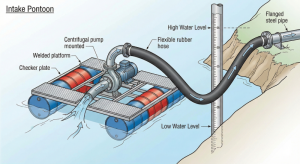
One of the classic problems in plantation water intake systems is extreme river water level fluctuations. Fixed pumps on riverbanks are often submerged during floods or run dry (sucking air) during prolonged droughts.
Our engineering solution is the use of a Pontoon Intake. The pump is placed on a steel raft/pontoon that floats following the rise and fall of the river surface. Using heavy-duty flexible pipe joints, this system guarantees the continuity of raw water supply to the WTP without being affected by river tides. Our pontoon design is also equipped with a screen (trash rack) designed so it is not easily clogged by drifting palm fronds or branches.
The heart of water treatment is the Clarifier unit. Here, we use precise coagulation and flocculation methods. Considering that river water in plantations often has a high mud load, we design sedimentation tanks with sufficient retention time capacity to ensure mud deposits are perfectly separated from clean water.
Next, the water will pass through the final filtration stage. We provide options for palm oil borehole water filters as well as river water filters using high-quality media:
Silica Sand: To filter micro-suspended particles.
Manganese Green Sand: Effective for water with high iron content (common in plantation groundwater).
Activated Carbon: To remove organic odors and the color of peat water.
Choosing a contractor for inland projects requires high trust. You are not just buying equipment, but buying long-term system reliability. Here are the reasons why PT Mizui Osmosa Teknovasi is the right strategic partner for your plantation group.
We understand that sending large filter tanks to plantation areas where road access is still laterite soil or requires crossing rivers with LCT ships is not an easy matter.
Our project team has extensive experience in site logistics management. We account for heavy equipment mobilization, road conditions during the rainy season, and technician accommodation in the field. We regularly collaborate with local civil contractors to ensure foundation and piping installations run on schedule, so that mill commissioning targets or housing placements are not delayed.
We don’t just “sell and forget.” Our services cover the full project cycle:
Survey & Water Analysis: Our team can deploy to the site to take water samples and analyze them in the laboratory to determine the most cost-effective treatment method.
Engineering Design: Creation of P&ID (Piping and Instrumentation Diagram) and layouts tailored to the available land.
Fabrication & Installation: Using industry-standard materials that are resistant to corrosion and tropical weather.
Training & Handover: This is the most important part. We train local operators (plantation employees) on how to operate the WTP, how to perform routine filter backwashes, and how to apply the correct chemical dosing. We realize that operators on plantations often have limited educational backgrounds, so we compile SOPs (Standard Operating Procedures) that are visual, simple, and easy to understand.
In labor-intensive industries such as palm oil plantations, fundamental things often have the biggest impact. A reliable palm oil plantation clean water treatment system is not just about meeting regulations, but about keeping production machines (mills) and main prime movers (employees) working optimally.
PT Mizui Osmosa Teknovasi is ready to be your engineering partner in realizing robust, efficient, and sustainable utility infrastructure. Don’t let water quality issues hinder your company’s CPO production targets.
Consult your plantation Water Treatment Plant needs today.
Contact Us:
Email: jortahim.ambarita@mizuiosmosa.co.id
Phone/WhatsApp: +62 813 1417 0122
Office Address: Jl. SMP 135 No. 37, Pondok Bambu, Duren Sawit, East Jakarta 13430
Let’s build a healthier and more productive plantation infrastructure together with PT Mizui Osmosa Teknovasi.
Butuh bantuan? Tim kami siap membantu.