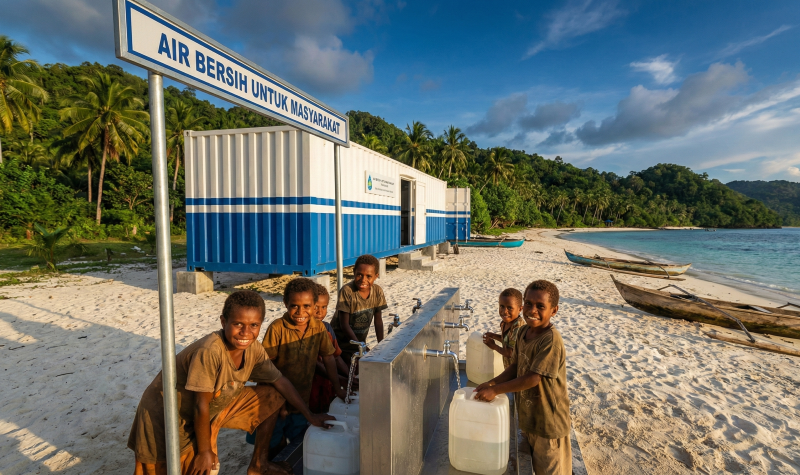
Papua possesses magnificent landscapes. The clusters of islands in Maluku also mesmerize the world. However, behind this beauty lies an irony. For communities on coastal reefs or in interior swamps, clean water is a luxury item. The lack of clean water is not just a thirst problem. In fact, it is the root of stunting and disease outbreaks. As an infrastructure consultant, I understand one crucial thing. Papua and Maluku clean water solutions cannot use ordinary approaches.
Local government officials and CSR managers often face dilemmas. Budgets have been disbursed and equipment purchased. However, installations often become abandoned within months. The reason is simple, the technology brought is unsuitable for the local environment. Extreme humidity and the absence of skilled technicians are the main enemies. Unfortunately, these factors are rarely accounted for in tender proposals.
This article is a roadmap for you. The goal is for you to build resilient water infrastructure.
Understanding Papua and Maluku means understanding extreme nature. As an Eastern Indonesia WTP system provider, we map out two main challenges.
First, we look at the Maluku archipelago region. Here, we face coral islands. Groundwater is often brackish due to seawater intrusion. Additionally, this water has high calcium levels. Consuming this water continuously is very risky. Kidneys can be damaged if the water is not treated first.
On the other hand, different challenges arise in the lowlands of Papua. The main enemy is peat and swamp water. This water is acidic and dark brown. Therefore, Papua turbid river water purification technology requires precise chemical processes. Ordinary sand filters will not be enough.
Building permanent WTP buildings on outer islands is very difficult. This often becomes a logistical nightmare. Because cement prices can reach three times the price in Java.
Another problem is electricity. Many villages only have generator electricity for 6 hours. Some even have no electricity at all. Therefore, energy efficiency becomes an absolute key.
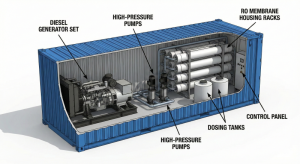
Civil construction costs are very expensive. Material mobilization is also difficult. To overcome this, PT Mizui Osmosa Teknovisa uses a modular approach. We offer an Easy-to-Ship WTP Containerized System. This is an instant yet permanent solution.
Imagine a complete clean water factory. Starting from pumps, membranes, to control panels are inside. Everything is neatly integrated within a standard ISO container.
This unit is fully assembled in our workshop. Furthermore, the unit is tested (Factory Acceptance Test) before shipping. So, field work remains only 10%. The team just needs to place the container and connect pipes.
For Jayapura & Sorong clean water contractors, this is very profitable. Project completion time can be drastically cut. Consequently, project delay risks due to rain can be avoided.
We do not use ordinary used containers. Instead, we perform special modifications:
Thermal Insulation: Inner walls are lined with heat insulators. Electronic components remain safe even in scorching hot weather.
Marine Grade Coating: The exterior is painted with ship-standard anti-rust paint. This is important to withstand salt water vapor.
Safety Flooring: Floors are made anti-slip and easy to clean.
This system ensures your assets are protected. This unit is ready to operate for decades inside a steel “fortress”.
Desalination Technology (SWRO) is vital for small islands. It is the only way to get abundant fresh water. However, many RO machines fail in Papua. The key lies in materials. We only provide rugged and low-maintenance RO machines.
Seawater is highly corrosive. Ordinary pumps will rust in a short time. Therefore, as a Papua water filter machine distributor, we have high standards.
We use Duplex Stainless Steel (SS2205). This material is used for vital pump components. As a result, corrosion resistance is far better than ordinary iron. Additionally, we use uPVC Schedule 80 pipes. This type of pipe is 100% rust-proof.
Operators on outer islands may not be engineers. Therefore, our system is designed Fool-proof.
The Auto-Flushing feature is one of our advantages. The machine will rinse the membrane with fresh water automatically. This process occurs every time the machine is turned off. This prevents salt scale from damaging the membrane. Furthermore, the control panel is designed very simply. Operators just need to press one button.
The toughest challenge is often not the technology. However, the challenge is goods delivery. Shipping to Jayapura might be easy. But, shipping to Pegunungan Bintang is an art in itself.
Heavy equipment delivery logistics to the Papua interior needs a mature strategy. We use a multimodal method:
Main Sea Transport: We use cargo ships to hub ports like Sorong or Ambon.
Feeder Vessel: Then, goods are transferred to a Landing Craft Tank (LCT). This ship can land on beaches without docks.
Pioneer Air Transport: Mountainous areas often have no land roads. For this case, WTP units are designed modularly. Components can be detached to fit into pioneer cargo planes.
We collaborate with local logistics. The goal is ensuring goods arrive intact. Packaging is done with hardwood. This step is important to withstand extreme shocks.
Not all regions need advanced technology. Sometimes, a simple approach is actually better. In villages without electricity yet, we offer a different solution.
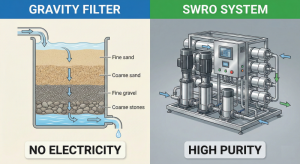
Electricity-free clean water solutions (Gravity Filter – optional) are the right answer. This system utilizes earth’s gravity. Water flows from high places through sand filters.
This technology adapts the Sand Filter system.
Energy Free: Electricity and fuel costs are truly zero.
Layered Filter Media: We arrange silica sand, activated carbon, and zeolite. This layer effectively filters mud and odors.
Easy Maintenance: Residents just need to turn a tap to wash the filter.
This is the most sustainable solution. Especially for CSR programs prioritizing citizen empowerment.
Border areas are the face of Indonesia. State Cross-Border Posts (PLBN) are now very magnificent. Nevertheless, magnificent buildings need prime utilities.
Cross-border post clean water provision has unique challenges. Water is not only for officers. But, water is also needed for border crossers and health quarantine. Water quality must meet Ministry of Health Regulation standards.
PT Mizui Osmosa Teknovisa is ready to be a technical partner. We understand the coordination between BNPP and the Ministry of Public Works and Housing (PUPR). For that, we offer Ultrafiltration technology. This technology is capable of removing 99.99% of bacteria. Even swamp water can become clear.
Buying equipment is easy. However, keeping equipment functioning is the real challenge. As a remote location drinking water installation service, we do not just sell and leave.
Every project ends with training. We train local residents to become operators. Training materials are made very visual.
We teach how to read pressure. Additionally, we teach how to mix cleaning chemicals. We also guarantee spare part availability. Thus, repair time can be accelerated if there is damage.
Building clean water access in the East requires empathy. Additionally, civil engineering resilience is needed. Natural challenges are indeed harsh. However, that can be circumvented with appropriate technology.
PT Mizui Osmosa Teknovisa is present with complete solutions. We have a practical WTP Containerized System. We also have rugged RO machines.
For decision-making Ladies/Gentlemen, this is the time to act. Let’s switch to permanent solutions. Let’s realize clean water rights for Eastern Indonesian communities.
Contact our expert team today. Get free technical consultation for your region.
Butuh bantuan? Tim kami siap membantu.