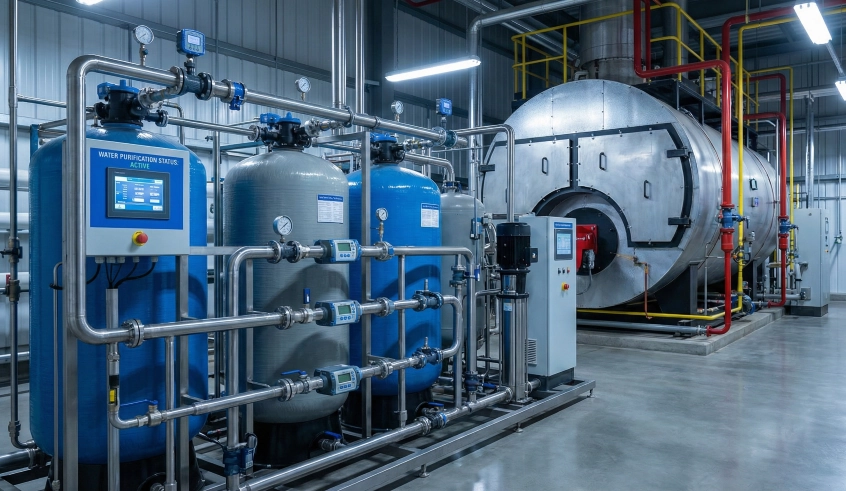
In industrial factory operations, the boiler is the thermodynamic heart that converts the chemical energy of fuel into steam enthalpy energy. Heat transfer efficiency Q from the combustion chamber to the water inside the tubes depends heavily on one variable that is often underestimated yet crucial: feed water quality.
As engineers, we understand that the main barrier to heat transfer is not the thickness of the metal pipe walls, but the thermal resistance formed by mineral deposits. A layer of scale as thin as an eggshell (less than 1 mm) can reduce thermal efficiency by 5-10%. However, the consequences are far more fatal than just fuel wastage. Deposit accumulation causes local overheating of the pipe material because water cannot effectively cool the metal. This phenomenon triggers creep rupture, material failure, and even the risk of catastrophic boiler explosions.
This is where boiler water demineralization services play a vital role. Natural water—whether from deep wells or surface water—contains Total Dissolved Solids (TDS) consisting of cations (Calcium, Magnesium, Sodium) and anions (Chloride, Sulfate, Silica, Bicarbonate). Feeding this water into a boiler without proper treatment is akin to injecting poison into your factory’s circulatory system.
PT Mizui Osmosa Teknovasi exists not just as a vendor, but as an engineering partner that understands the complexities of water chemistry. We provide comprehensive boiler water treatment solutions, ensuring that the water entering your steam generation system possesses purity that meets strict standards such as ASME (American Society of Mechanical Engineers) or other specific industrial standards.
Technical Note: To understand the basic chemistry of demineralized water, you can refer to the technical definition on Wikipedia: Demineralized Water or safety standards for pressure vessels in the ASME Boiler and Pressure Vessel Code.
Why is ordinary clean water not enough? Many plant operators assume that visually clear water is safe for boilers. This is a fatal misconception. The boiler’s biggest enemies are invisible to the naked eye; they are dissolved in ionic form.
Scale forms when the solubility of mineral salts decreases as temperature rises (inverse solubility), or when mineral concentration exceeds the saturation limit due to evaporation cycles within the boiler drum.
Besides scale, improperly treated water triggers corrosion.
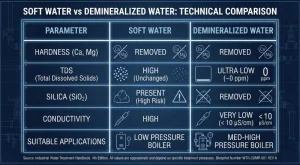
Many industries only use a Water Softener (sodium ion exchanger). While softeners are effective at removing hardness (Calcium and Magnesium), they do not reduce TDS and do not remove Silica.
In the softening process, Ca2+ ions are simply exchanged for 2Na+. The total mineral load (TDS) remains the same. For medium to high-pressure boilers (> 20 bar), high TDS and Silica from softened water cannot be tolerated as it will cause foaming, carryover, and silica deposits.
The absolute solution to this problem is a demin water system (Demineralization), where almost all dissolved minerals are removed.
The core of the boiler water demineralization services offered by PT Mizui Osmosa Teknovasi is Ion Exchange technology. This process is not just physical filtration, but an elegant reversible chemical reaction.
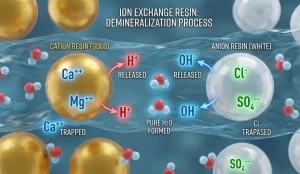
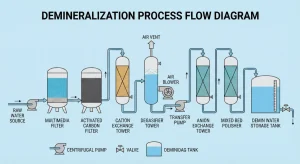
Raw water first enters the cation column. Here, cation exchange resin in the Hydrogen cycle (R-H) will capture positive ions (Cations) such as Calcium (Ca2+), Magnesium (Mg2+), and Sodium (Na+).
Simplified reaction:
R-H+Na+⟶R-Na+H+
The output from this column is acidic because mineral ions are exchanged for Hydrogen ions (H+).
For large capacity systems, water from the cation tower flows to a Degasifier Tower. The goal is to remove CO2 gas formed due to the pH drop in the cation stage. This mechanical removal of CO2 is crucial to lighten the load on the subsequent Anion Resin, saving regeneration chemical costs.
Water that is free of cations (and free of CO2) enters the anion column. Anion resin (R-OH) captures negative ions such as Chloride (Cl–), Sulfate (SO42-), and Silica (SiO2).
Simplified reaction:
R-OH+Cl-⟶R-Cl+OH–
The H+ ion from the cation stage meets the OH– from the anion stage to form H2O (Pure water).
For high-pressure boiler applications demanding very low boiler water conductivity (< 0.2 µS/cm) and Silica < 0.02 ppm, a two-column system (Cation-Anion) is often insufficient due to Sodium Slip or Silica Slip phenomena.
This is where the Mixed Bed Ion Exchanger comes in. In a single tank, cation and anion resins are mixed homogeneously. This creates the effect of thousands of mini ion exchange stages in sequence, producing ultra-high purity water. The mixed bed functions as a “polisher” or final refiner.
Resin has a saturation capacity. When the resin’s active sites are full of minerals, the resin must be regenerated.
Errors in the cation anion resin regeneration procedure are the main cause of demin system failure. Incorrect regenerant concentration, improper flow rates, or insufficient contact time will cause resin capacity to drop drastically (“Short Run”).
As specialists in boiler feed water treatment, PT Mizui Osmosa Teknovasi offers a complete spectrum of technical services:
We don’t sell “one size fits all” systems. Our engineering team performs deep raw water analysis before designing a system.
Factories often face sudden spikes in boiler water conductivity or sharp declines in throughput (product water volume). Our team is expert in:
We provide demin water plant services including the supply of ion exchange resins from leading global brands (such as Amberlite, Lewatit, Purolite, or equivalent). We also serve resin replacement (rebedding) needs, including disposal of used resin according to environmental regulations, as well as new resin conditioning so it is ready for use.
Clients often ask: “Which is better, RO or Demin?” The answer depends on raw water TDS parameters and water quality targets.
For modern high-pressure boilers, a combination is the gold standard. RO is used as pre-treatment to remove 98% of the mineral load (Bulk Removal), and the RO product water (Permeate) is polished using a Mixed Bed Ion Exchanger or EDI (Electrodeionization). This provides the best operational cost efficiency and superior water quality.
PT Mizui Osmosa Teknovasi has the capability to calculate OPEX (Operational Expenditure) between these two systems to provide the most economical recommendation for your factory.
Ignoring boiler water quality is a gamble with billions of Rupiah in assets at stake. The investment cost for professional boiler water demineralization services is only a small fraction compared to the cost of production downtime, replacement of ruptured boiler tubes, or fuel inefficiency that eats away at your company’s profits for years.
Don’t let scale and corrosion stop your production. Entust the health of your utility system to experts who understand the science behind it.
Is your boiler water conductivity often unstable? Or are you planning to build a new water treatment system?
Contact the PT Mizui Osmosa Teknovasi Technical Team now. We are ready to perform a comprehensive Water Quality & Demineralization System Audit for your facility. Get precise, efficient, and guaranteed technical solutions.
Butuh bantuan? Tim kami siap membantu.