In the era of healthcare modernization, sanitation management is no longer merely an operational add-on, but a vital foundation of patient safety and environmental sustainability. As a strategic partner for healthcare facilities (Fasyankes), PT Mizui Osmosa Teknovasi understands that hospital & clinic WWTP services are a crucial, non-negotiable need. Wastewater generated from medical activities contains a high organic pollutant load and pathogenic microorganisms which, if not managed with precision, have the potential to become a source of new disease outbreaks.
Our services are specifically designed to address the complex challenges faced by hospital management: balancing compliance with strict environmental regulations and operational efficiency. Through a measurable environmental engineering approach, we provide a Wastewater Treatment Plant (WWTP) system that guarantees the outlet.
WWTP is Not Just an Obligation: The Main Foundation of Hospital Accreditation
In the hierarchy of healthcare facility management, the existence of a functional WWTP is an absolute requirement. There is no compromise. Hospital accreditation, whether at the basic, intermediate, main, or plenary level, places waste management as one of the key assessment indicators in the Facility Management and Safety (MFK) standards. Failure to manage liquid waste not only impacts the reduction of accreditation scores but also carries serious legal risks.
As an experienced
medical WWTP contractor, we often encounter cases where healthcare facilities have a WWTP structure, but it does not function optimally (abandoned) or the treated effluent is still far above the threshold. This is often caused by errors in the Basic Engineering Design planning, which fails to account for fluctuations in wastewater discharge during peak hospital operational hours.
Fatal Risks of Infectious Waste to the Environment & Patients
Hospital wastewater is categorized as hazardous waste because it contains infectious, genotoxic, and chemical characteristics. If this wastewater seeps into groundwater or city drainage channels without adequate treatment, the risk of spreading Nosocomial Infections (INOS) or Healthcare-Associated Infections (HAIs) increases drastically.
Pathogenic bacteria such as Salmonella typhi, Vibrio cholerae, and resistant viruses can survive in wastewater. Referring to the principles of environmental epidemiology, one liter of untreated medical wastewater can contaminate thousands of liters of surrounding clean water. Therefore, the main priority is to break this chain of transmission right at its source. Our system is designed to eliminate these biological risks, ensuring the environment around the hospital remains safe for residents and patients.
Dissecting MoEF Regulation P.68/2016: The Latest Quality Standards
The primary legal foundation that serves as our working reference is the
Minister of Environment and Forestry Regulation Number P.68/Menlhk/Setjen/Kum.1/8/2016 concerning Domestic Wastewater Quality Standards. This regulation specifically sets strict parameters that every healthcare facility must comply with. The shift from the old regulation (Minister of Environment Decree No. 58 of 1995) to P.68/2016 demands more advanced technology, particularly in reducing Ammonia and Coliform Bacteria levels.
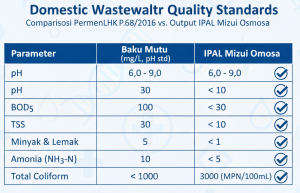
As a provider of hospital WWTP construction services, we ensure our designs are capable of consistently achieving the following parameters:
Table of Key Performance Indicators:
| Parameter | Unit | Quality Standard (MoEF Reg P.68) | Mizui Osmosa Output Standard |
| pH | – | 6 – 9 | 6.5 – 7.5 (Neutral) |
| BOD (Biological Oxygen Demand) | mg/L | 30 | < 20 |
| COD (Chemical Oxygen Demand) | mg/L | 100 | < 60 |
| TSS (Total Suspended Solids) | mg/L | 30 | < 15 |
| Oil & Grease | mg/L | 5 | < 2 |
| Ammonia | mg/L | 10 | < 5 |
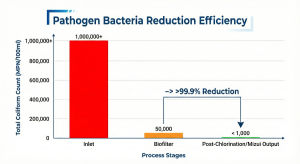
| Total Coliform | Amount/100mL | 3000 | < 1000 |
The data above shows that our technology provides a wide margin of safety, so you do not need to worry in the event of a sudden inspection from the Environmental Agency.
Typical Challenges of Healthcare Facilities: From Narrow Land to Discharge Fluctuations
Every hospital and clinic has unique characteristics. A primary clinic in an urban shophouse certainly has different land constraints compared to a Type B Regional General Hospital (RSUD) in a regency. In line with accreditation requirements that mandate spatial efficiency, we realize that healthcare facility wastewater treatment installations must not consume areas that should be used for medical services or patient waiting rooms.
Clinic WWTP Design Solutions for Limited Space (Compact Design)
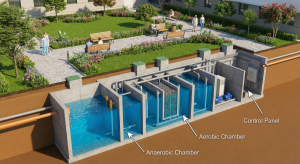
One of the flagship innovations of PT Mizui Osmosa Teknovasi is the Compact WWTP system with an underground installation method. For clinics or Type C and D hospitals located in densely populated areas, we implement modular designs that can be placed under hospital parking areas or gardens.
The technical implications of this design are highly significant:
- Zero Footprint: Does not reduce commercial/service land on the surface.
- Odor Control: The closed (anaerobic) system guarantees no foul odors will disturb the comfort of patients and surrounding residents.
- Maintained Aesthetics: The top part of the WWTP can be utilized as a green garden (landscape), creating a lush healing environment.
Managing Liquid Hazardous Waste from Laboratories & Laundry Separately
It is important for hospital management to understand that not all liquid waste can directly enter the domestic WWTP. Waste from laboratories (containing chemical reagents, heavy metals) and laundry (containing high phosphates) requires pre-treatment. As a hospital WWTP vendor that prioritizes compliance with the Indonesian Ministry of Health, we design a flow segregation system:
- Laundry Pre-treatment: Uses a coagulation-flocculation system to reduce detergent and phosphate levels before entering the main equalization tank.
- Laboratory Pre-treatment: pH neutralization and heavy metal precipitation so as not to kill the decomposing bacteria inside the biological WWTP unit.
Without this separation, the decomposing bacteria in the WWTP system will die (shock loading), causing a complete system failure.
Modern Medical Waste Treatment Technology from Mizui Osmosa
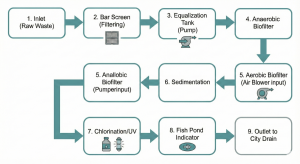
We do not use outdated conventional systems. PT Mizui Osmosa Teknovasi implements Anaerobic-Aerobic Biofilter technology combined with advanced sterilization.
Anaerobic-Aerobic Biofilter Process: The Heart of Organic Decomposition
The core process of our treatment lies in the biological reactor. We use bacterial cell media (bio-balls or honeycomb) that have a high specific surface area as a breeding ground for decomposing microorganisms.
- Anaerobic Zone: Microorganisms work without oxygen to decompose complex organic loads (long chains) into simpler compounds and reduce BOD and COD concentrations by up to 60-70%.
- Aerobic Zone: With the help of an air blower supplying micro-bubble oxygen, aerobic bacteria complete the decomposition of remaining organic pollutants and effectively eliminate ammonia odors.
Chlorination & UV Systems: Guarantee of Pathogenic Bacteria Eradication
This is the most crucial stage in the medical waste chlorination system. After the water looks clear from the biological process, it is not necessarily microbiologically safe. We apply dual disinfection:
- Measured Chlorination: Injection of liquid or tablet chlorine with precise dosage to kill Coliform bacteria and other pathogens. We use automatic dosing pumps to ensure residual chlorine levels comply with regulations (not excessive, which would poison the environment).
- Optional – UV Sterilization: For beauty clinics or premium hospitals wanting extra security, we add an Ultraviolet (UV) unit capable of destroying viral and bacterial DNA without chemical residues.
Why Do Healthcare Facilities Choose to Partner with Us?
Choosing a contractor for a vital installation like a WWTP is a long-term investment decision. Choosing the wrong vendor means risking repeated repair costs and legal sanctions.
Environmental Agency Lab Test Pass Guarantee (BOD, COD, Ammonia, Coliform)
We do not just sell equipment; we sell results. Every hospital WWTP construction project we undertake comes with a guarantee of laboratory test results accredited by KAN (National Accreditation Committee). Before the handover, our engineering team will conduct commissioning and sampling with the hospital to prove that BOD, COD, pH, Ammonia, and Coliform parameters meet MoEF Regulation P.68/2016. If the results are not compliant, we will make repairs at no additional cost.
After-Sales Support & Sanitarian Operator Training
The best technology will be useless in the hands of untrained operators. Therefore, our service package includes intensive training for sanitarian officers or Hospital Facility Maintenance Installation (IPSRS) technicians. We teach operational SOPs, how to read control panels, and handle minor issues (troubleshooting).
Additionally, we provide periodic hospital WWTP maintenance services, including sludge draining, bacterial media replacement, and checking pumps and blowers. This service ensures your WWTP’s lifespan can reach decades with stable performance.
Secure Your Hospital's Accreditation & Environment
Do not let waste management become a stumbling block for your hospital’s progress. Entrust your
hospital & clinic WWTP services to the experts. PT Mizui Osmosa Teknovasi is ready to provide technical consultation and free site surveys to design the most efficient system for your facility.