In the Food & Beverage (F&B) industry, water is not just a supporting utility, water is a primary raw material (ingredient) that comes into direct contact with the final product. Therefore, the construction of a food factory water treatment plant demands much stricter engineering standards compared to WTPs for general manufacturing or hospitality industries.
Failure to design a hygienic water treatment system can be fatal: ranging from the formation of biofilms in pipes, pathogenic microbial contamination, to product recalls that destroy brand reputation. PT Mizui Osmosa Teknovisa is here as your strategic engineering partner, ensuring every drop of water used in the production process meets, and even exceeds, national and international food regulatory standards.
The term “Food Grade” in the context of water treatment does not only refer to the final water quality result, but involves the integrity of the entire system—from tank materials, types of pipe connections, to bacterial control methods.
As an owner or quality assurance manager in a food factory, compliance with regulations is non-negotiable. In Indonesia, water quality standards for the food industry refer to several main legal frameworks, including:
Regulation of the Minister of Health No. 32 of 2017 concerning Environmental Health Quality Standards and Water Health Requirements for Sanitary Hygiene Purposes.
Regulation of the Minister of Industry No. 75/M-IND/PER/7/2010 concerning Guidelines for Good Manufacturing Practices for Processed Food (CPPOB).
SNI Standards related to bottled drinking water (if relevant to the final product).
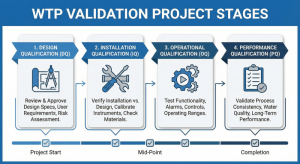
Within the HACCP (Hazard Analysis and Critical Control Points) framework, water is categorized as a critical control point. The WTP system must be designed to prevent physical, chemical, and biological hazards. PT Mizui Osmosa Teknovisa implements designs that facilitate BPOM audits with complete technical documentation (IQ, OQ, PQ).
Authority Reference: Learn more about the WHO Guidelines for Drinking-water Quality and national regulations at JDIH BPOM.
The biggest challenge in food industry water treatment installation is microorganisms. Bacteria such as E. coli, Salmonella, or Pseudomonas can multiply rapidly in areas unreached by water flow (stagnant).
The greatest risk is not in the water source, but in the distribution system (looping). Rough pipes, threaded connections, or designs that have dead-legs are favorite places for bacteria to form colonies called biofilms. Once a biofilm forms, it is very difficult to remove even with high-dose chlorination. This is why the sanitary design approach is the main differentiator of our services.
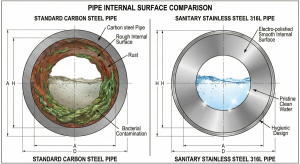
As an experienced food and beverage WTP contractor, PT Mizui Osmosa Teknovisa tolerates no compromise on material specifications. We apply pharmaceutical standards (USP) to the food industry to ensure absolute safety.
Many conventional WTP contractors offer Stainless Steel 304 (SS304) to reduce costs. However, for food grade applications involving Purified Water or heat processes, SS304 is often inadequate. We recommend the use of SS316L (Low Carbon) for all parts that come into contact with the product water (wetted parts).
Here is the technical comparison:
| Feature | Stainless Steel 304 | Stainless Steel 316L |
| Molybdenum Content | None | 2.0% – 3.0% |
| Corrosion Resistance (Pitting) | Medium | Very High (Resistant to Chlorides & Acids) |
| Biofilm Risk | Higher at welds | Very low (smoother surface) |
| Ideal Application | Raw water tanks, outdoor utility piping | F&B product water distribution pipes, Mixing Tanks |
The addition of Molybdenum to SS316L increases resistance to pitting corrosion often caused by chloride ions in water. In addition, the “L” (Low Carbon) variant prevents carbide precipitation during welding, maintaining rust resistance in the welded joint areas.
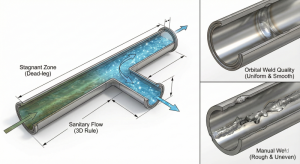
In bakery or beverage clean water systems, the pipe connection method is the key to sterility. We abandon manual welding methods (manual TIG/Argon) for critical distribution lines and switch entirely to Orbital Welding technology.
Surface Roughness (Ra Value): Our standard sanitary pipes have an internal surface roughness value (Ra) of 0.8 μm (even up to 0.4 μm for electro-polish). This glass-smooth surface prevents bacteria from adhering.
Orbital Welding: Using automated machines to weld pipes. The result is a flat and smooth 100% penetration on the inside of the pipe, without crevices where bacteria can hide.
Dead-Leg Elimination: One of the biggest enemies of sanitation is the dead-leg (blind pipe branches). Our standards follow the “6D Rule” or the stricter “3D Rule”, where the branch length must not exceed its main pipe diameter, ensuring water always circulates.
As a pharmaceutical and food WTP contractor, we implement a layered protection system (Double Barrier) for final sterilization before water enters the production line:
Ultraviolet (UV) System: Utilizes a 254 nm wavelength to instantly destroy the DNA of bacteria and viruses. We use high-intensity UV lamps with intensity monitor sensors.
Ozone (O3): Ozone is a strong oxidizer that not only kills bacteria but also destroys biofilms on the walls of pipes and storage tanks. Its self-destructing nature into pure oxygen makes the water safe for consumption without harmful chemical residues.
The construction process of a food factory water treatment plant at PT Mizui Osmosa Teknovisa follows a structured project cycle to minimize downtime and construction errors.
1. Design & Engineering Process
This stage begins with a comprehensive raw water analysis. The industrial water sterilization technology we choose will be tailored to the characteristics of your source water, whether it is groundwater, municipal water (PDAM), or surface water.
P&ID (Piping and Instrumentation Diagram): We compile detailed flow diagrams showing every valve, measuring instrument, and sampling point.
3D Layout: Ensuring efficient equipment placement and facilitating maintenance access.
2. Fabrication & Installation (On-Site)
Our certified technician team performs the installation of sanitary stainless steel piping with strict cleanliness protocols (Clean Build Protocol). During this process, pipes are cleaned (passivation) to remove free iron residues and form a passive protective oxide layer.
3. Water Quality Validation & Commissioning
Before handover, the system must go through a series of tests:
Hydrotest: Pressure test to ensure there are no leaks.
Passivation Report: Proof that the pipes have been passivated.
Lab Test: Water samples are taken from various points (inlet, after RO, return loop) and tested in a KAN-accredited laboratory for microbiological and physical-chemical parameters according to bottled drinking water regulations standards or the factory’s internal standards.
Investing in a water treatment system is an investment in your brand’s security. PT Mizui Osmosa Teknovisa does not just sell equipment; we sell quality assurance. Our advantages include:
Specific Expertise: Deep focus on High Purity WTP for the F&B and Pharmaceutical industries.
Complete Documentation: We provide manual books, as-built drawings, and material certifications (Mill Certificates) required for ISO 22000 or BPOM audits.
After-Sales Service: Periodic service contracts, provision of consumables (RO membranes, filter cartridges), and a rapid response team.
Do not let poor water quality threaten your food production line. Ensure your water system is designed with correct Sanitary Engineering principles.
Ready to raise your factory’s sanitation standards? Contact the PT Mizui Osmosa Teknovisa expert team today for a free consultation regarding the design and upgrade of your WTP system.
Butuh bantuan? Tim kami siap membantu.