In the fast-paced ecosystem of manufacturing industries—from textile plants and pulp and paper mills to regional clean water treatment facilities (PDAM)—water quality is a non-negotiable asset. As an experienced industrial PAC coagulant supplier, PT Mizui Osmosa Teknovasi understands that production stagnation due to turbid raw water is not just a technical problem, but a significant financial loss.
River water with fluctuating turbidity levels requires precise chemical intervention. This is where the vital role of Poly Aluminium Chloride (PAC) comes in. Unlike conventional coagulants, PAC offers much faster reaction efficiency and better pH stability. This article will thoroughly dissect why transitioning to PAC is a smart engineering decision and how we ensure your chemical supply chain remains secure.
For plant managers or utility engineers, treating surface water (river water) is a dynamic daily challenge. River water parameters are never static; they change with the weather, upstream activities, and seasons. The inability of a Water Treatment Plant (WTP) system to adapt to these changes will be fatal to the product water quality.
When the rainy season arrives, river water discharge increases drastically, bringing along colloidal particles, mud, and suspended organic materials. This causes a surge in turbidity levels that can reach thousands of NTU (Nephelometric Turbidity Units).
These colloidal particles are generally negatively charged, causing them to repel each other and preventing natural settling (they are stable). Without the intervention of the right sludge settling chemical, these particles will pass through to the filtration stage, causing clogging in RO membranes or sand filters, and ultimately halting production. As engineers, we know that downtime due to water quality is an operational nightmare. Therefore, selecting a coagulant with strong charge neutralization capabilities is crucial.
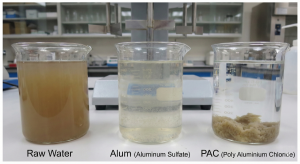
For decades, Aluminium Sulfate, known as Alum, was the prima donna of coagulants. However, modern industry standards demanding high efficiency have begun to shift away from alum usage. There are several fundamental weaknesses of alum when compared to new inorganic polymer technologies:
Drastic pH Drop: Alum consumes large amounts of water alkalinity. As a result, the treated water’s pH drops (becomes acidic), forcing operators to add large amounts of pH-balancing chemicals (like Soda Ash or Caustic Soda). This increases operational costs.
Fragile Flocs: The flocs (clumps of dirt) produced by alum tend to be small and light. The settling time becomes long, requiring massive sedimentation basins (clarifiers).
Aluminium Residue: Excessive alum use leaves high levels of dissolved aluminium residue, which can become a health and environmental regulatory issue.
Seeing these inefficiencies, many industries are now shifting to find a poly aluminium chloride distributor capable of providing more advanced solutions and saving on the Total Cost of Ownership.
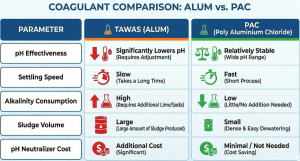
| Comparison Parameter | Alum (Aluminium Sulfate) | PAC (Poly Aluminium Chloride) |
| Effective pH Range | Narrow (pH 6.0 – 7.5) | Wide (pH 5.0 – 9.0) |
| Alkalinity Consumption | High (Makes water acidic) | Low (pH relatively stable) |
| Floc Formation Speed | Slow | Very Fast |
| Floc Structure | Small and light | Large, dense, and heavy |
| Performance in Cold Temps | Drops drastically | Remains effective |
| Sludge Residue | Large volume | Smaller volume (dense) |
Why is PAC so superior? Let’s dissect it a bit from a chemical engineering perspective. PAC is a complex inorganic polymer with the general formula Aln(OH)mCl(3n-m). The key to its power lies in its basicity degree and polymer structure.
Unlike alum, which only relies on the charge neutralization mechanism, PAC works with a dual mechanism:
Adsorption & Charge Neutralization: The strongly positive aluminium ions in PAC quickly neutralize the negative charges on the dirt/mud particles.
Polymer Bridging: Because PAC is already partially polymerized (has long molecular chains), it acts like a net that catches micro-particles and binds them together.
This phenomenon allows the formation of “bridges” between particles, resulting in flocs that are much larger in size and higher in density. According to the laws of physics (Stokes’ Law), larger and denser particles will settle at an exponential rate. This is why industries that have water clarifying PAC for sale often claim this product has a “fast reaction.”
For a deeper understanding of coagulation and flocculation mechanisms, you can refer to industry standards such as SNI 06-0084-1987 regarding Water Clarifying Chemicals or international academic literature.
(Technical Reference: Environmental Engineering Journals on Coagulant Effectiveness)
One of the biggest headaches for WTP engineers is maintaining the raw water pH so the coagulant works. Alum is very fussy; if the pH is off even slightly, the alum won’t react or will even redissolve.
PAC, thanks to the hydroxyl groups (OH⁻) in its structure, has built-in alkalinity. This makes it far more tolerant of pH fluctuations. PAC can work effectively in a pH range of 5.0 to 9.0. This means operators do not need to perform pre-treatment pH corrections as often, which directly reduces the consumption of supporting chemicals like H2SO4 or NaOH. This efficiency is exactly what an industrial PAC coagulant supplier looks to offer their clients.
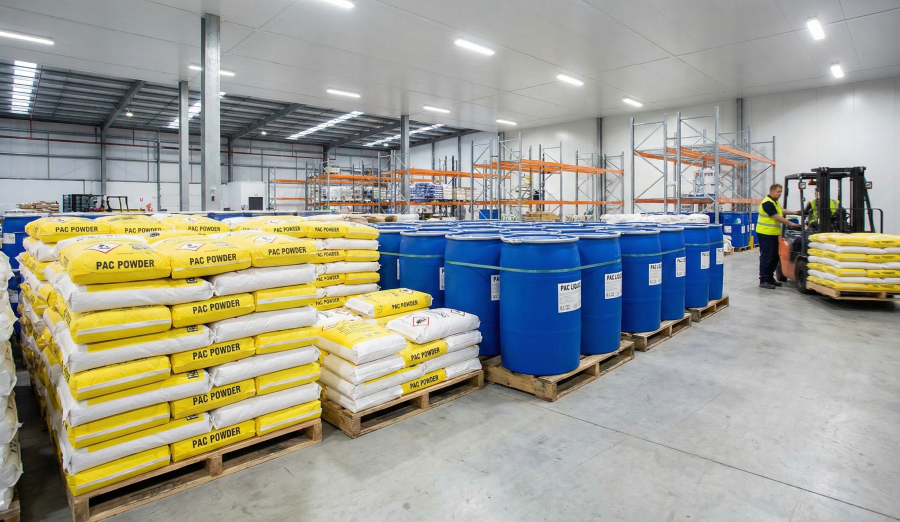
As a supply chain manager, I understand that every plant has different logistical constraints and material handling preferences. Therefore, PT Mizui Osmosa provides two main PAC variants. Choosing between powder or liquid is not just about price, but about operational strategy.
PAC Powder usually has an active content (Al2O3) of around 28-30%.
Logistical Advantage: High concentration means you are not “paying to ship water.” Highly suitable for plants located far from our distribution center in Greater Jakarta, or for off-island shipping.
Storage: Sack packaging (25kg) is easy to stack on pallets, saving warehouse footprint.
Variants: We provide Yellow PAC (standard for wastewater/river water) and White PAC (high purity for the pulp/paper industry or drinking water).
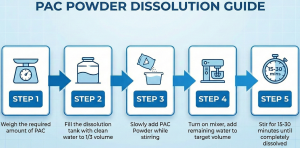
If you are looking for the most economical PAC drum/sack price for the long term and have adequate dissolving facilities (mixing tanks), the powder type is the right choice.
PAC Liquid has an active content (Al2O3) of around 10-12%.
Operational Advantage: “Plug and play.” Operators do not need to bother weighing powder, inhaling chemical dust, or waiting for the dissolving process. The risk of human error in mixing doses becomes zero.
Handling: Supplied in drums (250 kg), IBC Tanks (1000 kg), or bulk tanker trucks.
Application: Ideal for plants with limited space that do not have separate mixing tanks, or industries that prioritize a clean (dust-free) work area.
Having the best chemical is only half the solution. The other half is correct application. Often, complaints about “the chemical not working” are actually rooted in incorrect dosage determination. Here is a technical guide from our engineering team.
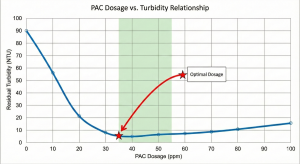
There is no “magic dose” that applies forever. The PAC dosage for turbid water is highly dependent on the current pollutant load. Therefore, a Jar Test is a mandatory ritual.
Take a sample of the actual raw water.
Prepare a PAC solution (usually 1% concentration).
Run a simulation with dosage variations (e.g., 10 ppm, 20 ppm, 30 ppm, etc.).
Observe the speed of floc formation and the clarity of the supernatant water.
The optimal dosage is the lowest dosage capable of producing clear water with an acceptable settling speed (usually < 5 minutes).
Understanding the difference between PAC and alum is not enough; you must also understand the chemical injection sequence.
Coagulation (PAC): Injected in an area with rapid mixing or a water drop. The goal is for the chemical to spread evenly and break colloidal stability instantly.
Flocculation (Anionic/Cationic Polymer): If additional flocculant is needed, inject it after the PAC has worked, in a slow mixing area. This gives the micro-flocs time to stick together without being broken apart again by rough agitation. This is the correct synergy of the function of coagulant and flocculant.
(Supporting Reference: Technical Documents on Wastewater Treatment)
As a professional in the supply chain field, I know that price per kilogram is not your only KPI. Security of supply and quality consistency are often more valuable than a slim price difference.
Running out of chemicals means utility downtime, and utility downtime means a production shutdown. We position ourselves as an industrial PAC coagulant supplier who understands this risk. Our warehouses in strategic areas maintain buffer stock to anticipate demand surges or delivery delays from upstream manufacturers. Whether you need 1 drum for a trial or 20 tons per month for a routine contract, we are ready to serve.
We are not just traders (“box shifters”). Our team consists of chemical engineers ready to conduct site visits to help you perform on-site Jar Tests, troubleshoot WTP problems, and optimize dosages for cost savings.
Our logistics fleet is accustomed to serving deliveries to major industrial estates, including complete documentation (MSDS, CoA – Certificate of Analysis, and Tax Invoices). We ensure the chemicals arrive at your plant safely and on time.
Don’t let turbid water problems hinder your plant’s productivity. Switch to scientifically proven solutions with guaranteed supply. Contact PT Mizui Osmosa Teknovasi today for free technical consultation and the best price quotes.
Butuh bantuan? Tim kami siap membantu.