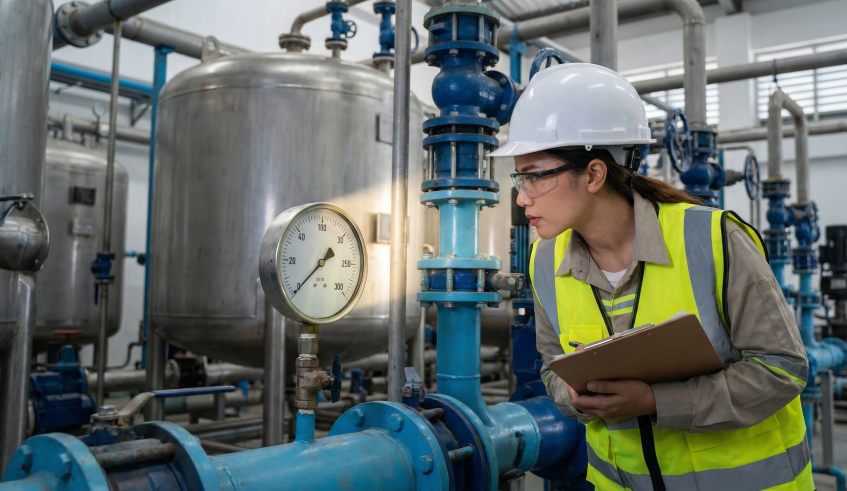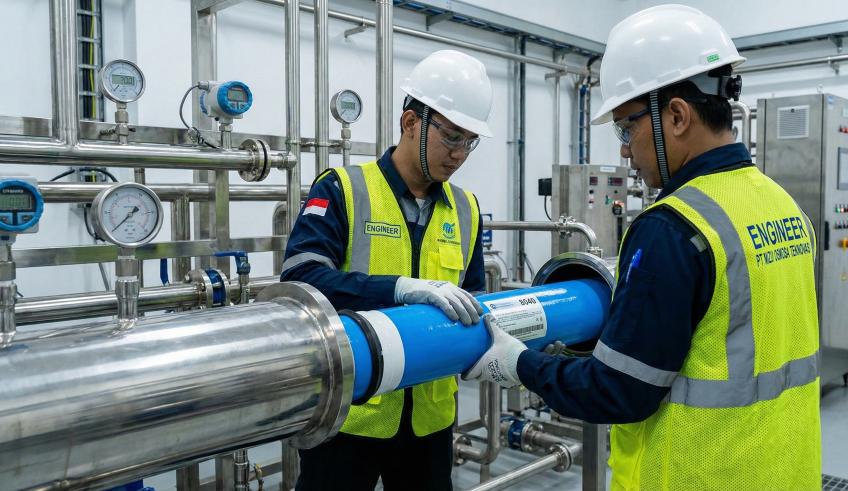
Is your desk phone constantly ringing with complaints from the security post about pungent odors? Are you starting to worry every time you see dark clouds because low air pressure often traps odors from the wastewater pond in the plant area and spreads them to residential neighborhoods?
We understand that being in your position as a Plant Manager or General Affairs right now is not easy. Foul odors from the Wastewater Treatment Plant (WWTP) are not just a technical problem, they are a reputation crisis that can lead to the sealing of your business premises. If you are looking for a WWTP odor problem consultation that provides not only theory but also measurable on-site engineering solutions, you have landed on the right page. At PT Mizui Osmosa Teknovasi, we combine a deep understanding of environmental microbiology with mechanical engineering to solve odor problems from the root.
This article will thoroughly dissect why your WWTP is suddenly emitting unpleasant aromas, the lurking health risks, and the permanent technical solutions we can implement for you.
Many industry players still underestimate odor problems as long as wastewater quality parameters (like BOD, COD, TSS) are met. However, from a social and environmental law perspective, odor is a pollution indicator most easily detected by the general public without the need for laboratory equipment.
The social impact of wastewater odors often escalates faster than other ecological impacts. Residents around the plant have a very low tolerance for air comfort disturbances. When our WWTP environmental consultants go to the field, we often find that the root of the residents’ anger is not just the smell, but the company’s slow response in handling it.
This problem usually escalates in the following pattern:
Internal Complaints: Plant employees start complaining of dizziness or nausea.
Community Complaints: Local neighborhood leaders (RT/RW) send verbal protests.
Mass Action: If unaddressed, residents stage demonstrations or blockade plant access.
Legal Intervention: The Environmental Agency (DLH) steps in to conduct field verification, which can lead to administrative sanctions up to the suspension of operational permits.
According to regulations in Indonesia, odor level standards are strictly regulated. Violating this not only damages the company’s Corporate Social Responsibility (CSR) image but also threatens the continuity of your production operations. Therefore, odor management must be prioritized on par with other wastewater parameters.
Beyond social impacts, foul odors—especially those resembling rotten eggs—are a red flag for occupational health and safety (OHS). This odor generally originates from Hydrogen Sulfide (H2S) gas. This gas is highly toxic, corrosive, and flammable.
In low concentrations, H2S produces a highly disturbing odor. Ironically, at higher concentrations (above 100 ppm), H2S can paralyze the olfactory nerves (olfactory fatigue). This means a person may no longer smell the foul odor, even though they are inhaling a lethal dose of toxic gas.
According to international safety guidelines such as the OSHA Guidelines on Hydrogen Sulfide, long-term exposure, even at low levels, can cause:
Severe eye and throat irritation.
Chronic headaches and fatigue.
Respiratory disorders.
Corrosion of electronic equipment and metal structures around the WWTP (damaging company assets).
Understanding these hazards emphasizes that investing in an odor control system is not just an expense, but a protection of human assets and infrastructure.
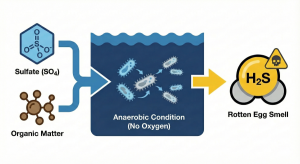
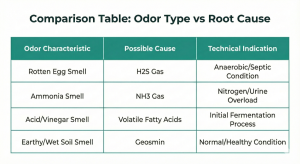
Before we talk about solutions, as experts, we must diagnose the disease first. In the WWTP odor control services we offer, we always start with the question: Why are the bacteria in your WWTP producing odorous gases? Scientifically, organic foul odors from wastewater are almost always caused by uncontrolled anaerobic (oxygen-free) decomposition processes. Here are the two “main suspects” we frequently find in the field:
1. Septic Conditions (Wild Anaerobes) in the Equalization Tank
The Equalization Basin functions to stabilize the flow rate and characteristics of wastewater before it enters the main biological process. However, this tank often becomes the primary source of odor. Why? Because it is frequently designed without sufficient mixing or aeration.
When wastewater rich in organic matter is left sitting too long without an oxygen supply, the conditions turn “septic.” This is where Sulfate-Reducing Bacteria take over. They consume organic matter using sulfate (instead of oxygen) and produce byproducts like H2S and mercaptans (organic sulfur compounds).
This is why smelly equalization tank solutions are often our first priority. If your equalization tank looks pitch black, has dirty foam, and smells pungent, it is a sign that wild anaerobic conditions are occurring.
2. The Problem of Settled and Rotting Sludge
The second factor that is often the cause of pungent WWTP odors is poor sludge management. In biological processes (like Activated Sludge), bacteria grow and die, forming biomass. This biomass must be managed.
If there is a dead zone at the bottom of the aeration tank or sedimentation tank where sludge settles and is not mixed/circulated, this sludge pile will rot. The bottom of the sludge pile gets no oxygen, creating a mini anaerobic reactor inside what should be an aerobic pond. The gas generated from the decomposition of this bottom sludge will rise to the surface as gas bubbles (rising sludge), carrying a very sharp, foul odor.
Effective WWTP sludge management includes a routine desludging schedule and ensuring the Return Activated Sludge (RAS) system functions optimally to prevent accumulation.
Once the root cause is identified, PT Mizui Osmosa Teknovasi will design a treatment strategy. We divide these solutions into process approaches (preventing gas formation) and end-of-pipe approaches (capturing the gas). Here are the proven effective steps on how to eliminate wastewater odor.
The most fundamental solution to eliminate H2S odor is to return oxygen to the system. H2S gas will not form if there is sufficient Dissolved Oxygen (DO) available (usually > 1-2 mg/L).
Technical steps we take include:
Surface Aerator or Diffuser Installation: In the equalization tank, we might suggest installing coarse bubble diffusers or submersible mixers. The goal is not full biological treatment, but just enough mixing to prevent the water from going septic.
Mixing Optimization: Ensuring there are no corners of the pond where water is stagnant. Even mixing ensures sludge remains suspended and bacteria receive oxygen.
Besides mitigating the social impact, an often-overlooked technical factor is that adding oxygen will also reduce the pollutant load (BOD) for subsequent treatment stages, thereby improving overall WWTP performance.
Sometimes, mechanical repairs take time, while residents are already pressing for action. This is where chemical and biological interventions play a role.
Chemical Treatment (Oxidizers): For emergency situations, we can use oxidizing chemicals like Hydrogen Peroxide (H2O2) or Calcium Nitrate. These work quickly by oxidizing sulfides into odorless sulfates or providing a chemical oxygen source for bacteria. This is a highly effective short-term solution to quell sudden complaints.
Bio-Augmentation: For a more environmentally friendly long-term solution, we apply the addition of nutrients for odor-decomposing bacteria. We inject specific bacterial strains (usually from the Thiobacillus genus or photosynthetic bacteria) capable of metabolizing sulfide and ammonia compounds. Unlike consumable chemicals, these bacteria will multiply and maintain the balance of the WWTP ecosystem to prevent odor production.
In some industries with extremely high waste loads (like rubber plants, crumb rubber, or petrochemicals), preventing gas formation might not be enough because the volume of gas generated is massive. If your plant is directly adjacent to a residential wall, you need a last line of defense: a wastewater odor scrubber system.
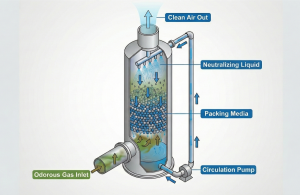
A Wet Scrubber is a gas washing tower. The working principle is simple yet highly effective:
Gas Collection: The WWTP tanks acting as odor sources are covered. Odorous gases are drawn using blowers (exhaust fans) through ducting pipes.
Scrubbing: The gas flows into the scrubber tower. Inside, the gas is sprayed with a neutralizing liquid.
For acidic odors (H2S), we use an alkaline liquid (NaOH).
For alkaline odors (Ammonia), we use an acidic liquid (H2SO4).
Alternatively, we use Water Scrubber technology with bacterial media (Bioscrubbers).
Release: The air exiting the scrubber stack is clean and meets air emission quality standards.
Not all plants need a scrubber. As honest consultants, we will only recommend this equipment if:
The distance from the WWTP to residential areas is very close (< 50 meters).
Waste loads fluctuate and frequently experience shock loading, making biological control difficult to stabilize.
The waste type contains highly volatile compounds that cannot be perfectly degraded by aeration alone.
Handling wastewater odor cannot be done by trial and error. The cost of mistakes is too high. PT Mizui Osmosa Teknovasi offers a structured approach to solving your problem.
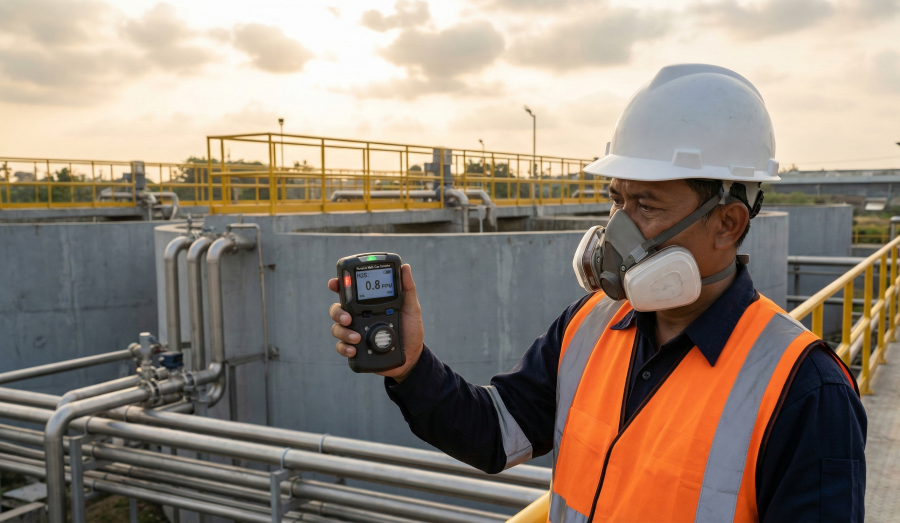
Our service starts with a site visit. Our engineering team will bring portable gas detectors to map:
Which points are the highest sources of odor (H2S, NH3, VOCs).
Dominant wind speed and direction.
The existing condition of equipment (aerators, pumps, blowers).
We cross-reference this data with applicable regulations, such as PermenLHK No. 50 of 1996 concerning Odor Level Standards, to determine the odor reduction targets that must be achieved.
We understand that a production shutdown is a massive loss. Therefore, our WWTP odor control services strategy is designed to be implemented in parallel.
Installation of chemical/bacterial dosing pumps can be done while the WWTP is running.
Piping modifications or scrubber installations are done using a temporary bypass system.
However, for permanent results, collaboration between your plant operations team and our technical team is key.
Are you ready to end the nightmare of community complaints and DLH warning letters?
Don’t wait until your plant gates are protested. Contact PT Mizui Osmosa Teknovasi now for an initial assessment. We are ready to help you create a healthy, odor-free work environment that is safe for your business.
Butuh bantuan? Tim kami siap membantu.