In today’s fast-paced industrial ecosystem, plant managers are often caught in a classic dilemma: Ever-increasing production demands are inversely proportional to the capacity of aging supporting infrastructure. One of the most critical points—and often the most expensive if ignored—is the Wastewater Treatment Plant (WWTP). If you are reading this, chances are you are looking for WWTP optimization & retrofit services capable of answering these challenges without destroying your company’s cash flow by building new facilities.
As an environmental efficiency consultant, I often encounter the misconception that a WWTP failing to meet effluent quality standards must always be replaced with a brand-new construction. This is wasteful thinking. Through the right process engineering approach, in-depth evaluation, and the integration of the latest technology into existing assets, PT Mizui Osmosa Teknovasi is here to prove that drastic performance improvements can be achieved with a retrofitting strategy.
The reality on the ground shows that the majority of industrial estates in Indonesia, especially in Greater Jakarta and East Java, operate WWTPs designed 10 to 15 years ago. At that time, quality standard parameters might not have been as strict as the current Minister of Environment and Forestry Regulation No. 80 of 2019 concerning Wastewater Quality Standards for Industrial Businesses and/or Activities.
The gap between the initial design and the actual operational load is the root of the problem. Your plant may have doubled its production line capacity, but your WWTP is still operating on the old design. As a result, the system experiences chronic overload.
Before we talk solutions, let’s make a diagnosis. A WWTP doesn’t “die” suddenly; it gives signals of declining performance that are often ignored until a warning letter from the environmental agency arrives. Some technical indicators that you need an immediate WWTP performance evaluation include:
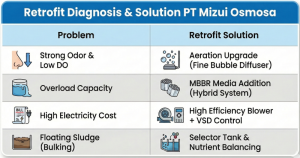
Persistent Sludge Bulking: Activated sludge struggles to settle in the clarifier, causing Total Suspended Solids (TSS) in the effluent to spike. This is often an indication of an unbalanced F/M (Food to Microorganism) ratio due to an organic load exceeding the design capacity.
Pungent Odors in Anaerobic/Aerobic Areas: Odor is an indicator of process inefficiency. In aerobic ponds, a foul smell indicates a lack of dissolved oxygen (DO), which means your aeration system is failing to supply the bacteria’s needs.
Spikes in Key Parameters (COD/BOD/Ammonia): If daily data shows sharp fluctuations (spikes) when production discharges concentrated waste (shock loading), this indicates your biological system’s buffer capacity is exhausted. A healthy system should be able to absorb these load shocks.
Swelling Energy & Chemical Costs: You keep adding coagulant/flocculant doses or running blowers 24 hours non-stop, but the results remain marginal. This is a sign of operational inefficiency eating away at OPEX (Operational Expenditure).
When the above problems arise, many conventional vendors will suggest: “You need to build a new pond, the land next door is still empty, right?”
As a Process Engineer, I advise you to be skeptical of such suggestions. Building a new WWTP means:
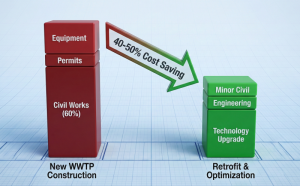
Civil Works costs that consume 50-60% of total CAPEX.
New permits (AMDAL/UKL-UPL) which are highly time-consuming.
Downtime or operational disruptions during massive construction.
Conversely, WWTP revamping or retrofitting services focus on utilizing existing civil structures. Your aeration pond’s concrete might be old, but as long as it’s not leaking, it’s a valuable asset. Our focus is on replacing the “brain” and “heart” of the system—the process technology, aeration, and bacterial media—not replacing the “container.”
The basic philosophy of industrial WWTP renovation is process intensification. How do we treat a higher pollutant load (kg COD/day) within the same tank volume (m3)? The answer lies in Specific Surface Area and Oxygen Transfer Efficiency.
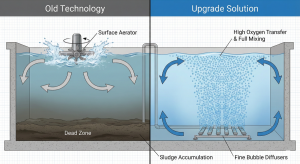
Many old WWTPs in Indonesia still use Surface Aerators (rotating surface aerators that splash water). Although robust, this technology is highly energy-inefficient and has a low Oxygen Transfer Efficiency (OTE), typically ranging only from 1.5 – 2.0 kgO2/kWh.
In the wastewater treatment plant modification process, one of the highest-impact steps we take is replacing this system with a Fine Bubble Diffuser System. Why is this considered a smart solution?
Energy Efficiency: Fine bubble diffusers have a much higher OTE (reaching 6.0 kgO2/kWh or more). This means you can achieve the same DO level with significantly lower electricity consumption.
Process Control: By using blowers equipped with Variable Speed Drives (VSD), the air supply can be automatically adjusted to follow fluctuations in waste loads.
Elimination of Dead Zones: Diffusers are installed at the bottom of the pond, ensuring even mixing from bottom to top, preventing the accumulation of dead sludge in the pond corners.
What if your aeration tank volume is mathematically insufficient to hold the required bacteria (low MLSS)? Do you have to build a new tank?
No. The existing wastewater system upgrade solution we offer is a conversion to a Moving Bed Biofilm Reactor (MBBR) or Integrated Fixed-film Activated Sludge (IFAS) system. This technology works by introducing thousands of small plastic media (bio-carriers) into the existing aeration tank. These media act as “apartment buildings” for bacteria, allowing the bacterial population (biomass) to increase 2 to 3 times without burdening the clarifier system.
No Additional Land Needed: Treatment capacity increases drastically without adding a single square meter of concrete.
Shock Loading Resistance: The biofilm attached to the media is far more resistant to toxic waste load shocks or sudden pH changes compared to free-floating bacteria.
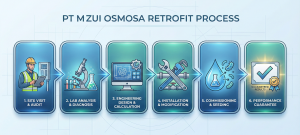
We are not just contractors who install equipment and leave. We are process engineers. Our approach to WWTP optimization & retrofit services is based on data and science, not assumptions.
Every project starts with a comprehensive Medical Check-Up of your WWTP. Often, the main problem isn’t biological capacity, but overlooked operational issues, such as water flow short-circuiting or improper chemical dosing. Our evaluation services include:
Comprehensive Sampling: Taking samples from the inlet, every process stage, up to the outlet during peak production periods.
Microbiological Analysis: Examining bacterial health under a microscope to check for filamentous bacteria (the cause of bulking) versus healthy bacteria.
Hydraulic Stress Test: Recalculating the actual Hydraulic Retention Time (HRT) to check if sedimentation is reducing the reactor’s effective volume.
Optimization isn’t always about buying expensive equipment. Often, massive savings can be achieved from a WWTP upgrade feasibility study in the chemical sector.
Many operators overdose coagulants (PAC/Ferric) and polymers out of fear of cloudy effluent. In reality, overdosing only increases the volume of chemical sludge that must be disposed of as Hazardous Waste (B3), which is very expensive per ton. We conduct precise Jar Tests to determine the optimum stoichiometry point. We also evaluate the bacteria’s nutritional needs (C:N:P Ratio). If your waste is poor in Nitrogen or Phosphorus, measured additions of urea/DAP can revive a “sluggish” biological system without heavy equipment investment.
As a decision-maker, the language you understand is ROI (Return on Investment). Let’s dissect the WWTP retrofitting cost compared to other options.
Building a new WWTP with a capacity of 500 m3/day can cost billions of rupiah, where the largest portion goes to civil works. Concrete is a passive asset; it doesn’t treat waste, it only holds water.
With activated sludge biological process optimization through retrofitting:
Investment is Focused on Active Assets: Your budget is allocated to mechanical equipment (high-efficiency blowers, pumps, diffusers, mixers) and bacterial media. These components directly reduce pollutants.
Sludge Handling Cost Reduction: An optimized system produces less, drier residual sludge. Reducing the volume of B3 sludge by just 20% can save hundreds of millions of rupiah in OPEX per year.
Space Utilization: No need to acquire new land. Your plant’s parking area or green space is safe.
The ultimate goal of all this is compliance. With the right methodology, a retrofitted system can produce effluent equivalent to, or even better than, a new system. (Based on the text’s mention of common problems and solutions, here is how we address them:)
We design systems with an adequate Safety Factor, referring to global standards like the US EPA Guidelines on Wastewater Retrofitting, to ensure your investment is safe for the next 5-10 years even as regulations tighten.
Leaving a problematic WWTP is like keeping a ticking time bomb. The social and legal costs of environmental pollution are far greater than the investment in WWTP optimization & retrofit services.
PT Mizui Osmosa Teknovasi is ready to be your strategic partner. We don’t just sell equipment; we sell performance and peace of mind.
Are you ready to conduct a health audit on your WWTP? Contact our engineering team today for a free initial consultation and site visit. Let’s turn your cost center into an efficient, regulatory-compliant, and proud facility.
Butuh bantuan? Tim kami siap membantu.