Building a successful laundry or car wash business isn’t just about location and marketing, but also about the water quality you use. Water softener machine prices are often the first question that pops into a business owner’s mind when budgeting capital expenditures (CAPEX). However, as a consultant who has handled hundreds of installations at PT Mizui Osmosa Teknovasi, I often see many entrepreneurs trapped by the lowest nominal figures without understanding the technical specifications behind them.
This article is not just a price list. It is a strategic guide for you—bulk laundry owners, car wash entrepreneurs, or plant managers—to understand what constitutes a reasonable investment value for a water softener system and how this equipment can save your business from long-term losses due to hard water (limescale water).
Many of my prospective clients ask, “Sir, do I really need this equipment? Isn’t well water enough?” The short answer is: it’s enough for washing, but not enough for a profitable business.
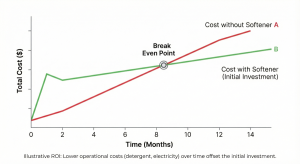
Viewed from the initial investment side, buying a softener machine does look like an additional burden. However, let’s change that mindset. A softener machine is not a consumptive expense, but a productive asset that “pays for itself” (self-liquidating asset).
Let’s talk real data. Hard water (water with high calcium and magnesium content) is detergent’s main enemy. Minerals in hard water will react with soap to form scum (insoluble soap curd), preventing lather from forming.
According to industry research and our field experience, using hard water can increase detergent consumption by 30% – 50% just to get the same lather results as soft water.
Simple Case Simulation: Imagine a medium-turnover bulk laundry spending Rp 3,000,000 per month on detergent and fragrance.
Without Softener: Detergent Cost = Rp 3,000,000/month.
With Softener: Efficiency increases, detergent cost drops by 30% = Save Rp 900,000/month.
Annual Savings: Rp 900,000 x 12 months = Rp 10,800,000 per year.
This savings figure of Rp 10 million per year often covers the installation cost of an SME-scale water softener in less than a year. This does not even include electricity savings because the washing machine’s heating element is free from limescale, making water heating much faster and more efficient.
Besides mathematical calculations, there are “intangible” factors that affect your business’s reputation.
For Laundry Businesses: Without a softener, lime minerals will be left behind in fabric fibers. The result? Towels become as rough as sandpaper, white clothes turn a dull yellowish color (graying), and fabric fibers quickly become brittle. Customer complaints about clothes not smelling good or feeling rough are the biggest risk that can destroy customer retention.
For Car Wash Businesses: Have you ever seen circular white spots on a car body or glass after it dries? Those are water spots caused by mineral deposits. The price of the water descaler equipment you pay is a guarantee that customers’ cars will be perfectly clean without the need to be wiped repeatedly and aggressively, which risks scratching the paint (swirl marks).
Conversely, if you insist on using untreated raw water to “save” on the initial budget, the risk of losing loyal customers due to poor quality is far more expensive than the price of the machine itself.
When you search for a water softener price list on the internet or marketplaces, you will find a very wide price range. Some offer packages for 2 million rupiah, while others are over 20 million rupiah for claimed “similar” capacities.
Why does this disparity occur? As an engineer, I need to provide this transparency so you don’t make the wrong purchase.
The water flow control component on the filter tank head (control valve) is one of the biggest price determinants.
Manual Valve: Uses a lever that must be turned by a human hand to perform Backwash, Brine Draw (sucking salt), and Rinse.
Pros: Very affordable price, easy maintenance, cheap spare parts.
Cons: Highly dependent on operator discipline. If the operator forgets to regenerate the salt, the machine will not function to soften the water.
Automatic Valve: Uses a digital computer/timer to perform the entire regeneration process automatically.
Pros: Guaranteed consistency. No need for a dedicated operator. It can be set to regenerate at 2 AM when operations are closed.
Cons: Higher initial price, requires a stable power supply.
If you have highly disciplined operators, the investment cost of a soft water filter can be reduced by choosing the manual option. However, for industrial scales or busy laundries, an Automatic Valve is a mandatory investment to prevent human error.
| Feature | Manual Valve Softener | Automatic Valve Softener |
| Initial Price | More Economical (Budget Friendly) | Higher (Premium) |
| Electricity Requirement | Not Needed | Needed (Low Wattage) |
| Operations | Must be monitored by operator (45-60 mins) | “Set and Forget” (Automatic) |
| Risk of Failure | High (If operator forgets/is lazy) | Very Low |
| Suitable For | Beginner Laundry, Tight Budget | Hotel Laundry, Industry, Factory |
Many rogue sellers sell cheap packages by reducing the amount of resin media or using low-quality (recycled) resin. Cation resin consists of golden-yellow beads inside the tank responsible for catching limescale.
High-Quality Resin (e.g., Dowex, Purolite brands, or Equivalent): Has high ion exchange capacity, lasts up to 3-5 years, and has strong physical beads that do not break down easily.
Cheap Resin: Saturates quickly, wastes salt during regeneration, and can break down in less than 1 year, causing blockages in the pipes.
At PT Mizui Osmosa Teknovasi, we are always transparent about the brand and the number of liters of resin we put into the tank. We do not sell “empty tanks” just to offer a low price.
Here are estimated water softener machine prices based on business needs categories. Please note that this is an investment range to give you an idea for budgeting. The actual price may change depending on the raw water conditions at your location (the higher the lime/hardness levels, the larger the required specifications).
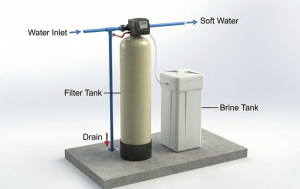
SME Package (Bulk Laundry / 1-2 Hydraulic Car Wash)
For start-up businesses with water usage of around 1,000 – 2,000 liters per day.
General Specifications: 1054 size FRP Tank, 3-Way Manual Valve, Standard Cation Resin (25-30 Liters).
Price Range: Equivalent to the price of a mid-range smartphone (Millions of Rupiah, low digits).
Value: Very affordable to start, but demands owner discipline to perform manual salt regeneration every 2-3 days.
Medium Package (Hotel Laundry / Large Car Wash)
For high-load businesses or those requiring a continuous water supply.
General Specifications: 1354 or 1665 size FRP Tank, Automatic Control Valve (Time/Flow based), Large capacity Brine Tank.
Price Range: Equivalent to the price of a new automatic scooter.
Value: Work time efficiency. Employees can focus on washing and folding, while the machine maintains itself automatically.
Industrial Package (Factory / Large Capacity Boiler)
For boiler feeding, cooling tower, or garment factory needs.
General Specifications: Duplex or Twin Tank System (One working, one regenerating alternately), 1.5 – 2 inch installation pipes, Premium industrial-grade resin.
Price Range: Contact our engineering team for custom quotes (Project Based).
Value: Guaranteed Zero Hardness 24 hours non-stop. Protects billion-rupiah boiler assets from scale that can cause explosions or leaks.
To compare industry standards, you can also look at references from professional associations like the Indonesian Laundry Association (ASLI) or check the prices of raw components on global B2B sites like Alibaba (remember, prices there do not include engineering, assembly, and warranties).
As an honest consultant, I must inform you that costs do not stop when you purchase the equipment. There are operational costs for the water softener (salt) that need to be budgeted.
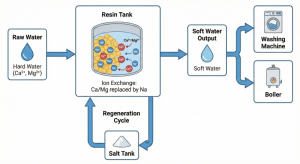
Just like a motorcycle needs gasoline, a water softener needs coarse salt (pure NaCl industrial salt) to “wash” the resin once it is saturated with captured lime.
Fact: Salt does not enter your washing water. Salt is only used during the media washing process (regeneration) and is then flushed down the drain.
Estimated Cost: Coarse salt is very cheap (around Rp 2,000 – Rp 4,000 per kg). For a small-scale laundry, you might only need 10-20 kg of salt per week.
Comparison: The cost of buying this salt is much smaller (only about 10%) compared to the detergent savings you get. So, net-net, you are still making a large profit.
One “price” component that is often forgotten is technical support. Buying a cheap, low-quality softener machine from an online store without technical support often ends up becoming junk in 6 months.
At PT Mizui Osmosa Teknovasi, the price we offer includes:
Initial Water Analysis: We don’t just install blindly. We check your water hardness levels (ppm) to determine the correct tank size.
Operator Training: We teach your staff how to maintain the equipment, how to pour the salt, and how to perform a backwash.
Spare Parts Availability: We guarantee the availability of replacement strainers, seals, and resin.
Leak Warranty: The piping installation we do is fully guaranteed.
Choosing a water softener is a strategic decision. Do you want to save on the initial investment but suffer a “slow leak” in operational costs (wasted detergent, ruined fabrics)? Or are you ready to invest a little more upfront for long-term efficiency?
By understanding water softener machine prices and the factors above, I hope you can make a wiser decision.
Want to get a specific ROI calculation for your business? Don’t hesitate to consult with the PT Mizui Osmosa Teknovasi engineering team. We are ready to help calculate the exact capacity—not too little (so it stays clean) and not too much (to save your budget).
Butuh bantuan? Tim kami siap membantu.