As an engineer who has been involved in the design and fabrication of Water Treatment Plant (WTP) systems for over a decade, I often encounter fatal flaws in pressure vessel specifications. Often, the focus is solely on the pump’s flow rate or the quality of the cation resin, while ignoring the “house” of the media itself. In fact, the industrial softener tank is a static component that bears the heaviest dynamic load in the hard water treatment cycle.
At PT Mizui Osmosa Teknovasi, we understand that tank structural failure is not just a matter of component replacement, but a potential catastrophic failure that endangers occupational safety and halts production lines. This technical article will deeply dissect the specifications, material science, and selection criteria for softener tanks—both Fiberglass Reinforced Plastic (FRP) and Mild Steel with Rubber Lining—to ensure your installation meets strict engineering standards.
In fluid system thermodynamics, pressure vessels in softener applications face far more complex challenges compared to standard multimedia filter tanks (such as Sand Filters or Carbon Filters). Ignoring this fact is the main cause of premature leaks in softener filter vessels that I frequently encounter in the field.
Mechanically, a softener tank experiences cyclic loading. During the service phase, the tank receives operating pressure (usually 4-6 Bar, with a design pressure of up to 10 Bar) from the transfer pump. However, the real challenge occurs during the regeneration phase.
During regeneration, the tank is flushed with a saturated salt solution (NaCl) or brine to reactivate the cation resin. Chloride ions (Cl–) in high concentrations are highly aggressive corrosive agents against metals. This phenomenon is known as Chloride Stress Corrosion Cracking (CSCC). In standard steel tanks without proper coating, chloride ions will penetrate the passive steel layer, causing pitting corrosion that is invisible from the outside but hollows out the tank wall thickness from the inside.
The combination of pressure fluctuations (during backwash and rinse) and this chemical attack demands a material with high tensile strength as well as superior chemical resistance. This is why industrial softener tank material specifications are non-negotiable.
In pressure vessel safety standards, as referred to in the ASME Boiler and Pressure Vessel Code (BPVC), pressure vessel failure can release massive amounts of energy. Imagine a 63-inch diameter tank operating at 6 Bar suddenly experiencing a rupture. The spray of water and resin media not only damages surrounding equipment (pumps, electrical panels, skids) but also potentially injures operators.
From an operational perspective, a ruptured tank means a total shutdown of the soft water supply to the boiler or cooling tower. The ripple effect: scaling in boiler pipes increases drastically, thermal efficiency drops, and maintenance costs soar. Therefore, selecting the right softener tank is a risk mitigation investment (Risk Management).
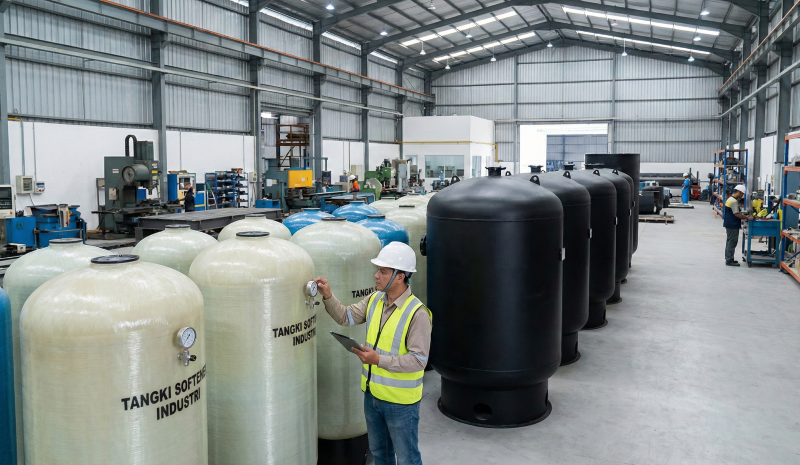
For applications with diameters up to 63 inches (or about 1.6 meters), FRP material has now become the global industry standard replacing conventional steel. These composite-based softener pressure vessels offer an exceptional strength-to-weight ratio.
The FRP tank structures we provide at PT Mizui Osmosa Teknovasi are manufactured using filament winding technology. High-quality fiberglass is precision-wound under controlled tension using high-performance epoxy resin. This creates an outer wall capable of withstanding internal burst pressure up to 4 times the normal operating pressure.
However, the secret to its chemical resistance lies in the Inner Shell. Our FRP tanks use a food-grade Polyethylene (PE) or ABS liner molded seamlessly (without weld joints).
Technical Advantage: This PE liner is completely inert (non-reactive) to saturated salt solutions. This means the risk of electrochemical corrosion is zero.
Implication: You do not need to re-coat or worry about rust contaminating the treated water, even after 10 years of use.
The flexibility of FRP allows us to provide industrial water filter tanks in various precise dimensions. The commonly used size codes (like 1054) represent the dimensions of Diameter (inches) and Height (inches).
(Note: If you have a technical specification matrix for sizes here, you can insert the table).
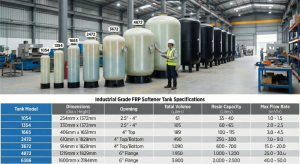
It is important to note regarding the capacity of FRP tanks 1054 to 6386: The flow rate figures mentioned are estimates at standard linear velocity. For critical applications, detailed calculations based on raw water hardness are still required.
Although FRP is superior, there are certain conditions where carbon steel (Mild Steel) tanks are the absolute choice. Especially when:
Resin volume requirements exceed 3,000 liters.
Operating temperatures exceed 50°C (the standard thermal limit of FRP).
Custom designs are required (e.g., manhole positioned on the side of the body, or limited height dimensions due to room constraints).
The Mild Steel (MS) tanks fabricated by our partners use pressure-vessel quality steel plates (such as SS400 or SA516 Gr 70) with wall thicknesses calculated based on Hoop Stress Calculations. The main advantage of MS is its toughness against physical impact and its ability to withstand extreme pipe vibrations.
However, as discussed earlier, steel is not resistant to brine. This is where coating technology plays a vital role.
Many novice contractors try to save costs by replacing Rubber Lining with standard Epoxy paint. This is a huge mistake. Epoxy, although chemically resistant, is brittle and has a different expansion coefficient than steel. Due to tank pressure fluctuations (expanding and contracting on a micron scale), the epoxy layer will develop micro-cracking, paving the way for corrosion.
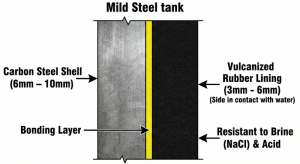
The advantages of the rubber lined tank solution we offer utilize natural or synthetic rubber vulcanized directly to the inner wall of the tank.
Thickness: Our standard is 3mm – 6mm.
Elasticity: Rubber has high elasticity, so it follows the tank’s expansion/contraction movements without cracking.
Application: The coating process is carried out by sandblasting to SA 2.5 first, applying a primer, attaching rubber sheets, and curing with hot steam (vulcanization) to ensure a perfect molecular bond between the rubber and the steel.
As engineers, we do not choose products based on “guesswork,” but based on data. Here is a practical guide to choosing the appropriate pressure vessel.
The numeric codes on FRP tanks are international standards. The first two digits are the diameter, and the next two digits are the height.
Example: Tank 1354.
13: 13-inch diameter.
54: 54-inch height.
A practical formula for determining the required softener tank size is:
Where Q is the water flow rate (m³/cycle).
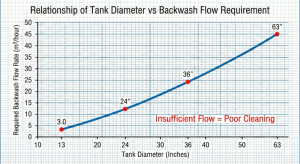
Physically, however, the tank volume must accommodate a freeboard (empty space) of 40-50% for resin expansion during backwash. Never fill a softener tank to the brim! If you fill the resin to 100%, the media will be flushed out during the first backwash.
A tank is just an empty vessel without an internal distribution system.
Top & Bottom Strainers: Function to retain the media so it does not flow out. For large tanks (above 24 inches), we recommend a Hub & Lateral system that provides a more even flow distribution than a single nozzle, preventing channeling (water flow creating “rat holes” so it is not filtered perfectly).
Side Mount Flange: On large industrial tanks, top-mount connections often complicate maintenance because the valve position is too high. A tank option with side connection ports (side mount) is highly recommended for easier piping access and maintenance.
We do not just sell goods; we sell system reliability. Every pressure vessel unit that leaves the PT Mizui Osmosa Teknovasi warehouse has gone through strict quality control (QC) protocols.
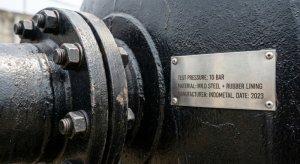
Our standard procedures include a Hydrostatic Test. The tank is filled completely with water and pressurized to 1.5 times the Design Pressure (usually reaching 10-15 Bar) and held for a specified time period (e.g., 60 minutes). The goal is to:
Ensure there are no micro-leaks in the weld joints (for MS) or the liner (for FRP).
Verify the structural integrity of flanges and manholes.
Only tanks that pass this test will be shipped to your site. You can also refer to international testing standards such as Pentair Structural Tank Specs to compare the quality we offer.
We understand project urgency. Therefore, we maintain ready stock for fast-moving sizes such as 1054, 1354, up to 3672. For large project needs that require competitive yet premium quality large water filter vessel prices, we are ready to provide the best quotation.
For Mild Steel tanks, we cater to custom fabrication according to your engineering drawings (P&ID), including adjustments to nozzle placement, addition of sight glasses, or skid mounting adapted to pump room conditions.
In conclusion, selecting an industrial softener tank is a strategic technical decision. Using low-quality FRP tanks or iron tanks without adequate rubber lining might save initial project budget (CAPEX), but will certainly inflate operational costs (OPEX) and future repair risks.
At PT Mizui Osmosa Teknovasi, we combine a deep understanding of chemical engineering with the availability of high-quality products. Whether you need the flexibility of FRP or the toughness of rubber-lined steel, we are ready to be your technical discussion partner to determine the most accurate dimensions and specifications.
Ready to improve the reliability of your WTP system? Contact our engineering team today for technical specification consultations and the best price quotes.
Butuh bantuan? Tim kami siap membantu.