In the operational landscape of massive-scale extractive and processing industries, the availability of clean water utilities is not merely a supporting need, but a critical parameter that determines production sustainability. For decision-makers in the palm oil plantation, mining, and pulp & paper manufacturing sectors located in wetlands, the primary challenge often lies in the extreme quality of the raw water. The implementation of high-capacity peat water WTP (Water Treatment Plant) systems, designed with high engineering precision, is the only answer to mitigate these operational risks.
PT Mizui Osmosa Teknovasi serves as a strategic partner in the development of water treatment infrastructure. We understand that treating peat water—with its characteristic low (acidic) pH, high organic content, and dark color—requires a different technological approach compared to standard surface water. This article will thoroughly dissect the urgency, technical challenges, and construction solutions of industrial-scale WTPs to guarantee the reliability of your water supply 24/7.
In heavy industry environments, volume is everything. We often encounter cases where companies attempt to adapt small or medium-scale filtration systems for factory needs, which ultimately leads to systemic failure. In an industrial context, the margin of error is extremely thin. Relying on an underrated system is not only inefficient but also dangerous for company assets.
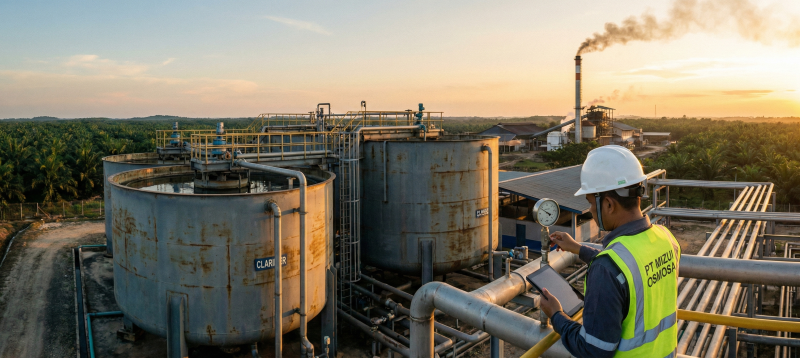
Analyzing the water balance in a Palm Oil Mill (POM) with a capacity of 60 tons of FFB/hour, or a mining area with thousands of personnel, the need for clean water spikes drastically. Water is not only used for domestic sanitation purposes.
Boiler Feed Water: This is the heart of the factory. Inadequately treated peat water contains silica and organic compounds that can cause scaling and corrosion in boiler pipes. For industrial capacities, we are talking about demineralized water needs, where the raw material must come from stable WTP pre-treatment. A supply failure at this stage means steam production downtime.
Large-Scale Domestic Needs: In remote areas like Kalimantan or Sumatra, companies take full responsibility for the livelihoods of thousands of employees in housing complexes (emplacements). As an experienced mining and plantation clean water contractor, PT Mizui Osmosa calculates per capita clean water requirements according to the SNI 19-6728.1-2002 standard. Multiplied by a massive population, this often reaches a flow rate requirement of 10 to 50 liters per second (36 – 180 m³/hour).
The implications of inadequate capacity design are fatal. Imagine a scenario where the water level in the Clean Water Tank drops below the critical point. The boiler feed water pump will trip automatically to prevent damage, instantly halting the turbine and the entire palm oil processing production line.
The opportunity loss cost from a single hour of factory shutdown far exceeds the investment difference between a small and large capacity WTP. Therefore, for PT Mizui Osmosa, building a large-capacity WTP package is a form of asset risk management. We design systems with redundancy to ensure that water demand fluctuations during peak hours will never disrupt the factory’s operational rhythm.
Treating peat water is not an ordinary civil engineering job; it is a chemical and hydraulic challenge. Peat water characteristics are highly unique: it has a low pH (2-4), high organic compound content (humic and fulvic acids), and deceptive turbidity (sometimes clear but dark brown/tea-red in color).
In designing an industrial peat water treatment plant, the challenges multiply because large volumes complicate homogeneous chemical mixing and particle settling.
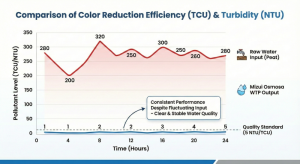
For plantation water treatment plants that source raw water from rivers or canals in peatlands, the season is an uncontrollable variable. During the rainy season, surface water run-off brings mud and increases Turbidity (NTU). Conversely, in the dry season, the water becomes more concentrated, pH drops drastically, and color (TCU) rises sharply due to high organic concentrations.
PT Mizui Osmosa Teknovasi implements an adaptive surface water WTP design. We do not design based solely on a single momentary water sample parameter. Our engineering team analyzes historical water quality data to determine flexible chemical dosing ranges and retention times. Our systems are designed to handle shock loading—sudden changes in raw water quality—without compromising the quality of the treated water.
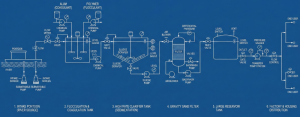
The heart of large-capacity peat water treatment lies in the efficiency of solid-liquid separation. Conventional peat water sedimentation tanks often consume vast amounts of space (large footprint) yet are inefficient at settling the light flocs typical of peat water.
As a solution, we implement High Rate Clarifier or Lamella Clarifier technology. By using tube settlers or lamella plates, the effective settling surface area increases up to 10 times compared to standard sedimentation basins. This is crucial for:
Settling the light organic flocs formed from the peat water coagulation process.
Saving construction space in restricted factory areas.
Accelerating the settling process so that high throughput (water flow rate) can be continuously maintained.
The transition from a design on paper to physical realization in the field requires disciplined project management. In building WTPs with capacities of 20 Lps, 50 Lps, up to 100 Lps, we integrate civil, mechanical, and electrical expertise.
One of the most frequently asked questions by clients regards construction materials: Should we use reinforced concrete or steel tanks (Mild Steel/Fiberglass)? Our answer is always based on logistics and durability.
For large-capacity WTP packages in highly remote locations where ready-mix concrete access is difficult, PT Mizui Osmosa recommends using Steel Tanks with a Food Grade Epoxy Coating. The advantages include:
Installation Speed: Tanks can be fabricated in our workshop (Knock-Down or modular system) and assembled on-site, cutting construction time by up to 50%.
Mobility: If the mine’s lifespan ends or there is a factory relocation, steel structures are much easier to move or modify.
However, for super-massive capacities (>100 Lps) and permanent locations, concrete civil structures remain a valid choice due to their durability against extreme weather. We provide a transparent Cost-Benefit analysis to you before the project begins.
Peat water is highly sensitive to pH changes. Even a slight error in the dosage of Soda Ash or Caustic Soda (to neutralize pH) and Alum/PAC (Coagulant) will cause the floc formation process to fail.
PT Mizui Osmosa leaves behind manual methods that are prone to human error. We integrate Automated Dosing Pumps controlled by real-time pH and turbidity sensors.
Static Mixer: We use static mixers inside the pipes to ensure chemicals mix instantly with high turbulence before entering the flocculation tank.
Chemical Efficiency: This automated system prevents chemical waste (over-dosing), which is often the largest operational cost component in water treatment.
Looking at industrial WTP package prices shouldn’t just be about the initial CAPEX (Capital Expenditure) figure. From an engineering economics perspective, a WTP is a long-term investment whose value must be measured by OPEX (Operational Expenditure) and Life Cycle Cost.
A poorly designed WTP is an energy and chemical “parasite.” Peat water intake pump specifications that do not match the required Head and Flow Rate will significantly waste electricity. Similarly, poor hydraulic design will force operators to use excessive chemicals to force the water to clear.
PT Mizui Osmosa designs systems based on energy efficiency principles:
Gravity Flow: Maximizing gravity flow between units (from clarifier to filter) to reduce the number of transfer pumps.
Chemical Optimization: Through regular Jar Tests and precision dosing systems, we suppress coagulant consumption to the optimum point, directly reducing monthly operational costs by 20-30%.
Longevity: The use of anti-corrosion materials ensures your assets last for over a decade without major repairs.
The project doesn’t end when the water flows. That is exactly where our moral responsibility continues. Many contractors abandon clients immediately after handover, leaving local operators confused about managing advanced systems.
PT Mizui Osmosa’s services include:
Strict Commissioning: Full-load testing to ensure water parameters meet quality standards (Ministry of Health or internal industry standards).
Operator Training: We train your local technicians until they are proficient in backwashing, chemical handling, and basic troubleshooting.
Spare Parts Availability: As an integrated vendor, we guarantee the availability of critical spare parts such as filter media, nozzles, and membranes (if there is an advanced RO unit).
In accordance with sustainability standards like ISPO (Indonesian Sustainable Palm Oil), good water management also becomes a crucial point in your company’s environmental audits.
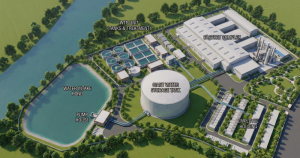
Building a large-capacity peat water WTP is not just a construction project; it is a strategic decision to secure your business foundation. Operational risks due to poor raw water are too vast to gamble on half-measure solutions.
PT Mizui Osmosa Teknovasi is ready to be your engineering partner, bringing technical experience and a deep understanding of peat water challenges in Indonesia. From conceptual design until crystal-clear water flows from the furthest tap on your site, we are here to provide the solution.
Don’t let water quality hinder your factory’s productivity.
Interested in discussing your WTP capacity needs and specifications? Contact our team of experts today for a free technical consultation.
Butuh bantuan? Tim kami siap membantu.