In the heart of Southeast Asia’s largest industrial estate, factory operations running 24 hours demand uncompromising utility stability. For Utility Managers and Factory Heads in industrial areas like Jababeka, MM2100, up to Delta Silicon, water is not merely a supplementary resource, but a vital component in the production process. From boiler feedwater, cooling towers, to process water for painting and cleaning, even a slight decrease in water quality can be fatal to production output. Therefore, the need for professional, responsive, and data-driven Cikarang WTP maintenance services is a top priority to prevent costly unplanned downtime.
PT Mizui Osmosa Teknovisa is here as a strategic partner who understands this urgency. We realize that water treatment challenges in Cikarang have unique characteristics, ranging from fluctuations in raw water quality from Kalimalang or Estate WTPs to strict industrial waste standards. Through this technical article, we will thoroughly dissect the crucial aspects of Water Treatment Plant (WTP) system maintenance, from diagnosing Reverse Osmosis (RO) problems to spare parts management, to ensure your factory operates at peak efficiency.
Industrial water quality stability is non-negotiable, especially for the automotive and electronics sectors that dominate the Bekasi and Cikarang areas. The failure of a filtration system to filter micron particles or high conductivity in product water can cause large-scale product rejects. For example, in the electro-deposition painting (EDP) process in the automotive industry, the presence of excess mineral ions due to RO membrane failure can cause painting defects that require rework, wasting significant time and material costs.
Besides the direct impact on products, negligence in regular Cikarang industrial WTP services will shorten the lifespan of your expensive machinery assets. Scaling on heat exchangers or corrosion in boiler pipes often starts from water chemical imbalances that escape routine monitoring. Therefore, the maintenance approach we offer is not just “fix it when it breaks” (breakdown maintenance), but shifts towards predictive maintenance that relies on water parameter trend data to anticipate failures before they occur.
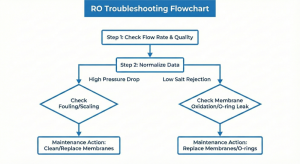
The heart of many modern WTP systems in industrial estates is the Reverse Osmosis (RO) unit. Although this technology is highly reliable, it is also very sensitive to changes in operational conditions. Often, field engineering teams are faced with situations where the water production capacity (permeate flow) drops drastically or the water quality (conductivity) suddenly deteriorates. In this situation, the ability to make an accurate diagnosis is key.
The first step in Reverse Osmosis system troubleshooting is to normalize the operational data. Many novice technicians make the mistake of immediately condemning the membrane as damaged just because the flow drops, when perhaps the raw water temperature is simply low. By normalizing the data—comparing current parameters (pressure, temperature, flow) with the initial startup conditions—we can see if the performance drop is purely due to membrane issues or external factors.
If the data shows a significant increase in Differential Pressure (ΔP) between stages, this is a strong indication of blockage (fouling or scaling). Blockages in the first stage are usually associated with microbiological problems or suspended solids (sludge), indicating a failure in the pre-treatment system. Conversely, if the pressure increase occurs in the last stage, it is highly likely that scaling due to mineral deposits such as Calcium Carbonate or Silica has occurred. Identifying the location of this blockage is very crucial because it will determine what type of chemicals must be used during the cleaning process later.
For more on ideal water quality standards and RO parameters, you can refer to technical guidelines from the Water Quality Association (WQA) or specific membrane standards from global manufacturers. This deep understanding distinguishes an ordinary technician from an experienced Cikarang on-call WTP technician in handling complex problems in large factories.
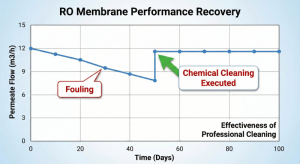
When the diagnosis has confirmed fouling or scaling, the mitigation step that must be taken immediately is the Cleaning In Place (CIP) process. However, many factory operators are hesitant or make mistakes in executing this process, which can actually damage the membrane permanently. The procedure for chemical cleaning for clogged RO membranes is not just circulating random chemicals; it is a precise chemical process that requires strict control of pH, temperature, and flow rate.
An effective cleaning process is usually divided into two main stages: Low pH Cleaning and High pH Cleaning. Low pH (acidic) cleaning, usually using a measured concentration of citric acid or HCl solution, aims to dissolve inorganic deposits like carbonate and iron scale. This stage is very crucial for factories in Cikarang that use groundwater or surface water with high hardness. It is important to monitor the color of the cleaning solution; if the solution turns cloudy or the pH changes drastically quickly, it means the dissolution reaction is actively occurring, and the solution may need to be replaced midway through the process.
After the mineral scale is addressed, the next step is High pH Cleaning (alkaline), using Sodium Hydroxide (NaOH) often combined with surfactants or chelating agents like EDTA. The goal is to destroy biofilms, bacteria, and other organic materials that are often the main cause of biofouling in tropical areas like Indonesia. Solution temperature also plays an important role; raising the cleaning solution temperature to the limit allowed by the manufacturer (usually around 35-40°C) can significantly increase cleaning effectiveness.
As an experienced Cikarang RO membrane cleaning provider, PT Mizui Osmosa Teknovisa always emphasizes the importance of perfect flushing between chemical stages. Acid residues meeting bases inside the membrane can cause heat shock or salt precipitation that actually worsens the blockage. Expertise in regulating circulation and soaking durations guarantees the membrane recovery rate can return close to its original performance, delaying the need for expensive new membrane replacement investments.
Often, problems in the RO unit are merely symptoms of a disease that actually lies in the pre-treatment system. Filter media, whether Sand Filters, Carbon Filters, or Multimedia Filters, are the front line protecting sensitive RO membranes. If this pre-treatment fails to filter pollutants, the RO workload will increase manifold, accelerating the rate of damage.
The main indicators of a decline in filter media performance are high pressure drop and unstable outlet water quality (e.g., chlorine slipping through or turbidity). Routine backwashing can indeed clean trapped dirt, but over time, filter media will experience physical wear (abrasion), mudballing, or adsorption saturation that cannot be restored with regular backwashing.
When is the right time to replace media? Generally, it is recommended to check the physical condition of filter media once a year, and replace it totally every 1-2 years depending on the raw water dirt load. The filter media replacement services (silica sand/activated carbon) we offer include draining the old media, cleaning the internal tank (including checking strainers and distribution nozzles), and filling new media with proper stratification.
In activated carbon filters, the crucial parameter is the Iodine Number, which indicates its absorption capacity for organic material and chlorine. In the Cikarang industrial area, where raw water often contains residual chlorine from municipal treatment processes, saturated activated carbon can let free chlorine pass into the RO unit. Chlorine is the main enemy of Polyamide (PA) type membranes because it can cause oxidation that permanently damages the membrane’s polymer structure. Therefore, replacing activated carbon is not just about clarifying water, but about protecting your RO membrane investment worth hundreds of millions of rupiahs.
The media replacement process must also pay attention to bed expansion during backwash. Our technicians will ensure that the volume of filled media accounts for enough expansion space so that during the backwash process, the media grains can lift and rub against each other to release dirt, but not to the point of being carried out of the tank. Technical precision like this makes us the top choice for factory water filter system repair services in this region. For references regarding ideal filter media specifications, standards from the American Water Works Association (AWWA) can be a valid technical guide.
The biggest challenge in manufacturing industry maintenance is time. Production machines stopping while waiting for water spare parts is a huge loss. Often, procurement departments have difficulty getting specific spare parts quickly because vendors are located far away or stock is unavailable.
To answer this logistical challenge, PT Mizui Osmosa Teknovisa positions itself not only as a service contractor but also as a strategic Cikarang WTP spare parts supplier. We realize that warehouse location and stock availability are key factors in Mean Time To Repair (MTTR).
We provide ready stock for fast-moving components such as cartridge filters (spun/string wound), dosing pumps (Prominent, LMI Milton Roy), measuring instruments (pH meters, conductivity meters, flowmeters), to various types of filter media and antiscalant chemicals. Our close presence to the MM2100, Jababeka, and EJIP industrial estates allows same-day delivery for emergency situations.
Additionally, we also provide critical components like pressure vessels, RO membranes (Dow Filmtec, Hydranautics, Toray), and high-pressure pumps (Grundfos, CNP). As a technical partner, we don’t just sell goods, but also provide specification consultation. We ensure the spare parts you buy are the right substitutions or upgrades suitable for your existing system, avoiding incompatibility risks that often occur when purchases are made randomly without technical review.
Performing repairs when damage occurs (corrective maintenance) might look economical initially, but the hidden costs of production disruption are far greater. Modern utility management trends are now shifting to integrated service contracts that guarantee peace of mind for factory management.
PT Mizui Osmosa Teknovisa offers periodic WTP service contracts for industrial estates (MM2100/Jababeka) designed to take the technical burden off your internal team’s shoulders. In this contract scheme, our technicians will make routine visits (weekly or monthly) to conduct a thorough check of all system parameters.
The main advantages of this service contract are:
Early Detection: With the log sheets and trend analysis we perform every visit, symptoms of damage such as pressure increases or water quality decreases can be detected long before causing a total system shutdown.
Service Priority: Contract clients get top priority in the emergency service queue. If a problem occurs outside the visit schedule, our team is committed to the shortest possible response time to arrive at your factory location in Cikarang.
Cost Efficiency: Routine maintenance prevents damage to expensive components. Cleaning a membrane regularly is much cheaper than replacing it. Replacing a noisy pump bearing is cheaper than replacing a motor burned out due to jamming.
Comprehensive Reporting: Every visit ends with an in-depth technical report covering current conditions, actions taken, and recommendations for repairs or part replacements for your department’s future budgeting.
This service is perfect for factories with a lean utility team, where internal staff focus is more absorbed by electrical issues or main production machinery. Let us take care of the water, so you can focus on production.
Managing a WTP system in the dynamic and high-standard Cikarang industrial environment requires a competent and responsive partner. From complex issues like RO membrane fouling diagnosis, precise chemical cleaning procedures, timely filter media replacement, to guaranteed spare part availability, PT Mizui Osmosa Teknovisa offers end-to-end solutions.
Our commitment is clear: to provide Cikarang WTP maintenance services that not only fix momentary problems but increase your system’s reliability for the long term. Don’t let poor water quality disrupt your company’s production targets.
Contact PT Mizui Osmosa Teknovisa today for a free consultation and site survey. We are ready to be your trusted partner in maintaining your industrial water quality.
Butuh bantuan? Tim kami siap membantu.