As a Senior Maintenance Engineer at PT Mizui Osmosa Teknovisa with decades of experience handling critical industrial water treatment cases, I understand one crucial fact: on the production floor, water is a utility just as vital as electricity. For Plant Managers, especially in the F&B, fisheries cold storage, and warehousing sectors operating in the Makassar Industrial Estate (KIMA), any disruption to clean water supply or wastewater treatment (WWTP) issues is an operational nightmare. The need for Makassar WTP maintenance services that go beyond mere “fixes” to include rapid response and deep technical understanding has become absolute.
This article is written not just as a service offer, but as a comprehensive technical guide for you, decision-makers in South Sulawesi’s industry, to understand the critical points of your Water Treatment Plant (WTP) and Wastewater Treatment Plant (WWTP/IPAL) systems. PT Mizui Osmosa is here to ensure these vital utilities operate at peak efficiency, minimizing unplanned downtime.
Makassar, as the gateway to Eastern Indonesia, has unique industrial dynamics. The KIMA area, home to many food processing and seafood cold storage industries, demands rigorous water quality standards. A WTP system failure doesn’t just mean taps run dry; it can mean halting fish freezing production lines, contaminating packaged beverage products, or the failure of vital cooling towers.
As technicians frequently deployed to the field in the Tamalanrea and Biringkanaya areas, we often encounter challenging raw water characteristics in Makassar. Groundwater sources at several points in KIMA often exhibit fluctuating Total Dissolved Solids (TDS), high iron (Fe) and manganese (Mn) levels, and occasional brackish water intrusion, especially during the dry season.
Such raw water conditions place a heavy workload on pre-treatment systems and Reverse Osmosis (RO) units. Without routine South Sulawesi industrial water filter service and precise chemical dosage adjustments, filter media will quickly saturate. Consequently, water with a high Silt Density Index (SDI) will pass through to the RO membrane, accelerating fouling (clogging due to organic/biological matter) and scaling (mineral buildup). This is why a “install and forget” approach never works for industrial WTPs in Makassar.
Let’s talk about financial impact. For fisheries cold storage industries, water quality is crucial for raw material washing and ice making (flake/tube ice). If the WTP system breaks down suddenly due to a blown pump or total membrane blockage:
Product Spoilage: Fresh fish not immediately processed with food-grade standard clean water risks quality degradation or rot. Losses can reach hundreds of millions of rupiah in hours.
Halt Production: In F&B factories, water is the main raw material. When RO product water conductivity spikes beyond thresholds (e.g., > 20 µS/cm for specific applications) due to lack of maintenance, entire production batches must be stopped or rejected.
Environmental Sanctions: Failure in the WWTP system due to dead aerators or shock-loaded decomposing bacteria can cause waste parameters (BOD, COD, TSS) to exceed quality standards. This risks sanctions from the local environmental agency.
Therefore, shifting mindset from reactive maintenance (fixing when broken) to preventive and predictive maintenance is a mandatory investment for factory operational continuity in KIMA.
When emergencies occur, speed and diagnostic accuracy are everything. PT Mizui Osmosa’s technical team is trained to perform systematic troubleshooting to quickly isolate root causes in Makassar RO & WWTP system repair scenarios. We don’t just replace parts; we analyze why those parts failed.
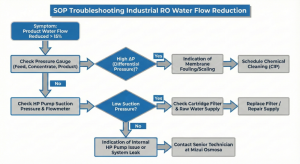
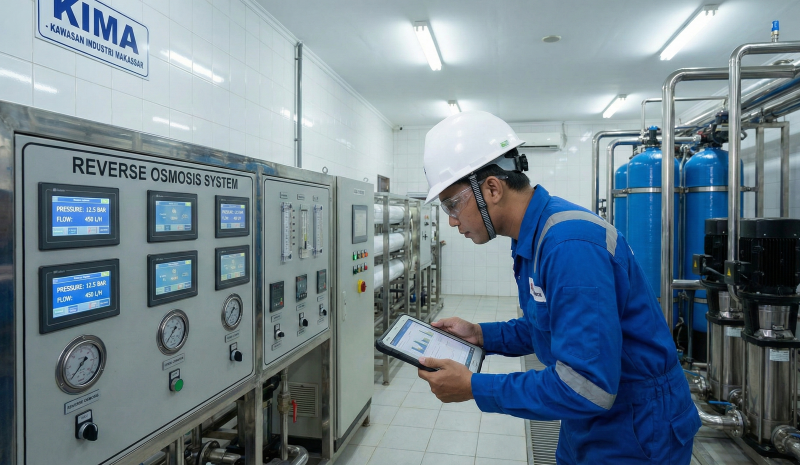
We often receive emergency calls with common complaints: “RO production flow dropped drastically” or “Pump sounds very rough.” As a Senior Engineer, my approach always starts with data. We immediately check operational parameters on the control panel:
Pressure: Is there an abnormal rise in Differential Pressure (ΔP) between membrane stages? Or a drastic pressure drop on the pump suction side?
Flow Rate: How does Product Flow compare to Reject Flow? Is the recovery rate still per initial design?
Water Quality: We perform quick on-site TDS meter and pH checks to compare raw water, post-pre-treatment water, and product water.
This data gives us clues whether the issue lies in physical blockage, mechanical pump failure, or chemical dosing errors.
One of the most critical—and expensive—components in an RO system is the High-Pressure Pump. Failure in this component is often catastrophic for WTP operations.
HP pump damage usually doesn’t happen overnight. There are early signs often ignored by untrained operators:
Cavitation Noise: Sounds like gravel rattling inside the pump. This indicates insufficient water supply to pump suction (starvation) or trapped air.
Excessive Vibration: Strong vibrations felt on the pump body or discharge pipe, often due to shaft misalignment or bearing damage.
Fluctuating Pressure: Pressure gauge needles moving unstably, indicating impeller or internal seal issues.
The High-Pressure Pump replacement procedure by the Mizui Osmosa team is not as simple as unscrewing bolts. We ensure your investment is safe with strict procedures:
System Isolation: Ensuring the RO system is totally off (LOTO – Lock Out Tag Out) and pipe pressure is released (depressurize).
Suction Line Inspection: Before installing a new pump, we MUST check the cartridge filter (usually 5 or 1 micron) before the pump. A clogged filter is the main cause of cavitation damaging old pumps. We also check for air leaks in suction pipes.
Precision Installation: Installing a new pump, especially multistage centrifugal types, requires precise alignment between motor and pump shafts using measuring tools (dial indicator or laser alignment) to prevent bearing-destroying vibrations.
Gradual Commissioning: When starting a new pump, the discharge valve must not be fully opened immediately. We open it slowly (throttling) while monitoring motor amperage and system pressure to ensure the pump operates on an efficient and safe performance curve.
We often find cases in KIMA where pumps frequently fail because operators skip cartridge filter replacements or start pumps without ensuring sufficient water supply (dry running). Operator education is part of our service.
The RO membrane is the heart of high-level water purification systems. Without proper maintenance, these membranes, worth tens of millions of rupiah per element, can be permanently damaged in just months. Our focus is maximizing your membrane’s lifespan.
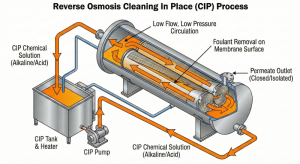
This is the most frequently requested service when WTP production capacity has plummeted. However, Chemical Cleaning or Cleaning In Place (CIP) is not a “magic cure” to be done haphazardly. Timing is key.
When to CIP? Don’t wait until no water comes out at all. Based on guidelines from leading membrane manufacturers like DuPont (Dow Filmtec) or Hydranautics, CIP must be performed if one of these conditions is met (compared to normalized initial start-up data):
Normalized Permeate Flow drops by 10-15%.
Normalized Salt Passage (salt leakage/TDS rise) increases by 5-10%.
Differential Pressure (ΔP) between feed-concentrate increases by 15-25%.
Our clogged RO membrane chemical cleaning procedure involves circulating specific chemicals using a separate CIP unit (tank, chemical pump, and heater). We don’t use generic chemicals, but specific formulas based on foulant type:
Foulant Analysis: We analyze operational history. If the issue is biofouling (slime, bacteria) common in food industries, we use Alkaline-based cleaners with high pH (around 11-12) at controlled temperatures (usually < 45°C to prevent membrane damage).
Circulation and Soaking: Chemical solutions are circulated at low pressure and high flow to scour dirt. For severe clogging, we perform soaking for several hours or overnight to let chemicals break down deposits.
Acid Cleaning (If Necessary): If after alkaline cleaning there are still indications of mineral scaling (calcium carbonate or silica), we proceed with Acid-based cleaners with low pH (around 2-3). Strict Warning: Never perform acid cleaning first if biofouling is suspected, as acid will harden the organic layer on the membrane surface, making it permanent.
Thorough Flushing: Rinsing with clean RO product water (permeate) or demin water is absolutely necessary between chemical stages and at the end of the process until water pH returns to neutral and conductivity normalizes.
Improper CIP processes—such as using excessive pressure during cleaning or wrong temperatures—can permanently damage the membrane’s polyamide thin-film composite structure. Leave it to the experts.
Prevention is always cheaper than cure (or replacing membranes). Our prevention strategy includes:
Correct Antiscalant Dosing: Many factories in KIMA use antiscalant (scale inhibitor chemicals) with “approximate” doses. We perform precise dosage calculations based on complete raw water analysis (including silica, barium, strontium) and your RO system’s recovery rate. Too low a dose causes scaling; overdosing can become a foulant itself.
Routine SDI Monitoring: Silt Density Index (SDI) is a crucial parameter to measure feed water’s potential to clog membranes. We recommend daily or minimum weekly SDI checks. SDI15 values should always be below 5.0, and ideally below 3.0 for long membrane life. High SDI means pre-treatment system issues (Multimedia Filter or Cartridge Filter) must be addressed immediately.
Downstream, wastewater treatment (WWTP/IPAL) is the company’s legal and moral responsibility. Environmental regulations in South Sulawesi are increasingly strict, and ignorance is not an acceptable excuse in the eyes of the law.
To ensure WWTP performance, empirical testing is essential. We provide sampling and Makassar wastewater laboratory analysis services in collaboration with KAN-accredited laboratories.
We help you monitor key parameters according to applicable local regulations (such as Wastewater Quality Standards for Industrial Business and/or Activities in South Sulawesi):
pH: Basic indicator of chemical or biological process balance.
COD (Chemical Oxygen Demand) & BOD (Biological Oxygen Demand): Measures organic load in waste. Correct BOD/COD ratio is vital for bacteria health in aeration ponds.
TSS (Total Suspended Solids): Measures suspended solids that should settle in the clarifier.
Oil & Grease: Crucial for fish and food processing industries in KIMA. Grease Trap or DAF (Dissolved Air Flotation) units must function optimally.
This lab data isn’t just numbers on paper. for us, it’s a diagnostic tool. For example, if effluent (outlet) COD values spike suddenly, we check if there’s raw material spillage in production areas entering waste channels (shock loading) or if there are aeration system issues (blowers or diffusers) causing aerobic bacteria to lack oxygen. For further reference regarding water quality standards, please refer to the relevant government regulations or publications from the Ministry of Environment and Forestry.
Back upstream (pre-treatment), many RO and boiler issues start with neglected filter media. As experienced providers of South Sulawesi industrial water filter service, we often find conditions where filter media (silica sand, activated carbon, manganese greensand) are no longer usable.
Signs filter media need replacement or service:
High Pressure Drop: Large pressure difference between filter inlet and outlet, even after backwashing.
Channeling: Water forms shortcuts (rat holes) inside filter media, so it’s not filtered at all. Indicated by poor output water quality even though pressure drop seems normal.
Saturated Media: Activated carbon loses ability to absorb chlorine or odors, or greensand is no longer effective at oxidizing iron.
We don’t just replace media. We perform internal filter tank inspections, check nozzle strainer conditions at tank bottoms (often broken causing media escape), and perform re-bedding with correct stratification (layers), starting from coarse gravel at the bottom to fine media at the top, to ensure optimal flow distribution and backwash efficiency. Correct backwash procedures are also re-taught to your operators, as many media compaction cases are caused by inadequate backwash rates. (For a deeper understanding of the importance of pre-treatment, you may consult literature from water quality associations such as the WQA – Water Quality Association).
Why do many multinational companies in KIMA switch from on-call service models to annual factory WTP maintenance contracts with us? The answer is simple: Certainty and Long-Term Cost Efficiency.
In a reactive model, you pay dearly for emergencies: production downtime costs, sudden spare part procurement costs (often at premium prices and expensive air freight), and managerial stress.
In PT Mizui Osmosa’s Service Contract model, we take over that burden:
Scheduled Periodic Visits: Our technicians come routinely (monthly or bi-weekly) for thorough inspections, not just when things break. We record all key parameters (log sheet analysis).
Predictive Maintenance: With historical data we collect, we can predict when membranes need CIP or when pump bearings start showing wear signs, before fatal damage occurs.
Service Priority: Contract clients get top priority in emergency service queues with strict response time guarantees (SLA).
Chemical & Consumables Stock Management: We ensure antiscalant, chlorine, pH adjuster, and cartridge filter stocks in your warehouse are never empty, with inventory management we handle.
This is a strategic partnership where our goal aligns with yours: Zero Unplanned Downtime.
In the competitive KIMA Makassar industrial environment, your water utility system performance directly affects the company bottom line. WTP and WWTP problems cannot be handled with half-measures or inexperienced technicians. You need a partner who understands industrial urgency, possesses engineering depth, and is ready to respond quickly.
PT Mizui Osmosa Teknovisa is here to answer that challenge. We combine advanced diagnostic expertise with client satisfaction-oriented service commitment. Don’t let water quality issues hinder your production targets.
Need immediate technical assistance for your WTP or WWTP in Makassar? Contact our team now for an initial consultation or to schedule an emergency visit. Let us handle your water problems so you can focus on your core business.
Butuh bantuan? Tim kami siap membantu.