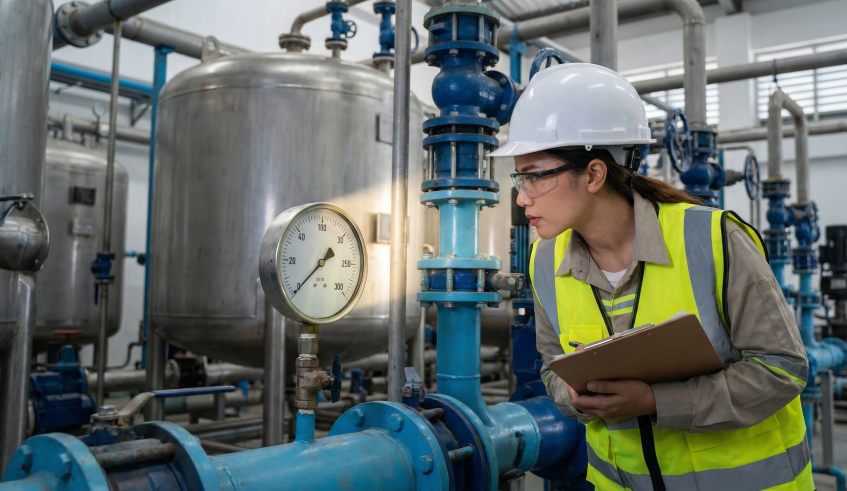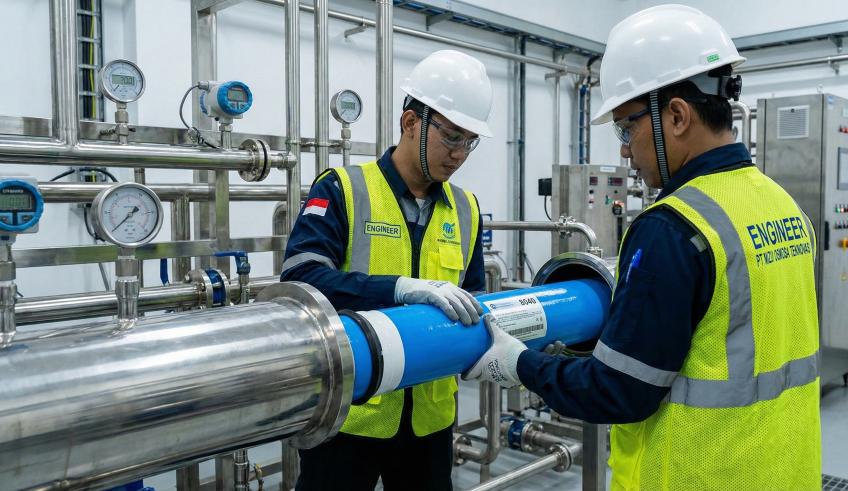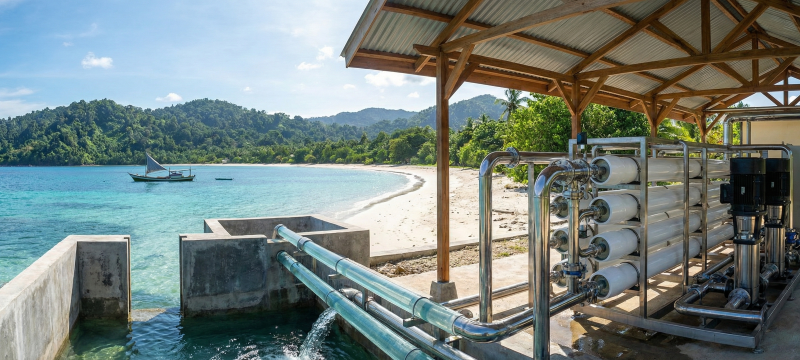
Are you seeking a reliable clean water solution in the archipelago region? Maluku Seawater Desalination Services from PT Mizui Osmosa Teknovisa is your answer. We understand that conventional approaches often fail in harsh island environments. Therefore, we present a service specifically designed to overcome the unique challenges of this region.
This article outlines why Sea Water Reverse Osmosis (SWRO) technology is an urgent necessity—particularly for economic sustainability on the small islands of Maluku.
As an engineer with two decades of experience, I have tackled various water treatment challenges in maritime environments. I have witnessed firsthand the paradox of Eastern Indonesia: Maluku is surrounded by infinite seawater, yet the region frequently suffers from severe freshwater scarcity.
For resort owners or ice factory entrepreneurs, Maluku seawater desalination services are not merely a luxury option; they are a vital solution. Ensuring a stable supply of clean water in Ternate and Ambon is a formidable logistical struggle. However, we have the solution.
The geographical characteristics of Maluku Province are dominated by the ocean, with approximately 92.4% of its territory being water. Consequently, the region faces unique challenges in clean water provision.
Unlike larger islands, the small islands of Maluku—from the Banda Islands and Kei Islands to the satellite islands surrounding Ternate—have limited natural freshwater resources. This crisis is more than just an inconvenience; it is a major hindrance to economic growth. The marine tourism sector and the fishing industry are severely impacted. Without freshwater, resorts cannot properly serve their guests, and ice factories cannot operate at maximum capacity.
Small islands often lack adequate freshwater sources. The traditional solution is “water importation.” Freshwater is purchased from larger islands like Ambon and then transported via barge to holding tanks.
This method creates a risky logistical dependency. Furthermore, the costs are exorbitant. Let’s conduct a simple economic analysis. As providers of Maluku seawater desalination services, we often encounter the following scenario: A resort or ice factory requires approximately 20,000 liters (20 m³) of water per day.
The cost of purchasing bulk water at the port may only be IDR 30,000 – IDR 50,000 per m³. However, sea transportation is the largest variable. Vessel chartering and fuel costs can skyrocket the price.
Upon arrival at the location, the price can reach IDR 150,000 to IDR 250,000 per m³. If the average total cost is IDR 200,000 per m³, then the daily cost reaches IDR 4,000,000. In a month, you would have to spend IDR 120,000,000. This Operational Expenditure (OPEX) is immense. Therefore, switching to an independent system is a smart decision.
Many of our clients initially attempt to drill wells. Unfortunately, these efforts often end in disappointment. The water extracted tastes brackish or salty. This phenomenon is explained by the Ghyben-Herzberg principle.
On small islands, freshwater forms a thin “lens” floating above the seawater. This balance is extremely fragile. If freshwater withdrawal is excessive, the seawater rises—a process known as seawater intrusion. Consequently, the well becomes permanently contaminated. Therefore, relying on groundwater on small islands is not a long-term solution.
Facing these issues, the most logical solution is to utilize seawater. This is the vital role of the SWRO system. As the most effective remote island drinking water technology, SWRO operates on the principle of physical separation.
This process forces seawater through a high-pressure semi-permeable membrane. This membrane possesses microscopic pores that block salt, minerals, and bacteria, while allowing pure water to pass through.
Our modern SWRO systems produce two streams: First is the Permeate (freshwater), which meets drinking water standards. Second is the Brine (saline wastewater), which is returned to the sea. For Indonesian waters, we always equip our systems with rigorous Pre-treatment. This step prevents premature membrane fouling.
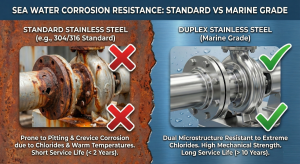
This section is crucial. As an experienced provider of Maluku seawater desalination services, we understand the aggressive nature of tropical seawater. The combination of high salinity and warm temperatures creates an extremely corrosive environment.
Many projects fail due to subpar materials. Using standard Stainless Steel is a fatal error. Therefore, PT Mizui Osmosa maintains high standards regarding equipment durability against seawater corrosion.
High-Pressure Pumps: We utilize Duplex Stainless Steel (SAF 2205). This material is significantly more rust-resistant than standard stainless steel.
High-Pressure Piping: All piping lines use Duplex SS or marine-grade flexible hoses.
Machine Frame: We apply multi-layered marine epoxy coating.
While the upfront investment in these materials may be higher, it guarantees your asset will remain operational for up to 15 years.
The implementation of SWRO systems has a direct impact on the economy. Maluku is a hub for the national fishing industry. The greatest challenge lies in maintaining the cold chain. This is where the availability of freshwater for ice factories becomes critical.
Ice quality depends on its raw water source. Freshwater ice possesses a consistent freezing point. Furthermore, it melts slower than ice made from brackish water, allowing fishermen to stay at sea longer while keeping their catch fresh. A 10-ton capacity ice factory requires a minimum SWRO freshwater supply of 12 m³ per day.
Beyond ice production, water makers for the Maluku fishing industry are essential for port operations. Fish Processing Units (UPI) require clean water for washing fish in compliance with HACCP standards. Fishing vessels also rely on clean water for their crew. SWRO installations ensure that economic activities do not grind to a halt while waiting for water deliveries.
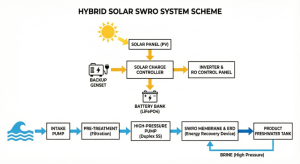
Electricity poses another significant challenge on outer islands. Many locations lack 24-hour access to the national grid (PLN). In response, we have developed integrated solar-powered RO machines.
To maximize efficiency, we implement Energy Recovery Devices (ERD). This technology captures energy from the high-pressure brine (wastewater) stream and recycles it into the system. Consequently, electricity consumption is reduced by up to 50%.
Furthermore, we design hybrid systems where solar panels serve as the primary power source during the day, with generators used solely as backup. This approach significantly lowers the production cost per liter of water.
Possessing the best technology is insufficient without proper execution; logistics are key. We offer turn-key services for SWRO installation in Ambon & Ternate. Our comprehensive service includes:
Site Survey: Analyzing water quality and determining optimal intake locations.
Logistics: Shipping units via sea cargo directly to remote islands.
Installation & Commissioning: Deployment by senior technicians until a steady water flow is achieved.
Training: Training local operators for routine maintenance.
Reliance on external water supplies is detrimental. It is time to transition to independent technology. PT Mizui Osmosa Teknovisa is ready to be your strategic partner. We are not merely vendors; we are marine technical experts.
Do not let water scarcity hinder your business. Contact us for the best offer regarding Maluku seawater desalination services. Our team is ready to conduct a feasibility study for you today.
Butuh bantuan? Tim kami siap membantu.