Many operators fall into panic and immediately think of replacing membrane elements with new ones. However, such impulsive decisions can drastically burden a company’s OPEX (Operational Expenditure). This is where RO membrane cleaning services play a vital role. With the right chemical approach and measured technical procedures, membranes that appear “dead” can often be saved and their performance restored to near-new conditions.
As a practitioner in the world of industrial water treatment, there is no sight more distressing for a Plant Manager than watching the product flow meter needle slowly but surely drop. You know your Reverse Osmosis (RO) machine is the heart of the factory’s utilities. When this heart is clogged, the entire production line is threatened with a shutdown.
This article is not merely a service offer. As a Senior Chemical Engineer at PT Mizui Osmosa Teknovasi, I will take you into the anatomy of your membrane problems—why they clog, and how our science-based methodology can restore them.
Performance decline in a Reverse Osmosis system rarely happens overnight, unless a catastrophic incident occurs in the Pre-treatment. Generally, it is a slow accumulation process. However, when permeate flow (product water) drops more than 10% from the initial design condition, it is a danger alarm that must not be ignored.
Technically, RO membranes work on the principles of diffusion and molecular filtration. When microscopic pores on the polyamide sheet are blocked, the operational pressure (feed pressure) must be increased to obtain the same amount of water. Consequently, pumps work harder, energy consumption spikes, and the risk of physical damage to the membrane increases.
To understand the solution, we must first dissect the enemy. In our experience handling hundreds of industrial clients, the primary causes of fouling (clogging) fall into two major categories.
Operators often generalize all blockages as “dirt.” However, in water chemistry, distinguishing the type of foulant is the key to cleaning success.
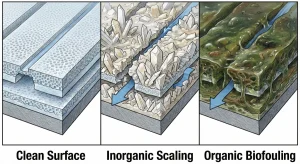
Scaling (Inorganic Scale): This occurs when the concentration of dissolved salts in the feed water exceeds their solubility limits (supersaturation). Imagine the white crust at the bottom of your water kettle; that is a simple analogy. In industrial RO systems, the most common scaling is Calcium Carbonate (CaCO3), Calcium Sulfate (CaSO4), or Silica (SiO2). Scaling is hard, microscopically sharp, and can tear the membrane surface if forced to operate under high pressure.
Biofouling (Biological Contamination): On the other hand, we face Biofouling. This is a nightmare for systems treating surface water or wastewater recycle. Bacteria, fungi, and algae form slimy colonies called biofilms on the membrane surface. Unlike hard scaling, biofouling is soft but extremely sticky and difficult for water to penetrate. This biofilm also shields bacteria from ordinary biocide attacks, rendering RO washing services that rely only on plain water rinsing useless.
The most honest indicator of your membrane’s health is not the flow meter, but the Differential Pressure (ΔP). This is the pressure difference between the incoming water (feed) and the reject water (concentrate).
When the feed spacer channels inside the membrane scroll begin to clog with debris, water finds it increasingly difficult to pass through. This causes ΔP to rise. If you allow this to happen without immediately performing clogged membrane service, the risk is fatal: Telescoping.
Telescoping is a physical condition where the membrane scroll is pushed out of its fiberglass casing due to extreme thrust pressure. If this happens, the membrane cannot be washed. The only solution is to throw it in the trash. Therefore, monitoring ΔP is an absolute obligation.
For a deeper understanding of the basic mechanisms of Reverse Osmosis and its pressure parameters, you can refer to technical references on Wikipedia regarding Reverse Osmosis.
There is a myth in the industry that “A washed membrane will never be the same again; it’s better to buy new.” This statement is only half true. Membranes washed with the wrong method will indeed be damaged. However, membranes washed with professional membrane cleaning service procedures can recover up to 95-98% of their original performance.
Let’s talk numbers and business logic.
The price of a single RO membrane element type 8040 (industry standard 8-inch) from top brands can range from millions to tens of millions of Rupiah per unit. An RO system with a capacity of 20 m³/hour might have 12 to 18 membranes.
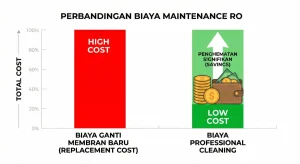
If you decide on a total replacement, the cost is fantastic. Compare this with the cost of washing RO 8040 membranes, which consumes only a fraction of the price of buying new ones.
Besides direct savings from delaying asset purchases, effective cleaning also lowers electricity costs. Clean membranes require much lower High Pressure Pump pressure to produce the same amount of water. A decrease of 1-2 bar in operational pressure, if accumulated over a year of 24-hour operation, is equivalent to significant electricity bill savings.
World-class membrane manufacturers like DuPont (Filmtec) or Hydranautics design their products to last 3 to 5 years, or even longer, provided they are maintained correctly. Technical references regarding standard maintenance procedures can be found in the Dow Filmtec Technical Manual.
However, without periodic reverse osmosis CIP services, membrane life can shorten to just 1-2 years. Fouling that is allowed to harden (polymerization) will become permanent and can no longer be dissolved by any chemical. By performing routine cleaning before fouling becomes severe, you effectively “reset” the lifespan of your membrane, ensuring the asset delivers maximum Return on Investment (ROI) for the company.
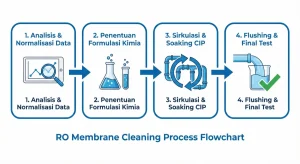
At PT Mizui Osmosa Teknovasi, we don’t just pour acid and base into your cleaning tank. We work with data. As Lead Engineer, I implement strict protocols in every membrane cleaning chemical project and its execution. Here is our workflow:
Our first step always begins with the question: “May I see your daily Log Sheet?”
Operational data (Flow, Pressure, Conductivity, Temperature) is crucial. We perform a process called Normalization. Raw data is often deceptive; for example, water production might look low simply because the raw water temperature is cold. With normalization, we can see the real condition of the membrane.
If necessary, we conduct a physical inspection or “light autopsy” on the membranes at the very front (Lead element) and the very back (Tail element).
Lead Element: Usually clogged by Suspended Solids or Biofouling.
Tail Element: Usually clogged by Scaling (mineral crust) because the salt concentration is highest here.
This analysis determines the “prescription” we will formulate. Do we need Acid Cleaner pH 2? Or Alkaline Cleaner pH 11? Or a combination of special chelating agents?
Once the diagnosis is confirmed, our technical team will mobilize the CIP (Clean-In-Place) unit. Our CIP cleaning procedure follows strict international standards:
Low Flow Pumping: Flowing the chemical solution at a low rate to heat the solution and push raw water out without compacting the dirt.
Recirculation: Circulating the chemical solution to provide contact time for the scale dissolution chemical reaction to occur. Here, we monitor pH in real-time. If the pH changes drastically, it means the dirt is reacting, and we will add chemicals until the pH stabilizes.
Soaking: This is the crucial phase. We turn off the pump and let the membrane “soak” in the chemical solution. For heavy biofouling, soaking can take all night (overnight soaking).
High Flow Flushing: After the dirt softens/loosens, we use a high flow rate (but low pressure) to flush the dirt out of the system. You will see turbid, brown, or black water coming out of the reject pipe. That is a sign of success.
We use specially formulated membrane cleaning chemicals (not just market-grade HCl or Caustic Soda).
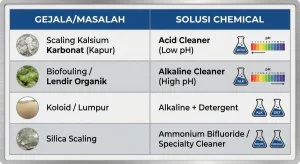
High pH Cleaner (Alkaline): Effective for destroying biofouling, oil, and organic colloids.
Low pH Cleaner (Acid): Effective for dissolving carbonate, sulfate, and metal oxide scales.
Specialty Cleaner: For heavy silica cases that are often immune to ordinary acids.
To make it easier for you to understand, here is a simple guide table we use:
Do not wait until your RO machine shuts down completely (trips). As an experienced RO maintenance contractor, I advise you to immediately schedule cleaning if you see any of the following signs:
Physical Signs on the Machine to Watch For:
A decrease in Normalized Permeate Flow (NPF) of 10-15%. Remember, this figure is normalized for temperature.
an increase in Normalized Salt Passage of 5-10%. Product water quality starts to decline (Conductivity rises).
An increase in Normalized Pressure Drop (ΔP) of 10-15%. This is the most critical indicator to prevent physical membrane damage.
If any of the parameters above are met, contact PT Mizui Osmosa Teknovasi immediately. Delaying cleaning until flow has dropped by 30-40% often makes the cleaning process ineffective because the channels are completely blocked (irreversible fouling).
PT Mizui Osmosa Teknovasi is ready to be your strategic partner in industrial water management. We combine deep chemical engineering expertise with precise field execution.
Need a quick consultation or a quote for RO Membrane Cleaning Services?
Contact our engineering team today for a free assessment. Let’s restore your factory’s production capacity together.
Butuh bantuan? Tim kami siap membantu.