As an Indonesian SWRO Contractor dedicated to technical excellence, PT Mizui Osmosa Teknovasi is here to bridge the gap between the vast ocean and your clean water needs. We are not just a vendor; we are a strategic partner who understands that for a Luxury Resort, clean water is the lifeblood of guest comfort. For a Steam Power Plant (PLTU), water is a vital component for cooling and boilers. And for the shipping industry, fresh water is essential for crew survival in the middle of the ocean.
Indonesia is the world’s largest archipelago, a geographical fact that presents a profound irony: we are surrounded by water, yet fresh water is often the scarcest commodity. In coastal areas, remote islands, and exclusive resort zones, the freshwater crisis is no longer just an environmental issue—it is a tangible operational threat to business.
Reliance on groundwater in coastal areas has triggered severe seawater intrusion, damaging ecosystems and jeopardizing long-term property sustainability. Meanwhile, importing fresh water via water barging involves logically unreasonable logistics costs and is highly vulnerable to bad weather. This is where utilizing seawater emerges as the only logical, sustainable, and limitless solution.
Turning seawater into potable water is no longer science fiction. With the latest Seawater Reverse Osmosis (SWRO) technology, we deliver desalination systems that are not only effective in removing salt content but are also highly energy-efficient. We are committed to providing independent clean water infrastructure, freeing your business from the uncertainty of conventional water supplies.
Expert Note: Desalination is not merely filtering water. It is precision engineering to separate dissolved salt ions at extreme osmotic pressures. Choosing the wrong contractor risks not only water quality issues but also total equipment failure due to aggressive seawater corrosion.
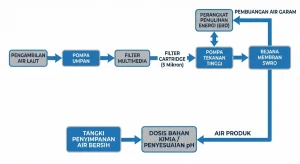
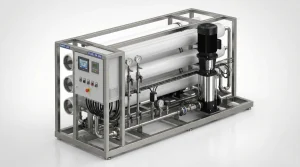
The Seawater Reverse Osmosis (SWRO) system is the heart of our service. As engineers at PT Mizui Osmosa Teknovasi, we do not believe in a “one size fits all” approach. However, fundamentally, the desalination process we design follows strict standards to guarantee durability and quality.
The process involves separating water molecules from seawater with high Total Dissolved Solids (TDS) (typically between 32,000 to 45,000 ppm in Indonesian waters) into fresh water (permeate) with low TDS (below 500 ppm, adhering to WHO standards).
The first step is seawater intake. The biggest challenge at this stage involves suspended particles, microorganisms, and marine biota. We design a multi-stage pre-treatment system that includes Multimedia Filters (MMF) and absolute micron Cartridge Filters. The goal is to lower the Silt Density Index (SDI) so the raw water is safe to enter the membranes. Failure at this stage is the primary cause of membrane fouling (clogging), which shortens your asset’s lifespan.
To overcome the natural osmotic pressure of seawater, an operational pressure between 800 to 1000 psi (55-69 bar) is required. The high-pressure pump is the “muscle” of this system. Given the highly corrosive nature of seawater, PT Mizui Osmosa Teknovasi exclusively uses advanced metallurgical materials such as Super Duplex Stainless Steel or industrial-grade polymers for all components in contact with high-pressure seawater.
This is what distinguishes modern desalination services from ancient, energy-hungry systems. We integrate Energy Recovery Device (ERD) technology.
How it Works: The ERD captures pressure energy from the reject water (concentrated brine) which still holds high pressure, and transfers that energy back to the incoming seawater.
Impact: This technology can save electrical energy consumption by 40-60%. While conventional systems require about 5-7 kWh per cubic meter of water, with ERD, consumption can be suppressed to below 3 kWh per cubic meter. This is a game-changer for your OPEX (Operational Expenditure).
The core of this process is the semi-permeable membrane element that rejects up to 99.8% of salt and contaminants. The filtered water (permeate) then enters the post-treatment stage. Here, we perform pH adjustment and remineralization (if required for drinking water) so the water is not aggressive toward distribution pipes and has a fresh taste.
To learn more about water quality standards and global desalination technologies, you can refer to the International Desalination Association (IDA) or read technical literature regarding Desalination on Wikipedia.
As an experienced SWRO vendor, PT Mizui Osmosa Teknovasi understands that every industry has unique “pain points” and technical requirements.
For resort owners in Bali, Labuan Bajo, or Raja Ampat, water is a crucial element of the Guest Experience. Guests paying premium rates expect high-pressure showers that are fresh and non-brackish.
Challenge: Using groundwater on small islands causes it to become salty (intrusion) quickly, destroying gardens and swimming pools.
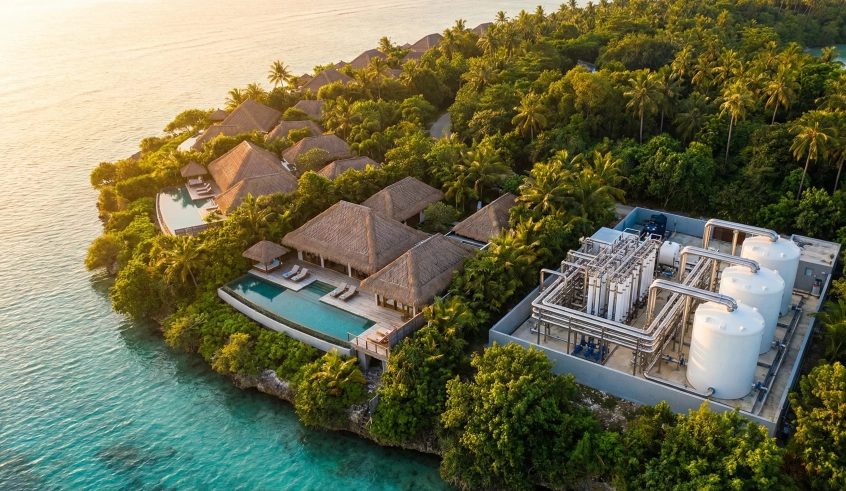
Our Solution: Installation of compact and low-noise SWRO units. We design systems that are aesthetically hidden yet capable of supplying thousands of liters per day for laundry, kitchens, pools, and bathrooms. Water independence increases your property valuation.
Cargo ships, tankers, and cruise liners require space and weight efficiency. Carrying large fresh water reserves adds load and increases fuel consumption.
Our Solution: We provide Marine Water Makers designed specifically for dynamic sea conditions. Our units are resistant to engine vibration and vessel movement (pitching/rolling). With a plug-and-play system, the crew can produce quality fresh water directly from the sea while sailing, saving cargo space for more commercially valuable loads.
In remote locations or offshore platforms, reliability is everything. Downtime due to a lack of process water (for boiler feed water or cooling) can cause billions of Rupiah in losses.
Our Solution: Industrial-scale SWRO systems with full redundancy (backup systems). We build Heavy Duty systems capable of operating 24/7 with minimal human intervention, equipped with remote monitoring systems to track machine performance from headquarters.
Why choose PT Mizui Osmosa Teknovasi over other contractors? The answer lies in our philosophy of Engineering Excellence.
Data-Driven Custom Design: Many contractors sell “ready-to-use” units without accounting for local seawater conditions. However, salinity in the Madura Strait differs from the Banda Sea. Water temperature also affects membrane performance. We conduct seawater sample analysis first to determine the correct hydraulic design. This ensures your machine is neither under-designed (fails quickly) nor over-designed (cost-inefficient).
Full EPC Services (End-to-End): We are not just equipment sellers. We are an EPC (Engineering, Procurement, Construction) contractor. Our services include:
Feasibility Study: ROI and environmental impact analysis.
Design & Fabrication: Unit assembly in our workshop with strict Quality Control standards.
Installation & Commissioning: On-site installation until water flows according to promised parameters.
Maintenance & After-Sales: Periodic service contracts and spare parts supply (membranes, chemicals, filters).
World-Class Components: We partner with top-tier global manufacturers. Membranes from DOW Filmtec or Hydranautics, pumps from Danfoss or Grundfos, and energy recovery systems from ERI or Danfoss iSave. We do not sacrifice quality for a momentarily lower price, because we know the cost of failure at sea is far more expensive.
One of the most frequently asked questions is regarding the price of seawater desalination machines. Often, the initial perception is that desalination is “expensive.” However, let’s dissect the structure from a long-term perspective. Although the initial investment cost (CAPEX) for an SWRO system appears significant, this technology offers Operational Costs (OPEX) that are significantly lower than alternatives, especially when using ERD technology.
Scenario: Water Supply for an Island Resort (100 m³/day)
Buying Fresh Water (Barging): ~Rp 100,000 – Rp 150,000 per m³
SWRO Production Cost (Mizui): ~Rp 20,000 per m³ (Electricity + Consumables)
Analysis: If you currently buy bulk fresh water at Rp 100,000 per cubic meter, and our SWRO production cost is only around Rp 20,000 per cubic meter, you save Rp 80,000 for every 1,000 liters of water.
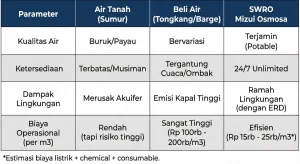
Analysis: If you currently buy bulk fresh water at Rp 100,000 per cubic meter, and our SWRO production cost is only around Rp 20,000 per cubic meter, you save Rp 80,000 for every 1,000 liters of water.
For a resort consuming 100 m³/day, savings can reach Rp 8,000,000 per day or Rp 2.9 Billion per year. In many cases, the Return on Investment (ROI) for our SWRO machines is achieved in less than 18 months.
Water is an asset. Without reliable clean water, the operations of luxury resorts, ships, or factories will grind to a halt. Choosing the right Indonesian SWRO Contractor is not just about choosing a machine provider, but choosing a partner who guarantees the continuity of your business in the future.
PT Mizui Osmosa Teknovasi offers a blend of high-level technical expertise, deep understanding of Indonesian maritime conditions, and a commitment to energy efficiency. Do not let your business be hampered by water scarcity when the limitless solution is right before your eyes—in the vast ocean.
Don’t wait until a water crisis occurs. Consult your desalination needs with our experts.
Contact PT Mizui Osmosa Teknovasi today for a Free Technical Consultation Session & Preliminary Feasibility Study. We will help you calculate capacity requirements, analyze costs, and provide a personalized desalination solution offer for your business.
Butuh bantuan? Tim kami siap membantu.