As fellow plant personnel who have been in your shoes, I fully understand how it feels when the flow meter on your Reverse Osmosis (RO) machine starts showing disappointing numbers. Production is at its peak, output targets must be met, but the product water (permeate) is drastically shrinking. You might think of immediately replacing it with a new membrane, but the operational budget will certainly swell.
This is where industrial RO membrane cleaning services come in as the most rational middle-ground solution: restoring performance without having to dig deep into your pockets to purchase new assets. At PT Mizui Osmosa Teknovasi, we don’t just “wash.” We perform performance restoration. In this in-depth article, I will invite you to dive into what is actually happening inside your membrane’s thin film, and how the right technical methods can save your production process.
Why Is Your Plant's RO Water Flow Suddenly Dropping? (Problem Identification)
The drop in water flow doesn’t happen overnight, even though it often feels that way. Usually, this is an accumulation of a process we call fouling or clogging. However, before we blame the membrane quality, we need to look at the daily operational data. Often, operators report that the feed pressure has been increased, but the output water remains low.
If this happens, your membrane is being “choked.” The microscopic pores that should only let water molecules pass through are now tightly sealed by contaminants. In technical terms we often use in the field, your membrane is experiencing a flux decline due to an increase in filtration resistance. This is not just dust; it is a complex chemical and biological interaction.
Not Just Ordinary Dirt: Understanding Silica Scaling & Biofouling
As a plant manager, it is important to distinguish the type of “enemy” we are facing. The industrial RO filter cleaning service we offer always starts with a diagnosis: is this inorganic scale (scaling) or organic dirt (fouling)?
-
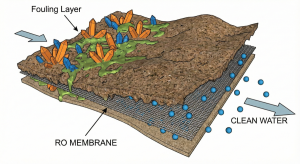
Scaling: In Indonesia, raw water often contains high hardness (calcium) and silica. When the concentration of these salts exceeds their solubility limit inside the membrane, they crystallize and form hard scale—much like the scale at the bottom of your steam boiler. Silica, in particular, is a nightmare due to its hard and insoluble nature.
-
Biofouling: This is a slime layer formed by bacteria and microorganisms. If your pre-treatment system (such as a sand filter or carbon filter) lets nutrients slip through, the RO membrane becomes a comfortable breeding ground for bacteria. This biofouling is sticky and evenly covers the membrane surface, causing a very significant drop in flow rate in a short time.
The Danger of Forcing the Machine to Work When the Membrane is Clogged
I often see operators taking shortcuts: “Flow rate dropped? Just turn up the pump pressure!” This is a highly dangerous instruction. Forcing water through a clogged membrane at high pressure will increase the Delta P (the pressure difference between the feed water and the permeate/reject water). If the Delta P exceeds the manufacturer’s specifications, the membrane can experience telescoping (the membrane roll jumps out of its casing) or even crack.
If the membrane is physically cracked, no reverse osmosis membrane cleaning service in the world can fix it. The only solution is to buy a new one. Therefore, stop forcing your machine to work beyond its limits, and start considering professional cleaning options.
Professional "Washing" Solution: CIP (Cleaning In Place) Method (Education)
You might ask, “Can I wash it myself?” The answer could be yes or no. The term “wash” here is often misinterpreted as simply rinsing with water or soaking in soap. In fact, in standard water treatment engineering, this process is called CIP or Cleaning In Place.
CIP is a procedure to restore the membrane by circulating specific chemicals at precisely measured temperatures, pH, and flow rates. The goal is to dissolve dirt without damaging the sensitive polymer structure of the membrane.
Why Isn't Ordinary Membrane "Laundry" Enough?
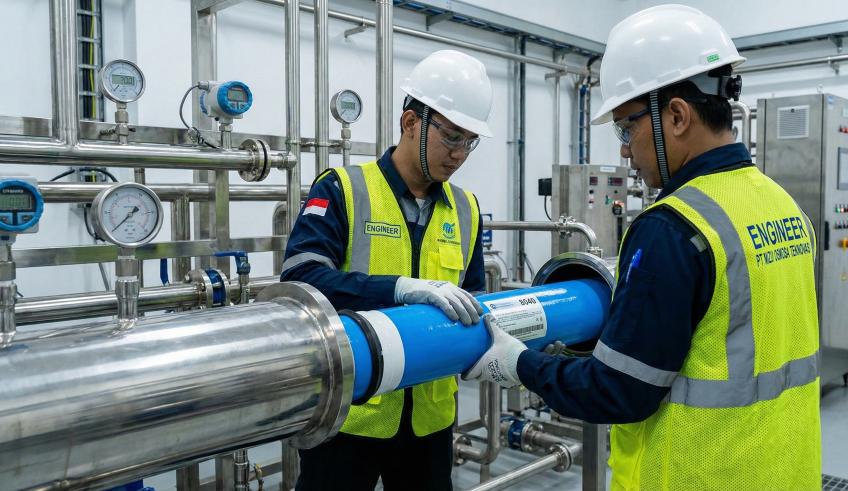
Many providers of 8040 RO membrane laundry services (the industry standard size) only use conventional soaking methods without proper circulation. As a result, the dirt only falls off the outer surface, but the inner pores remain clogged. Even worse, if they use spray pressure that is too high, the thin polyamide layer on the membrane can peel off.
At Mizui Osmosa, we use a specialized CIP Skid. This tool allows us to control the flow velocity to create enough turbulence to scour the dirt (scouring effect), while remaining safe for the membrane’s physical integrity. We also monitor the color change of the chemical solution to determine how effectively the dirt dissolution is occurring.
As a reference, you can read standard good membrane cleaning procedures on authoritative sites like
Lenntech or guides from the
Water Quality Association. These are the standards we adopt at Mizui Osmosa.
Comparison Table: Careless Washing Method vs. Industry Standard CIP Method
To make it easier for you to see the difference, pay attention to the following table:
| Feature |
Ordinary “Washing/Laundry” Method |
Mizui Osmosa CIP Method |
| Chemicals |
Bulk soap / Unmeasured harsh acids |
Special formula (food grade & membrane safe) |
| pH Control |
Often manual (litmus paper) |
Digital pH Meter (0.01 Accuracy) |
| Water Temperature |
Room temperature (cold) |
Heated (35°C – 40°C) for reaction optimization |
| Flow Method |
Static soak / Manual spray |
Low Pressure High Flow circulation |
| Damage Risk |
High (Torn membrane/chemical burn) |
Very Low (Controlled) |
| Result |
Temporary flow increase |
Long-term flow recovery |
The Importance of Using Food-Grade Cleaning Fluids
Safety is the top priority, especially if your plant operates in the food and beverage (F&B) or pharmaceutical industry. The arbitrary use of industrial chemicals can leave toxic residues on the membrane that could later be carried over into your product water.
We are highly selective in choosing our RO membrane cleaning fluid. We use food-grade and NSF-certified based chemicals to ensure that after the flushing process, the membrane is completely clean and safe to use again for production. Chemical residues must not exist. This is a quality assurance that is hard to get from non-specialist factory membrane cleaning services.
RO Membrane Cleaning Services at Mizui Osmosa (Offer)
As a Senior Plant Manager, I designed this service based on what I used to need: speed, safety, and measurable results. At Mizui Osmosa, we provide membrane cleaning services both On-Site (we bring the CIP unit to your plant) and Off-Site (membranes are brought to our workshop for intensive cleaning).
Specialization in 8040 and 4040 Sizes
We have the capability to handle various sizes, ranging from 8040 RO membrane laundry (8-inch diameter, 40-inch length) commonly used in large production capacities, to 4040 sizes for medium scales. Each membrane size has a different cleaning flow rate specification, and our technicians are trained to adjust these parameters.
Safe Procedures: From Acid Cleaning to Alkaline Cleaning
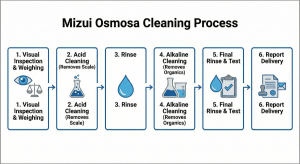
Our process follows strict scientific principles to ensure how to clean a clogged RO membrane is done correctly. Here is the workflow:
-
Initial Analysis: We physically inspect the membrane and weigh it (a clogged membrane is usually much heavier).
-
Low pH Cleaning (Acid): We circulate a special acid solution (pH 2-3) to dissolve mineral scales such as calcium carbonate and metal oxides.
-
Intermediate Flushing: Rinsing the acid residue with pure water (RO water) until the pH is neutral.
-
High pH Cleaning (Alkaline): This stage uses a base solution (pH 10-11) at warm temperatures to destroy biofouling, oils, and other organic materials.
-
Final Flushing & Sanitization: Final rinsing and the application of a mild disinfectant to prevent bacteria from growing back.
-
Performance Test: We test the membrane on our Test Bench to measure flow and salt rejection before returning it to you.
Cost Calculation: Washing vs. Buying New (Business Consideration)
Let’s talk numbers. As a decision-maker, you certainly care about Return on Investment (ROI). Replacing a well-known brand of 8040 Brackish Water (BW) RO membrane can cost between Rp 8,000,000 to Rp 12,000,000 per element. Imagine if your system has 12 elements or more.
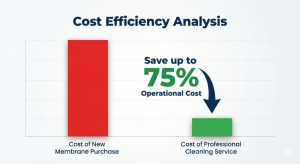
Save Operational Budget Up to 70%
Compare this with the membrane cleaning cost per element that we offer. The price is only around 20% to 30% of the price of a new membrane. By performing cleaning, you can extend the membrane’s lifespan for another 2-3 years (depending on the raw water quality).
Mathematically, if this industrial WTP maintenance service successfully restores the flow to 85-95% of its original condition, you have saved tens of millions of rupiahs that can be allocated for other plant needs.
When is the Best Time to Call Our Service?
Don’t wait until the water absolutely doesn’t come out (totally blocked). At that point, the scale might have petrified and become difficult to soften. The best time to call us is when:
- Normalized Permeate Flow drops by 10-15%.
- Normalized Salt Passage increases by 5-10%.
- Pressure Drop (ΔP) increases by 10-15%.
Monitoring these indicators is the key to smart preventive maintenance. For a further understanding of these parameters, you can refer to the
DOW Filmtec Technical Manual or other technical literature.
Conclusion: Restore Your Plant's Efficiency Now
Hampered production is a loss of time and money that cannot be recovered. Don’t let a dirty RO membrane become the bottleneck of your business growth. The industrial RO membrane cleaning service from PT Mizui Osmosa Teknovasi offers a combination of deep technical expertise, safe chemicals, and international standard procedures to restore your valuable assets.
We are ready to be your technical discussion partner. Let’s evaluate your membrane’s condition, make the right diagnosis, and return your water flow to its optimal point.
Contact our technical team today for a free consultation and initial check.