In the modern property development landscape, the existence of a wastewater management system is no longer just a complement, but a vital infrastructure that determines the smooth operation of a building. As an experienced STP contractor handling various large-scale commercial and residential projects, PT Mizui Osmosa Teknovasi understands that every square meter of your property’s land is a valuable asset.
The main challenge for hotel, apartment, and office building developers in dense urban areas is managing domestic wastewater effectively without taking up excessive land. On the other hand, you are also required to comply with environmental regulations whose adherence is strictly monitored.
The presence of a precisely engineered Sewage Treatment Plant (STP) is the answer to these challenges. Unlike conventional systems, a modern STP integrates biological, physical, and chemical processes to break down pollutants until they are safe to be discharged into city sewers or even recycled (water recycling). Therefore, PT Mizui Osmosa is here as your strategic partner, providing end-to-end solutions from planning and construction to commissioning. We ensure your property investment is safe from the risk of environmental pollution.
Why Choosing the Right STP Contractor is Crucial
Often, developers and building management consider wastewater as a “behind the scenes” aspect. However, failure in this system can be fatal. The impacts range from unpleasant odors that disturb hotel guests’ comfort to legal sanctions that can halt business operations. From our perspective as environmental engineers, the STP is the sanitation heart of a building that must not be handled carelessly.
Regulatory Compliance with a Professional STP Contractor
As a compliant STP contractor service provider, we always emphasize to clients that key parameters such as Biological Oxygen Demand (BOD), Chemical Oxygen Demand (COD), Ammonia, Oil & Grease, and Total Coliform must be below the threshold. The technical consequences of ignoring these rules are very serious. If your STP outlet’s lab test results exceed the quality standards, administrative sanctions ranging from government coercion to the suspension of environmental permits can be imposed. Consequently, the STP design must be calculated based on the real pollutant load generated by the building’s activities.
"Green Building" Image and Property Value
In today’s era of sustainability awareness, having an advanced wastewater treatment system significantly increases your property’s valuation. Buildings capable of managing their own waste, or even recycling the treated water (effluent) for garden watering and toilet flushing, have a higher chance of obtaining certification from the
Green Building Council Indonesia (GBCI).
This green certification is not just a plaque on the lobby wall. Moreover, it is a guarantee of long-term operational efficiency and a marketing appeal for multinational tenants who care about ESG (Environmental, Social, and Governance) issues. By using competent sewage treatment plant contractor services like PT Mizui Osmosa, you are investing in a sustainable and eco-friendly business reputation.
Modern vs. Conventional STP Technology
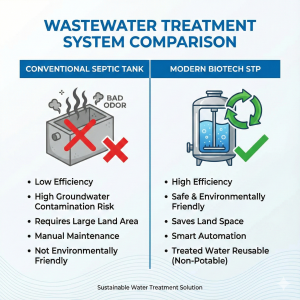
Many older properties still rely on conventional septic tanks that only use simple settling processes and soil infiltration. This might be sufficient for a residential scale, but for high-rise buildings with hundreds of cubic meters of wastewater per day, this system is obsolete. As an STP contractor championing modern technology, we apply methods that drastically accelerate the pollutant decomposition process.
Comparison Table: Septic Tank vs Modern Biotech STP
| Parameter |
Conventional Septic Tank |
Modern Biotech STP (Mizui Osmosa) |
| Working Principle |
Passive anaerobic (slow natural decomposition) |
Active Aerobic & Anaerobic (with oxygen injection) |
| Effluent Quality |
Still contains high pollutants, odorous |
Clear, odorless, meets KLHK regulation quality standards |
| Land Requirement |
Requires a large soil infiltration area |
Compact, can be installed underground or in the basement |
| Processing Time |
Long retention (days) |
Fast (hours due to active bacterial assistance) |
| Recycling |
Cannot be reused |
Treated water can be used for watering plants/flushing |
Understanding Extended Aeration & Biofilter for Limited Space
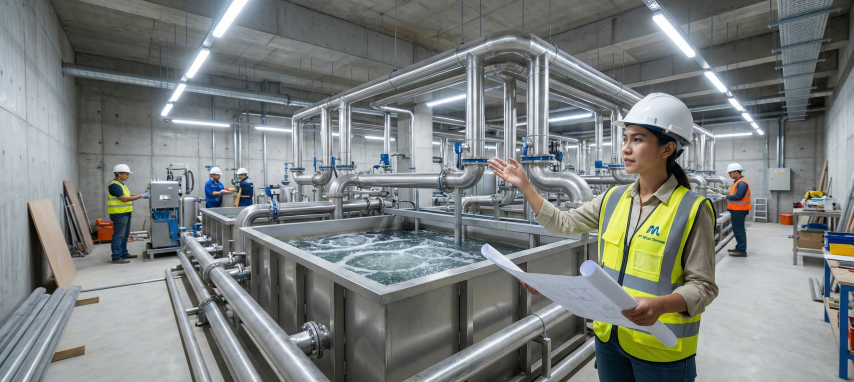
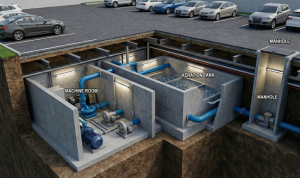
In many project cases in Jakarta or other big cities, the main constraint is limited land. We often recommend Extended Aeration technology or an Anaerobic-Aerobic Biofilter Combination. As an STP contractor specializing in limited space, we design these reactors to fit in basement or ground tank areas.
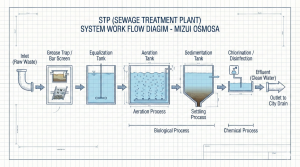
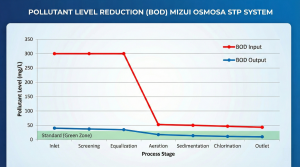
The biotech STP system works by cultivating decomposing microorganisms on specific media (such as honeycomb or bio-balls) inside the tank. Furthermore, we supply oxygen using an air blower (aerator) to keep the aerobic bacteria alive. These bacteria will “eat” the organic matter in domestic wastewater very greedily and quickly. The result is settled activated sludge and clear water ready for discharge. This technology is highly effective at reducing BOD and COD parameters by up to 90-95%, ensuring the discharged water is safe for the environment around your hotel or apartment.
The Difference Between STP and WWTP According to an STP Contractor
There is often terminology confusion among project owners between STP (Sewage Treatment Plant) and WWTP/IPAL (Wastewater Treatment Plant). Although the basic principles are the same, the characteristics of the treated waste are very different.
As a building STP vendor, our main focus is handling domestic wastewater (blackwater from toilets and greywater from sinks/laundry/kitchens). The characteristics of this wastewater are rich in organic matter and pathogenic bacteria, but relatively minimal in heavy metals compared to industrial factory wastewater. Understanding the difference between an STP and a WWTP is crucial in determining the type of bacteria used and the pre-treatment system design. For example, for a hotel building, we must install a large-capacity Grease Trap before the water enters the main STP. This aims to prevent blockages caused by restaurant kitchen grease, a component that might not be as crucial in a textile factory WWTP.
Our Workflow as an Integrated STP Contractor
The quality of an STP system is not only determined by expensive equipment but by appropriate engineering design. At PT Mizui Osmosa Teknovasi, we apply strict construction project management standards.
1. Accurate Capacity & BOD/COD Load Calculations
The first and most important step before a single shovel of dirt is dug is calculating the loading rate. We don’t just estimate; we calculate precisely. Our expert team will conduct the following analysis:
-
Wastewater Flow Rate: Calculated based on the number of rooms (hotel), number of employees (office), or number of seats (restaurant). The SNI 03-7065-2005 standard is our reference.
-
Pollutant Characteristics: We estimate the incoming BOD (Biological Oxygen Demand) load. Average domestic wastewater has a BOD of 200-300 mg/L. Our target is to reduce it to <30 mg/L according to regulations.
-
Hydraulic Retention Time (HRT): Calculating how long the water must stay in the aeration tank for the bacteria to work optimally. This calculation determines the volume of the tank to be built, which directly impacts the cost efficiency of civil construction.
Errors in these calculations can be fatal. Undersized systems cause the STP to overflow and smell, while oversized systems cause unnecessary waste of investment and operational (electricity) costs.
2. Civil Construction & Mechanical Electrical (ME) Installation
Once the design is approved, our construction team moves in. As an integrated STP contractor, we handle Civil and ME work simultaneously to accelerate the project schedule.
-
Civil Works: We build reinforced concrete (RC) tanks with high waterproofing specifications. Leaks in underground STP tanks are a nightmare that is difficult to repair; therefore, we use high-grade concrete (minimum K-300) with integral waterproofing additives.
-
Mechanical Works: Installation of the piping system, air diffusers, submersible pumps, and roots blowers. We only use reputable brands with proven durability for non-stop 24-hour operation.
-
Electrical Works: Manufacturing control panels (CP) equipped with automation systems. Our system regulates when transfer pumps should turn on, when blowers operate, and provides alarms in case of malfunction, making monitoring easier for your building technicians.
STP Construction Price Transparency
Choosing a vendor is not just about the cheapest initial price, but about the Life Cycle Cost. A cheap STP that frequently breaks down, smells, and fails lab tests will cost much more in the future due to repairs and environmental fines.
Regarding the transparency of the STP construction price per m
3, the cost is highly variable depending on several factors:
- Tank Material: Using cast concrete (Civil) or manufactured Fiberglass Reinforced Plastic (FRP) tanks?
- Technology: Using standard Extended Aeration or the more advanced but expensive Membrane Bioreactor (MBR)?
- Site Conditions: Does it require deep excavation with complex dewatering?
Nevertheless, PT Mizui Osmosa guarantees transparency in the Bill of Quantities (RAB/BoQ). Every component will be clearly detailed, from excavation volume and pump specifications to commissioning costs. Furthermore, you will get scalable options to adjust to your investment budget without sacrificing the quality of the treated effluent. For us, transparency is the key to trust in B2B relations.
After-Sales Service & Operator Training
As a responsible STP contractor, our job does not stop when the water flows smoothly. An STP system is a “living” biological system. The bacteria inside must be maintained so they don’t die from harsh chemicals (like excessive bleach) or lack of oxygen.
Our after-sales services include:
-
Bacterial Seeding: The initial initiation process of forming decomposing bacterial colonies.
-
Commissioning & Lab Testing: Taking outlet water samples to be tested at a KAN-accredited laboratory to ensure compliance with quality standards.
-
Operator Training: We train your building’s engineering team on daily maintenance, backwashing, pH checking, and troubleshooting emergency issues.
-
Maintenance Contract: Periodic maintenance contract options to ensure the STP’s performance remains prime for years after installation.
The Best Partner for Your Property's Sanitation
In the property business, reputation is everything. Don’t let wastewater issues tarnish the image of the hotel or building you’ve worked so hard to build. PT Mizui Osmosa Teknovasi is ready to be your technical partner, providing efficient, legal, and eco-friendly wastewater treatment solutions.
As a professional
STP contractor, we combine civil, environmental, and mechanical engineering expertise to give you peace of mind. Let us take care of the wastewater, so you can focus on growing your property business.