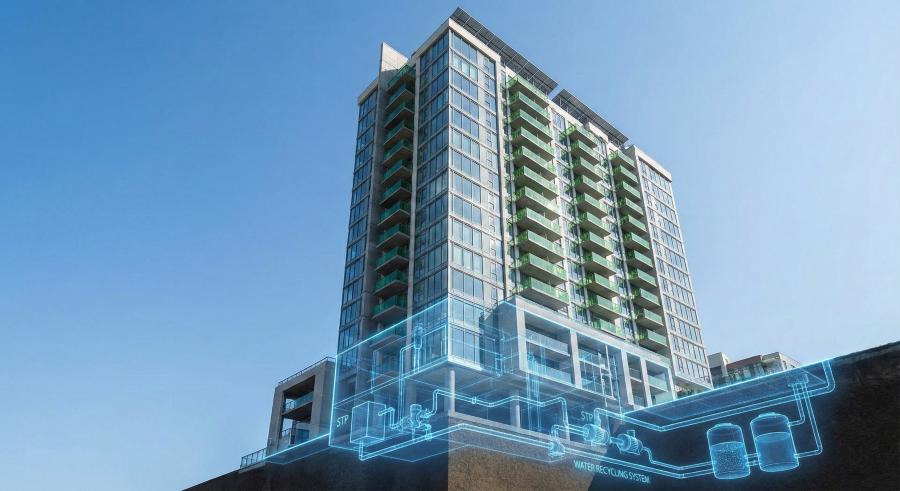
Building vertical housing is about creating an independent living ecosystem within a massive structure. At PT Mizui Osmosa Teknovasi, we understand that behind the architectural grandeur of a high-rise building, there is a sanitation “heart” that must never stop beating. Apartment STP (Sewage Treatment Plant) installation services are not just about laying pipes and tanks; it is precision environmental engineering to ensure thousands of residents can live comfortably without the risk of pollution. Given the complexity of population density in a single building, the failure of a wastewater treatment system is an operational nightmare that must be mitigated right from the planning phase.
This article will dissect in depth why our technical approach is different and how we address large-scale sanitation challenges.
Vertical Housing Sanitation Challenges: Massive Volumes & Extreme Fluctuations
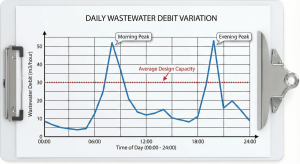
Unlike landed houses or regular residential complexes, apartments have unique and challenging “hydraulic” characteristics. As an experienced contractor handling apartment wastewater system installations, we at PT Mizui Osmosa always start projects by analyzing occupant behavior. The biggest challenge is not just “how much” wastewater is generated, but “when” it arrives.
Understanding the "Peak Hour" Phenomenon (Morning & Evening) in Apartments
In high-rise building wastewater management, we deal with what is known as Shock Loading. This is a phenomenon where the wastewater flow rate surges drastically within a very short timeframe. Imagine a 1,000-unit apartment. Between 06:00 and 08:00 AM, almost all residents shower and use the toilet simultaneously before starting their day. The same pattern repeats from 06:00 to 08:00 PM.
Consequently, the STP system must be able to absorb this massive water flow “punch” without overflowing or experiencing a drop in treatment quality. If the system is designed based on a flat daily average without accounting for this peak factor, it will fail. An Equalization Tank is key, but the biological process design behind it must also be robust. This is why building domestic WWTP installation requires fluid engineering calculations that are far more complex than residential-scale STPs.
The Risk of Conventional System Failures in High-Rise Buildings
We often encounter cases where developers get trapped into using conventional systems or forcing large-scale modified biofilter septic tanks to reduce initial costs (CAPEX). However, the long-term risks are fatal.
Conventional systems not designed for mass volumes often experience:
-
Incomplete Anaerobic Processes: Produces pungent odors that can spread through pipe shafts up to the residential units (upper floors).
-
Clogging: Rapid sludge accumulation because the bacteria cannot break down the high organic load.
-
Poor Effluent Quality: Wastewater discharge fails to meet environmental quality standards (Permen LHK No. 68 Year 2016), which can lead to legal sanctions for the building management.
Therefore, choosing the right technology is no longer an option, but a technical necessity to guarantee the sustainability of your property investment.
Why Extended Aeration is the Best Choice for Large Capacities?
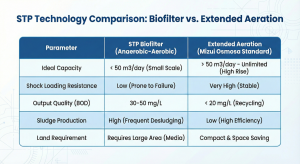
In the world of large commercial and industrial wastewater treatment, Extended Aeration technology is the Gold Standard. As apartment sewage plant specialists, PT Mizui Osmosa recommends this system for capacities ranging from 50 m3/day up to thousands of m3/day.
Advantages of Extended Aeration Technology Over Regular Biofilters
Extended Aeration works on the activated sludge principle, where oxygen is mechanically supplied (using blowers and diffusers) into the aeration tank. This oxygen activates wastewater-degrading aerobic bacteria to work much more aggressively and rapidly compared to anaerobic bacteria in passive biofilter systems.
Technically, the advantages include:
-
High BOD/COD Reduction Efficiency: Capable of reducing organic pollutant levels by 90-95%, far above biofilters which average only 60-70%.
-
Low Sludge Production: Due to the long bacterial retention time, less sludge is produced because most of it is consumed by the bacteria themselves (endogenous phase). This significantly reduces the frequency of sludge pumping.
-
Odorless Operation: Aerobic processes do not produce H2S (rotten egg) and Methane gases, ensuring the apartment’s basement or ground tank area remains free from unpleasant odors.
Process Stability Against Shock Loading (Flow Surges)
The Extended Aeration system is designed with a low F/M (Food to Microorganism) ratio. This means the number of bacteria (the degrading army) inside the tank is maintained in very large quantities relative to the incoming food (wastewater).
As a result, when there is a flow surge in the morning (shock loading), the system will not be “shocked.” The massive bacterial population is ready to rapidly consume the additional organic load. This stability is exactly what Building Managers look for, as they do not need to worry about wastewater quality deteriorating when the apartment is at full occupancy on weekends or holidays.
Apartment STP Installation Services by PT Mizui Osmosa
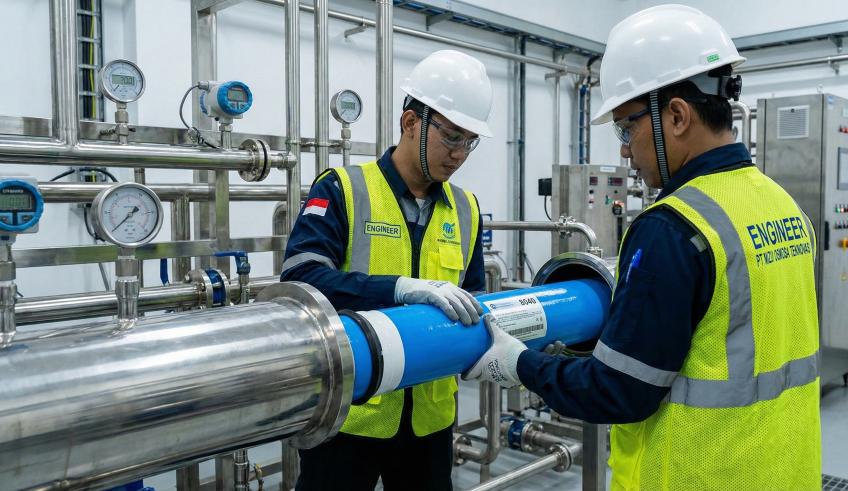
As a strategic partner for developers, PT Mizui Osmosa Teknovasi acts not only as an executor but also as a technical consultant. A good flats or apartment STP contractor must be able to translate architectural needs into functional mechanical systems.
Precision Engineering Calculations: Determining Capacity (m3/day)
The first step we take is not excavation, but calculations on the worksheet. Calculating apartment STP capacity cannot be done arbitrarily. We refer to the SNI 03-7065-2005 standard on Plumbing System Planning Procedures.
The basic formula we use involves:
-
Number of Units x Number of Occupants per Unit (Average 3-4 people).
-
Average clean water consumption (e.g., 150-200 liters/person/day).
-
Wastewater generation factor (usually 80% of clean water becomes wastewater).
However, PT Mizui Osmosa adds Safety Factor and Peak Flow Factor variables into our design. We ensure the volume of the Aeration Tank and Settling Tank is large enough to accommodate fluctuations without reducing bacterial contact time. An error in calculating this capacity is a major engineering sin that will cause the STP to overflow in the future.
Neat Civil & Mechanical Electrical (M&E) Integration
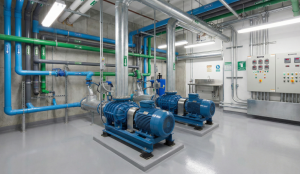
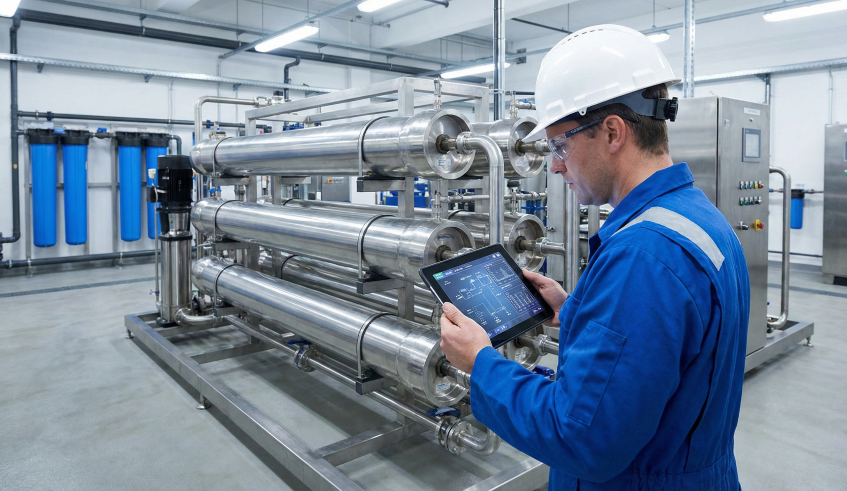
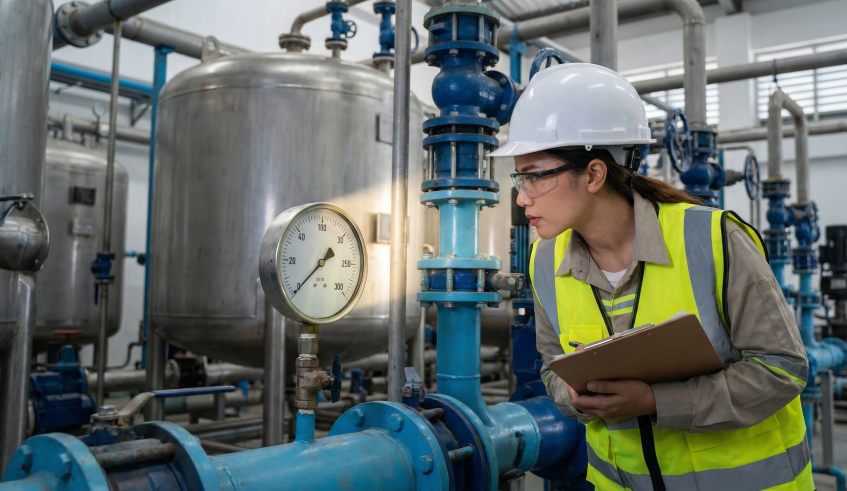
Large capacity STP installation is a harmonious blend of civil works (concrete, tank waterproofing) and M&E (pumps, blowers, control panels, piping).
Our team ensures:
-
Watertight Civil Construction: Using high-grade concrete (e.g., K-300 or higher) with waterstops at every cast joint to prevent wastewater leakage into the soil (groundwater pollution) or groundwater seepage into the STP.
-
Efficient Piping System: Evenly distributed air pipe headers and diffuser designs to ensure oxygen supply reaches every corner of the aeration tank (avoiding dead spots).
-
Automatic Control Panel: Our system is equipped with a PLC/WLC-based control panel that regulates the alternating performance of blowers and pumps, extending machine life and facilitating easy monitoring.
Long-Term Efficiency: Good News for P3SRS & Building Managers
For Developers, an STP is a licensing requirement. However, for the P3SRS (Association of Owners and Tenants of Multistory Buildings) and Building Managers, an STP is a Cost Center. Our mission is to change that paradigm. With the right design, an STP can become an efficient asset.
Reducing Operational Expenses (OPEX) to Keep Maintenance Fees Affordable
The Environmental Management Fee (IPL) is a sensitive issue for apartment residents. Electricity and utility maintenance costs contribute heavily to the IPL amount. High-rise building STP maintenance utilizing Extended Aeration technology from Mizui Osmosa is designed for energy efficiency.
We utilize:
-
High-Efficiency Blowers: The use of Roots Blowers or Turbo Blowers which offer high air efficiency with lower electricity consumption (kWh) compared to conventional compressors.
-
Intermittent Aeration: Automatic timer settings that adjust blower operation during peak hours and rest hours (early morning), significantly saving electricity without killing the bacteria.
-
Durable Components: The use of anti-corrosion materials reduces the cost of short-term spare part replacements.
Recycling Potential for Garden Watering & Toilet Flushing
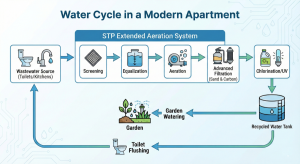
This is the biggest added value. In the Green Building concept, water is an expensive resource. With Extended Aeration technology combined with Advanced Filtration units (Sand Filter & Carbon Filter), we can create an apartment wastewater recycling system.
The clear and odorless treated water can be channeled back into the Recycle Water Tank for:
-
Watering vertical gardens and apartment landscapes (Gardening).
-
Toilet flushing in public areas and residential units (through a dual piping system).
-
Machine cooling (Cooling Tower make-up water).
With this system, building management can reduce municipal clean water (PDAM) purchase bills by up to 30-40%. This serves as a strong sales argument for Developers to pitch to environmentally conscious prospective buyers (“Eco-Apartment”).
A Smart Investment for the Future of Housing
Choosing a contractor for apartment
STP installation services is a strategic decision that impacts decades into the future. At PT Mizui Osmosa Teknovasi, we don’t just sell tanks or machines. We sell peace of mind for Developers, ease of work for Building Managers, and living comfort for thousands of residents.
Do not let the mistake of choosing the wrong wastewater treatment system ruin your property’s reputation. Switch to proven, robust Extended Aeration technology that is ready to face future volume challenges.
Ready to elevate your building’s sanitation standards?
Contact our expert team today for a technical consultation and free site assessment. Let’s build cleaner and more sustainable housing with PT Mizui Osmosa Teknovasi.