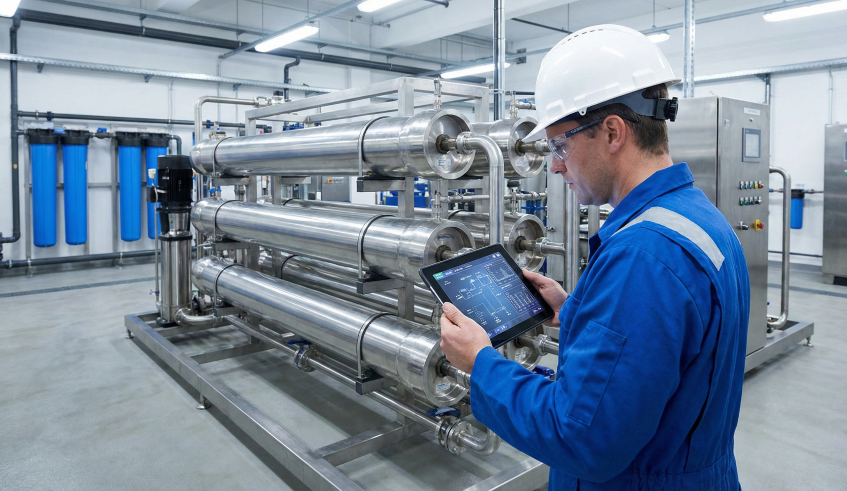
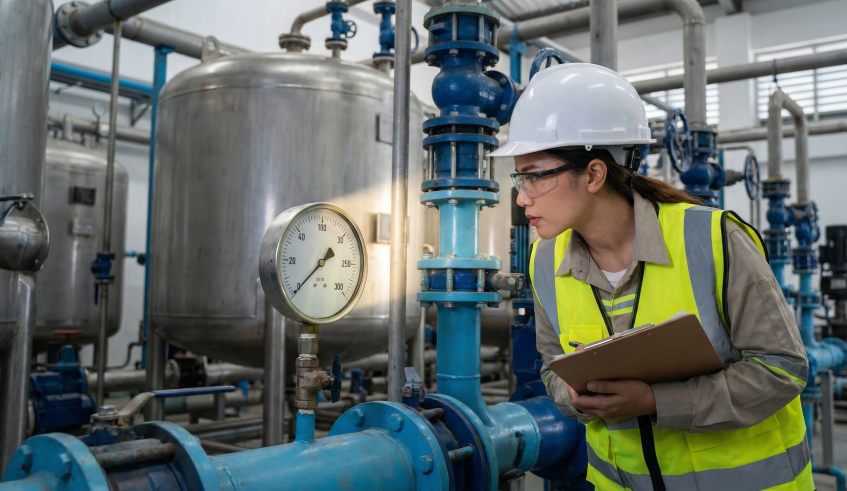
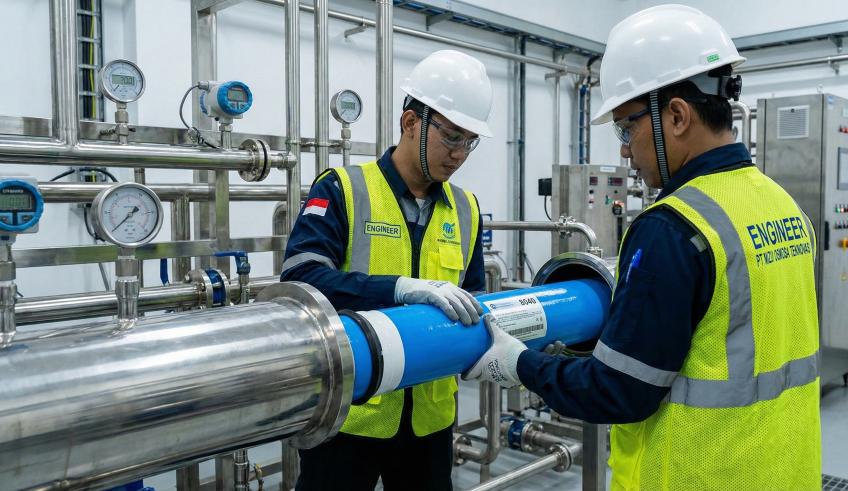
In modern architecture and vertical building (high-rise building) facility engineering, the existence of a building domestic wastewater treatment system is not merely a complementary utility, but a vital organ that determines operational sustainability. For fellow Architects and Engineers, understanding the complexity of an STP (Sewage Treatment Plant) is a necessity, especially when facing strict regulations such as the Ministry of Environment and Forestry Regulation (PermenLHK) No. P.68/2016.
Conventional designs that solely rely on simple septic tanks are no longer relevant for massive loads. PT Mizui Osmosa Teknovasi emphasizes a precision engineering approach, combining fluid hydraulics with biological reaction kinetics, to produce environmentally safe effluent. This article dissects the design anatomy of modern WWTPs (Wastewater Treatment Plants), ranging from vertical flow management to hybrid reactors.
Hydraulic Challenges in High-Rise Building STPs
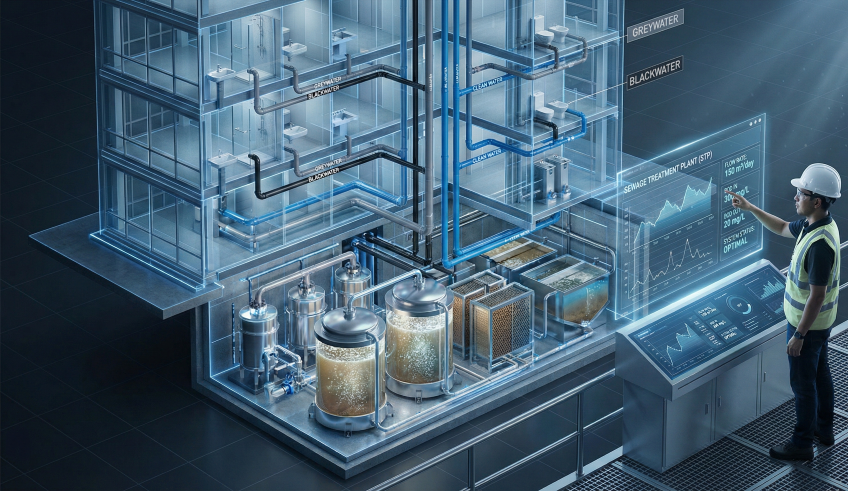
Designing vertical sanitation installations presents unique hydrodynamic challenges. The gravitational potential energy from the mass of water falling from hundreds of meters high must be managed to prevent back pressure that can damage water seals. Furthermore, limited space in the podium area demands extreme volumetric efficiency in treatment tanks.
Greywater and Blackwater Line Separation Strategy
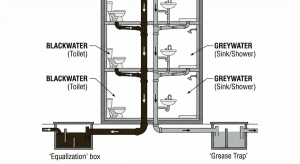
Efficiency begins with the plumbing shaft design. According to
SNI 8153:2015, the separation of greywater and blackwater pipelines is a non-negotiable technical mandate.
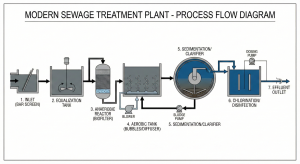
Biochemically, greywater has high detergent content, while blackwater has a high BOD (Biological Oxygen Demand) load. Mixing these two flows will overload the STP unit with extreme organic load fluctuations. We recommend using separate vent stacks to maintain air pressure stability. This separation facilitates pre-treatment; greywater passes through a Grease Trap, while blackwater is directed to an equalization tank.
Managing Peak Flow Fluctuations
The main enemy of biological process stability is shock loading. In apartments, flow peaks in the morning and evening, but drops drastically at midnight. If this fluctuating flow enters the reactor directly, the bacteria could experience “starvation” or even be “washed out.”
The solution is an Equalization Tank. Its primary function is to homogenize pollutant concentrations and regulate the pumping rate to remain constant (constant flow). With an interlocked Water Level Control (WLC) switch, this treatment plant will receive a stable hydraulic load, allowing the biomass to work optimally without turbulence disruptions.
The Core of Hybrid Technology Design: Anaerobic-Aerobic
A single solution is rarely effective for limited space. We offer a Hybrid system: a sequential combination of Anaerobic and Aerobic processes to balance energy efficiency and the quality of the treated effluent.
Anaerobic Phase: Load Reduction Without Energy
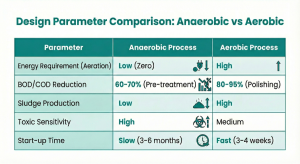
The first phase is the Anaerobic zone. Here, microorganisms work without oxygen to reduce high COD (Chemical Oxygen Demand) loads—typically up to 60-70%.
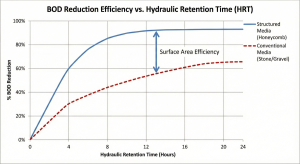
This zone utilizes honeycomb support media (biofilter). This media provides a specific surface area for bacteria to attach to (attached growth), maintaining a long Sludge Age without requiring electricity for aeration (blowers).
Aerobic Phase: BOD/COD Polishing
Although anaerobic processes are energy-efficient, they often leave behind odors. The effluent is then flowed into the Aerobic zone (Activated Sludge or Extended Aeration system).
Air is supplied using a Roots Blower through Fine Bubble Diffusers. This phase acts as a polishing unit, ensuring the water becomes clear, odorless, and the BOD level drops below 30 mg/L in accordance with environmental quality standards.
Technical Specifications & Design Parameters (For Engineers)
Design parameter errors in wastewater treatment plant (WWTP) installations can be fatal. Here are the key points:
-
Hydraulic Retention Time (HRT): The basic formula is HRT = V / Q. For the Fixed Bed Anaerobic process, we design an HRT of 12-18 hours. Meanwhile, for the Aerobic process, it ranges from 18-24 hours depending on the organic load. Precise calculations prevent short-circuiting while saving on the volume of the civil structure.
-
Bacterial Media (Bioball/Honeycomb): We avoid crushed stones that easily clog. Instead, manufactured PVC honeycomb-type media or Bioballs with a high Specific Surface Area (SSA) (150-250 m2/m3) are used. A high SSA means a greater pollutant decomposition capacity per cubic meter of the reactor.
Integration with Green Building Concepts
In the GBCI (Green Building Council Indonesia) era, the target is not just disposal, but Water Recycling. The treated water from our Anaerobic-Aerobic system, after passing through a Sand Filter, carbon filter, and UV disinfection, is highly suitable for reuse.
These recycling applications include toilet flushing, garden watering, or Cooling Tower make-up water. This turns your building’s domestic wastewater treatment system into an infrastructure asset that increases Green Building assessment points.
Why Mizui Osmosa?
Designing a WWTP is the art of balancing microbiology and fluid mechanics.
PT Mizui Osmosa Teknovasi provides comprehensive Engineering Design solutions, from mass balances to bacterial seeding assistance. If you are planning or renovating a sanitation system, let’s discuss to create a reliable and sustainable solution.